


On-street electric vehicle charging trial
Richard Youle Local Democracy Reporter
A trial is underway in a Welsh county to address issues surrounding on-street vehicle charging – and the feedback so far has been positive.
The era of electric cars has dawned but charging them at home is more than an inconvenience for people without a driveway.
Trailing cables across a pavement creates a trip hazard, local authority approval is needed for cross-pavement installations and not everyone can guarantee a parking spot outside their home.
Carmarthenshire County Council has been working with a company called Kerbo Charge to install cable gullies across pavements so electric vehicle owners can charge them from their terraced homes.
The owners lay their cable along the gulley, which is cut into and flush with the pavement, and press a lid down to cover it. There is an installation cost, however, and those taking part in the trial get it fully subsidised.
William Britton, who lives in a mid-terrace house in Llandovery, said the town was quite well-served by public EV charging points but that they were considerably more expensive than home-charging.
“If you buy an EV, the economics really only come into play if you can charge at home,” he said.
Mr Britton said his overnight home-charging tariff worked out at 7p per KW hour, compared to as much as 80p per KW hour for public charging. He said he could charge his second-hand Tesla Model 3 with 200 miles’ worth of power for around £4.50 overnight.
Many properties don’t have driveways so people in terraced houses and flats are at a disadvantage.
Given that sales of new petrol and diesel cars are due to be phased out in 2030 in the UK, making charging EV infrastructure accessible and affordable is essential.
Mr Britton, 44, said he had run his home-charging cable across the pavement under rubber matting before signing up to the council’s Kerbo Charge trial.
“An engineer came out and did a survey, and then a different crew came out and installed it, he said.
“It’s a 1.5-inch square channel lined with resin. You push the cable in and it clicks shut. It basically solves the problem of loose cables lying on the pavement.”
Mr Britton said he normally parked directly outside his Queen Street house although this wasn’t always possible. He said: “My neighbours try to leave me a space.”
Mr Britton said he’d never go back to a diesel or petrol car but felt the steep price difference between home and public charging had to be addressed.
“Something has to change,” he said.
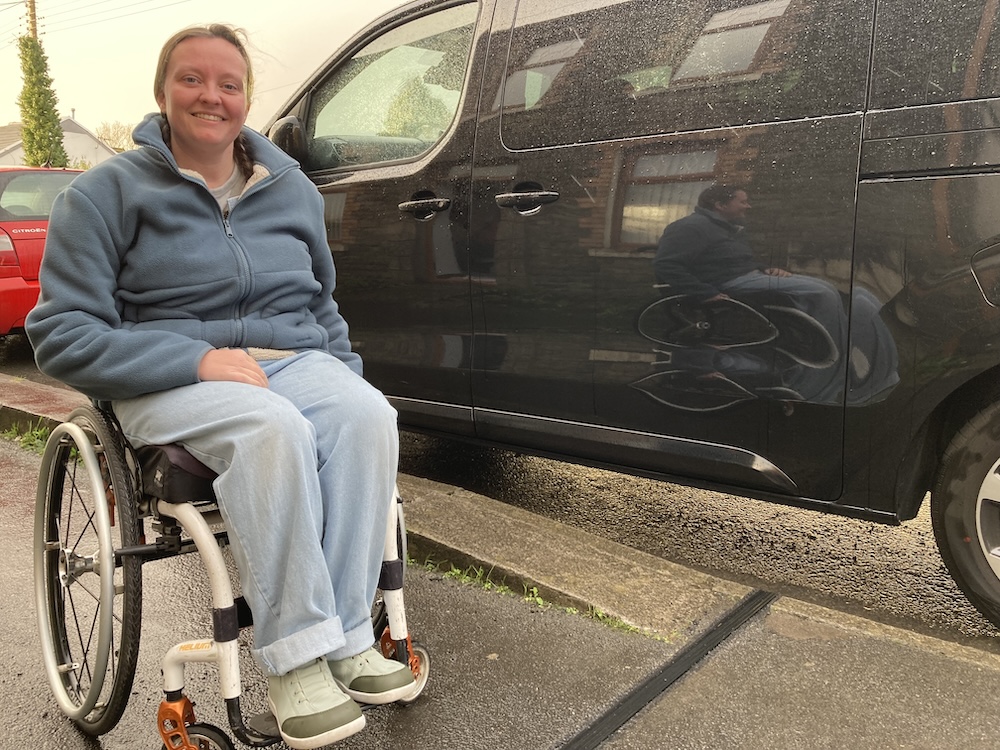
Gregg and Lauren Francis, of Llanelli, said the timing of the trial had worked out brilliantly for them as the gulley was fitted outside their home before they took delivery of their electric Vauxhall Vivaro van.
“It’s absolutely level with the pavement – you wouldn’t notice it unless you were looking for it,” said Mr Francis.
Their house on Gelli Road does have space at one side but Mr Francis said it became narrower at one end and couldn’t accommodate a car.
They have a cheap overnight tariff and charge the van once or twice a week.
Mrs Francis said “We were very lucky – it all fell into place at the right time.”
She uses a wheelchair and the van has a hoist at the back.
The couple, who have two young sons, said on trips to France they’d noticed how much more public EV charging structure was in place, for example fast-charging points at supermarkets, and that using them was a lot cheaper compared to the UK.
Mr and Mrs Francis were grateful for their installation, but reckoned the cost of it would deter people without a driveway from buying an electric car.
Mrs Francis said she’d spoken to the council about this a few years ago.
“I said, ‘What’s being done for people in the Valleys? How are they going to charge their cars?’”
In March 2025, the UK’s Public Accounts Committee said the Government needed to plan for a widespread uptake of electric vehicles and roll-out of public charge points, and that a “granular understanding” of where further support may be needed, such as rural areas, was required.
It said: “Public charge points are installed and maintained by charge point operators, private businesses who need enough people to use electric vehicles in an area for it to be profitable for them to install charge points.”
It added: “Drivers who have no option but to rely on public charge points pay significantly more to charge their vehicles, in part due to higher value added tax being charged, typically 20% compared to 5% VAT, which particularly affects those without access to off–street parking.”
The Department for Transport said while sales of most new petrol and diesel cars would end in 2030, sales of “full” and “plug-in” hybrid ones would be permitted until 2035, at which point all newly-sold cars would need to be zero-emission. People will still be able to own, buy and sell second-hand petrol and diesel cars though.
A DfT spokesman said: “We’re making it easier for everyone to switch to an EV. Households across the UK can get up to £350 towards installing a home charge point and a cross-pavement solution. We’re also working closely with the Welsh Government and have committed £600 million this year to expand charge points nationwide.”
The Welsh Government said it had given councils £6 million in 2025-26 to install EV charging infrastructure and that some like Carmarthenshire were trialling cross-pavement options. It’s also working with Transport for Wales to bring forward rapid charging on the main trunk road network, among other measures.
Asked what someone without a driveway should do if they wanted to run a cable to their car on the road outside, a Welsh Government spokeswoman said: “Local authority approval must always be obtained by home-owners for the installation of charging infrastructure solutions which cross public pavements.”
Carmarthenshire Council said around 45 households would benefit from the Kerbo Charge trial by the end of the next phase, and that costs were fully funded via a Welsh Government grant.
“A monitoring report will be completed covering three months post-install and 12 months post-install for all those taking part,” said a council spokeswoman.
Kerbo Charge – the company working with the council – said it charged £832 plus VAT for cross-pavement installations, excluding permit fees. Director Michael Goulden said EV owners who could charge at home saved around £1,150 per year than if they’d used public charging points.
Mr Goulden said the firm was working with 33 UK local authorities. “Many councils subsidise or fully fund initial installs but then usually move to a model of residents paying for them,” he said.
In some UK streets EV owners can charge from lampposts. Some workplaces have chargers too.
In 2025 just over two million cars were registered and 23.4% of them were EVs, according to figures from the Society of Motor Manufacturers and Traders. For some people in areas with good public transport a car isn’t needed.
Trade body ChargeUK, which represents companies working on the EV charging roll-out, said £6 billion of private money was being committed by 2030.
Its chief executive, Vicky Read, said public charging infrastructure was in fact well ahead of demand currently although public funding was needed for places where it lagged to ensure no drivers were left behind.
She added: “On-street charging is also ahead but has been comparatively slower in the last year or so, partially as it is more reliant on public funding which has taken longer in many parts of the country to come through.”
Support our Nation today
For the price of a cup of coffee a month you can help us create an independent, not-for-profit, national news service for the people of Wales, by the people of Wales.



Great until neighbours start parking in front knowing you’ll have to pay another £40 to get charged up at the charging station.