


Outrage as activists who damaged Israeli drones face being sentenced as ‘terrorists’
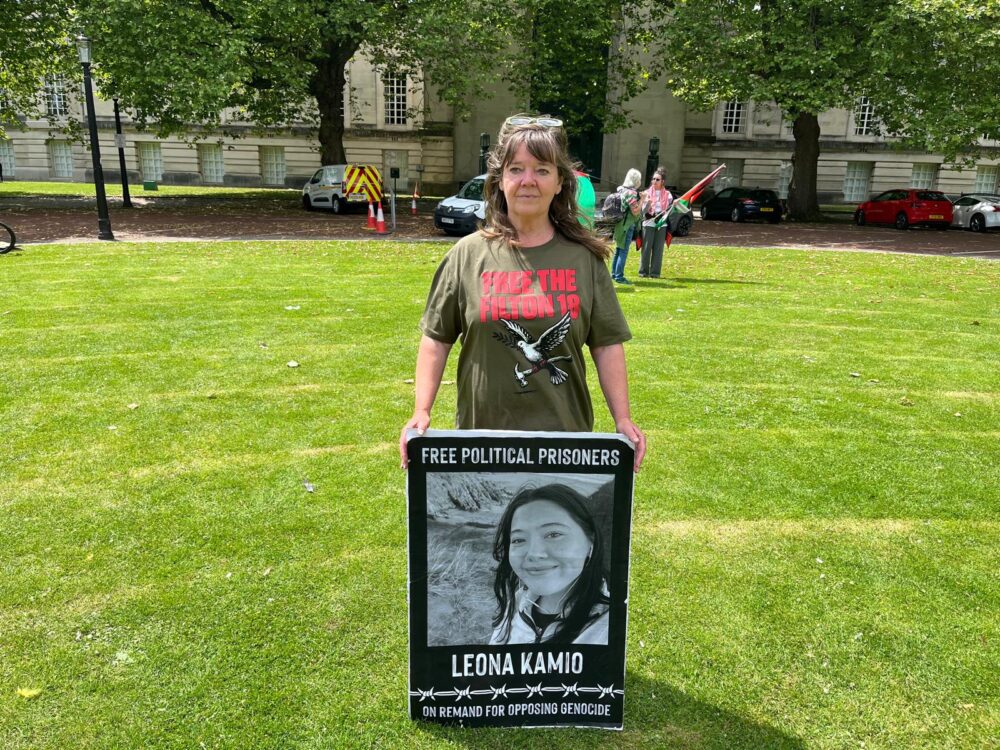
Martin Shipton
A veteran anti-war activist has warned that a case in which four activists face lengthy jail sentences as terrorists for damaging drones used by Israel in its Gaza genocide represents a fundamental attack on the right to protest against war crimes.
The four were convicted of criminal damage at the Filton, Bristol plant of Israeli-owned weapons company Elbit Systems and are due to be sentenced in June 2026.
One of the four is Leona Kamio, 30 – known as Ellie – whose mother Emma Kamio lives at Pennard, Gower.
Anti-war activist Angie Zelter, from Knucklas in Powys, who has previously been nominated for a Nobel Peace Prize, said: “This case is of the utmost importance for the general public to be aware of. Many of us locally have been active in trying to stop the export of arms going to Israel to be used in the genocide and ethnic cleansing of Palestinians. We may well be trapped in the same kind of authoritarian machinations of the judiciary that is being corrupted by Israeli pressures on our legal system.”
For the first time in British history, a court will seek to sentence direct action protesters as terrorists even though they were not convicted of terror charges, and even though the jury was not informed that they would be sentenced as terrorists.
Reporting restrictions that were in place to prevent this from being reported have now been lifted lifted by a judge at Woolwich Crown Court, where their trial took place.
The four defendants from the so-called Filton 24 were convicted of damaging Israeli quadcopter drones inside Elbit System’s Bristol research and development hub. Although the action took place long before Palestine Action was proscribed, the court will seek to add a “terrorism connection” at sentencing.
A court order has also lifted a ban on restrictions that led to five of the six defence barristers leaving the trial prior to closing speeches.
Mr Justice Johnson banned the barristers from speaking to the jury about “Elbit’s activities in manufacturing weapons and supplying them to Israel”; “The nature of the property that the defendants damaged or destroyed”; “The defendants’ beliefs that weapons and other technology at Elbit’s factory would be used to kill or injure others, including children”. The judge also directed that the barristers must not “inform the jury … that a judge may not direct a jury to convict”, even though such is an uncontroversial statement concerning the respective roles of judge and jury.
The “terrorism connection” under section 69 of the Sentencing Act 2020 is an aggravating factor applied at sentencing, not a charge. Judge Johnson kept secret from the jury that this would apply, meaning jurors who convicted the defendants did so without knowing that this criminal damage conviction would likely be treated as terrorism at sentencing.
‘Terrorist connection’
Judge Johnson ruled there appears to be a “terrorist connection” because activists were influencing the Israeli government by restricting their access to weapons. World-leading experts and the International Criminal Court – as well as millions of people across the world – recognise that Israel is committing genocide, war crimes and crimes against humanity.
The defendants have already spent 18 months in prison on remand – equivalent to nearly four years under sentencing guidelines, the upper limit for criminal damage. But with a “terrorist connection”, sentences can be aggravated and defendants must serve their whole sentence unless a parole board – satisfied they are “reformed” and rescind their beliefs – approves release after two-thirds.
This may see activists denied parole unless they renounce their opposition to Israel’s actions, placing them under extreme duress. Upon release, they could be licensed as terrorists for up to 15 years, requiring them to register any new device, bank account, email, or relationship with police. Any mistake could mean five years back in prison.
Their supporters argue that a conscientious motive – in this case, acting to stop a genocide – under normal legal principles would be a mitigating factor. Here, it is being turned against them.
Banned
All defences on the charge of criminal damage were banned by the judge before evidence was heard, meaning the defendants weren’t allowed to argue that their actions were legally justified as they acted to save lives and prevent a greater crime. He also barred defendants from telling the jury about their motivations for taking action, their emotional reactions to the massacres of Palestinians or the illegality of Israel’s actions.
In the UK, juries hold the right to return a not guilty verdict according to their own conscience. In this trial, the judge prevented the defendants from informing the jury of this right, and from stating that the judge could not compel them to convict. Protestors holding placards stating the right of juries to acquit according to their conscience were arrested outside the court.
Following the guilty verdicts, the prosecution did not apply to revoke bail. Nevertheless, in a highly unusual move, Justice Johnson revoked bail immediately and returned the defendants to prison, where they remain ahead of sentencing on June 12.
‘Miscarriage of justice’
A spokesperson for the campaign group Defend Our Juries said: “The public will be astonished to learn that in the British justice system a protester can now be convicted of criminal damage for disrupting an arms factory, and then be sentenced as a ‘terrorist’ without having been convicted of terror charges and with this having been kept secret from the jury.
“This grave miscarriage of justice should be a matter of public outrage. Had the jury not been deliberately kept in the dark about this secret terrorist sentencing, the jury may not have chosen to convict. The judge also forbade the defendants and their barristers from informing the jury of their right to acquit on the basis of conscience.
“It is even more appalling that the first time this is happening in British history is to sentence protesters as terrorists for influencing the Israeli government by restricting their access to weapons during a genocide.
“If this authoritarian and insidious precedent goes unchallenged, it will allow countless more protesters to be tried for an ordinary offence, but secretly sentenced as terrorists, without juries knowing this when they convict. When judges ban the word ‘genocide’ from court and manipulate verdicts behind juries’ backs, we are witnessing a truly authoritarian abuse of power, one which has everything to do with protecting Israel’s arms trade.”
Support our Nation today
For the price of a cup of coffee a month you can help us create an independent, not-for-profit, national news service for the people of Wales, by the people of Wales.
Get more trusted Welsh news
Choose Nation.Cymru as a preferred source in Google News to see more of our journalism.




Meanwhile Isreal are hunting and killing kids with drones.
And Hamas are murdering Palestinians and Israelis.
And the zionists are doing the same.
You follow Isreal in putting kids in the same boat as the terrorists and they use that commit genocide.
Got it.
That’s pure lies based on centuries old Antisemitism
Drones have only been around for a couple of decades
I don’t think you know what that means.
Yeah, tiring isn’t it? It’s also as if 7/10 never happened.
And the genocide in Ghazza and the destruction of a school full of iranian children didn’t happen either? Time to bring that head out of the sand.
I may have missed it, but I think you’ve failed to mention the bit about them attacking an innocent police woman with a sledgehammer and fracturing her back. I think this is very important when considering what sort of people they are. It was inexcusable.
Says they were convicted of criminal damage.
That perpetrator was lucky to get the lesser charge.
Meanwhile Netanyahu is free.
Considering that the zionists have started a unilateral war against Iran that is now destroying the world economy, we should never have and never should be giving them any more weapons.
They need weapons to defend themselves after the atrocities of 7 October. The recent human rights report into what happened that day is one of the most shocking things a human being could read. Oh, and nothing wrong with zionism. Israel has a right to exist, as does a Palestinian state.
So the genocide in Ghazza was defence?
There is and has been no genocide in Gaza.
20,000 children murdered by Netanyahu is genocide.
No. Just casualties in a war started by Hamas on 7/10.
So murder is justified in your definition? Therefore you suggest that the October 7th terrorist incident was acceptable in retaliation for Jenin murders in June and July 2023?
Clinton (the bloke) negotiated a peace treaty. Hamas ignored it
Remind me again who permitted qatar to transfer funds to Hamas despite their pledge to destroy zion. Was it some guy called Netanyahu?
Do as Cadwgan suggests. Watch the Clinton video from 2000. Palestinian rejected a state. Shocking stuff.
It is not a war, it is an invasion and colonisation. Hamas did just what Boudicca did against the Romans, yet she gets a statue on Hyde Park corner. Hamas are the resistance, and the right to fight against invaders is recognised in international law.
Nope, even if true that is not the definition of genocide. The ratio of combatant deaths to civilian deaths in Gaza is close to 1:1. In most conflicts it’s around 3 civilians to 1 combatant. Genocide involves the intent to wipe out an entire people… something Hamas want to do to the Jews. Israel on the other hand goes to considerable lengths to try to avoid civilian casualties, leafleting, phoning etc to move them away when targeting rocket launchers firing on Israel. Your hatred of Israel prevents you from acknowledging simple truths. If Israel WANTED to commit genocide they have… Read more »
https://news.un.org/en/story/2025/10/1166201 so the UN are wrong are they Susan?
They were for deportation etc. (Counts as genocide). Amir was claiming murders. Seems that your reference was not supporting the claim
Like showing a safe passage then bombing the area while refugees were using the passage. Sounds very caring of Netanyahu.
100% correct.
https://www.ohchr.org/en/press-releases/2025/09/israel-has-committed-genocide-gaza-strip-un-commission-finds
What genocide? Yes, it was a war to defend the democratic, multicultural country of Israel from barbarism. Lots of members of Hamas were killed. Unfortunately, there were also civilian casualties.
Systematic extermination of vast civilian population is genocide.
Genocide? Only if you redefine the word.
https://www.ohchr.org/en/press-releases/2025/09/israel-has-committed-genocide-gaza-strip-un-commission-finds
No need for redefining the word. Netanyahu and his evil government are guilty of genocide and attacking a sovereign country. And losing big.
No state has a “right to exist”. Did apartheid South Africa have a right to exist? Rhodesia? The German Reich? ISIS?
So Britain shouldn’t exist? France? Japan? ….
South Africa still exists. Germany still exists. I’m not following your logic?
Israel is a democratic country with equal rights for its citizens whatever colour, ethnicity, religion or sexuality. The only one in the middle east in fact.
It’s even a reinstatement of an indigenous homeland… something that would be applauded for any other ethnic group.
So why are you suggesting it has no right to exist?
Is that why they refused foriegn workers access to the bunkers when isreal was attacked by Iran.
Spot on Susan. Spot on.
I suppose you support the use of dogs to rape Palestinians in isreali prisons as well?
Superb that you believe a story that is physically impossible. There was a whole article on here about misinformation. Do give it a scan.
https://www.bbc.com/news/articles/c8dy8r7lq0go
https://www.middleeastmonitor.com/20250210-israel-using-torture-sexual-assault-with-dogs-in-prisons/
Superb. You really will believe anything.
Oh the irony of your comment.
That’s a vile slur and totally untrue, but like all your other Hamas propaganda if you repeat their lies often enough gullible people will swallow it.
If you don’t want any “atrocities” committed against you, maybe try not invading, colonising, and destroying other people’s homeland. No country has a “right” to exist, when that country was founded by a bunch of murderous Zionist thugs staging a land grab on innocent people.
Iran should never have been attacked I agree. However Iran is cesspit of misery for its own people because the Theocracy who are like Nazis in the way they have structured the country have exported terror for nearly 50 years to the detriment of Lebanon, Syria, Palestine and Yemen. They cannot feed and clothe their citizens yet they waste huge amounts of resources on missiles weapons and terrorism. They are disgusting criminals.
So you agree that while there is a cost of living crisis in the USA, trump asking for a 1.5 trillion dollar weapon budget is decidedly criminal?
Obama had Iran in a deal. Trump nixed the deal because Obama was a different colour to trump and trump killed and murdered his way through the leadership and bombed innocents that could have taken over and now Iran has locked the doors. Iran has not been defeated, it is stronger. The US fear crossing the straits, no merchant ship will get clearance from insurers and the sailors are at the mercy of the US and Iran. And harder men are now in charge in Iran. Not going the orange mans way is it. Not forgetting Isreal roll in all… Read more »
Why should Trump want the straits to be opened? As the USA is a net exporter of oil it’s economy is not being hit. All that extra revenue is being used in the US to buffer the effect of the price rise. It is others that want to open the strait eg China.
Wow talk about being brainwashed by the Epstien class. So you support an isreali state that allows wanted pedophiles from around the world to hide there from justice?
Spot on. The Iranian regime gets a free pass from the hard left.
Iran got a pass because trump and Netanyahu lost.
This about the genocide in Gaza. Not isreals illegal war against Iran.
I believe this discussion is about the Palestinian struggle. Imagine thinking that caring about the plight of Palestinian women and children makes you hard left.
Are the hard left in the room with you now John?
Or are you one of the thousands of zionist war criminals hiding in the UK?
You know the ones who shot children in the genitals, lower limbs or killed them when going to American run aid stations.
Iran has been waging war by proxy against Israel since the 1980s
Doesn’t justify the destruction of a school full of iranian children. Or threatening them with nuclear destruction and eradication.
The school had been placed in a disused military building. It was separated by a thin fence from the rest of the compound which was still active. This was a breach of the Geneva convention Article 28, as it amounts to using little girls as human shields.
This is not the first time Iran has used children in warfare. During the Iraq was children as young as 13 were being used to clear mines.
This outrage makes my blood boil. The jury was deceived. This is a fraudulent conviction.
I agree.
So they should found innocent then?
Rhys my understanding is that the jury are to find them guilty or not guilty of whatever crime they have been changed. The sentence is determined by the judge who follows guidelines. If you read the accounts they broke in attacking the security guards with 7lb hammers. They then attacked and severely injured a woman. This was violence. It was violence in pursuit of a political motive. That is terrorism. The jury was well aware of their actions and that it was politically motivated. I understand that to be terrorism. Don’t you?
English justice? Where a judge can manipulate the rules to suit the government? We are in deep cach if this stands. Sounds like Johnson the judge is a Zionist?
It doesn’t matter about Zionism it is a disgrace that the whole hearing is flawed.
Yes. This hearing should never have taken place. They are innocent of committing terrorism.
‘Anti-war activists’ or ‘selective anti-war activists’ ?
Yes
Heroes.
There are quite a lot of issues here. First it is not a genocide it is a war started by Hamas who committed the first act. Second there is ethnic cleansing going on extensively in the West Bank and that must cease and all the American/Israeli so called settlers should leave. Third the whole court procedure as is usual in this country would seem to be defective as far as evidence and procedure is concerned. Everything should be open. If they were not tried as terrorists then why should they be sentenced as terrorists? I find it difficult to define… Read more »
In a continuous volatile situation with ongoing hostilities, the war in the zionist state was not started by Hamas.
It didnt start in October 7th. It started when Zionist terrorists started murdering British soldiers in 1948
Go back further than that …. go back to Amin al- Husseini (the ‘Grandmufti of Jerusalem’ and one of the founders of the Muslim Brotherhood) …. instigator of anti-Jewish pogroms in the 1920’s and 30’s, a Nazi who was a big pal of Hitler and Himmler. Then and after you’ve looked him up, go back even further than that …..
I sm surprised any Jews ever visit or live in Austria and Germany with that sort of view.
The Palestinians were the only cou try to give refuge to Jews after the Second World War. That war expelled from America fled Germany and other European countries .
Palestine wasn’t a country after the war. If the land “belongs” to anyone historically it’s the Canaanites.
If you are going that far back, then Adam and Eve come to mind.
Selecting a narrow timeframe to suit a narrative isn’t doing anyone any favours.
Then live in the present. Stop blaming the past and stop killing and bring humanity and dignity to the forefront.
If everyone with an interest in the region was considered to be legitimate guests of ancient owners this would’ve been solved decades ago. Pretending that modern speakers of a three thousand year old language invented in the area have no legitimate connection to the area is no better than those who argue that Welsh is a foreign language on the island of Britain.
That was not actual bodily harm. It was GBH.
Compare gbh to the murder of 20000 children in Ghazza or a school full of iranian children. Netanyahu has a lot to answer for.
Despite the violence against that poor policewoman I feel sorry for them in a way. They are mostly very rich and privileged young people who have been radicalised by some very very dark forces. I hope their sentences are relatively brief but they do need to be punished.
So assaulting the police should be classed as terrorism?
Yes.
So our police are being terrorised then?
I would suggest that having your back fractured by a sledgehammer counts as being terrorised.
Strange that murdering innocent children doesn’t seem to enter that suggestion.
Why?
When it is done in pursuit of political motives , yes, are you not able to understand that?
Wow the pro zionist and pro genocide enablers are out in force today.
You all seem to have very little conscience.
Whilst what happened on Oct 7th was horrendous. What the isreali military have done to hundreds of thousands of civilians since in barbaric.
Those of who support that sort of behaviour need to hope it never happens to you and yours. As zionists detest plebs like you.
Plebs? Very classist posh boy.
Not a posh boy. Grew up the valleys and just because I dont support a state thay is systematically murdering any non zionists in the region. Unlike you. Who is fine with that. You eem to be ok with the rape and torture of Palestinians. Is it due to the colour of their skin perhaps
Zionist shills are always very active on social media and mainstream media , as exemplified here. There are only one or two on here shouting loudly and pushing Zionist propaganda, in contradiction to what the rest of the world knows to be true, but some readers may mistakenly think they speak for Jews in general; they do not. It is a measure of their desperation that they are on here defending genocide, trying to pretend that there is a moral equivalence between invaders and colonisers, and those they invade and colonise, and pretending that Israel is some kind of beacon… Read more »
I completely agree David. What does disgusting me about the people’s posts is that Nation.cymru allow these lies to be posted. Many of these contributions are from bot farms and other sate sponsored groups, including our own government’s. The 77th Brigade, which became prevalent in the Scottish indyref and Brexit. Especially when they take down posts or don’t allow some posts regularly. I only post to make sure others who read them at least get a different perspective to the one that is put out by these types of posters. Its a cult and many of them are either complicit… Read more »
If you attack your own nation-state’s and civilisation’s military defense industry, you are a terrorist.
So our military might was terrorised by a bunch of people armed with, um, spray paint?
Well said.
Hey its our favourite zionist troll. Are you are one of the over 2000 war criminals hiding in the UK. Who shot children in the genital area, knees and lower legs.
Thats the type of regime you support.
Delusional stuff again. Read what happened to women on 7 October.
We all read what happened to women and 20000 children in Ghazza. And the whole world knows what happened to a school full of iranian children as well. There are no angels amongst the zionists either.
I suggest you read about the Hannibal Doctrine before opining on October 7.
Not delusions. Documented by many international observers and the UN.
Nice try. Won’t work. It’s highly likely those same drones were used against seven aid workers—three of whom were British—who were killed by Israel in April 2024, even though they had informed the IDF, prior to delivering aid, of who they were and their exact position. I think a British arms manufacturer, in cahoots with the British government, aiding a pariah state in the killing of its own citizens is a far worse crime, don’t you?
https://www.bbc.com/news/articles/c8dy8r7lq0go
This is sick and twisted. We live in a morally upside-down world where those committing genocide are protected by the state, while peace protesters trying to prevent the mass killing of innocent civilians are demonised.
Very true.
Yes, indeed, Amir. Like you, I would rather have a clear conscience than support a drone manufacturer complicit in the mass killing of 72,619 innocent Palestinian civilians, over 20,000 of whom are children. Those protesters who damaged the drones, at least, have not killed anyone. They are trying to save lives and end the violence on both sides, whereas the manufacturers of those drones have been culpable for the deaths of hundreds, if not thousands, of innocent children.
And what of those who had their diabolical fun with the girls at the Nova Festival sunshine? I know what most women would do to them.
And what of those who got a son to dig up his recently buried father in West Bank. Shameful.
Good grief. People justifying 7/10 etc as usual (no different to mass rape at Glastonbury). Israeli state. Palestinian state. UN etc to protect borders of both. Job done.
Maybe it is worth reading the news article again to see what this thread was all about and then comment whether it was all worth it bringing up everything for a bit of spray paint.
You seem to think its ok to murder thousands of women and children because of what happened on October 7th. Wow.