


Parkinson’s patient regains confidence to walk again thanks to innovative treatment
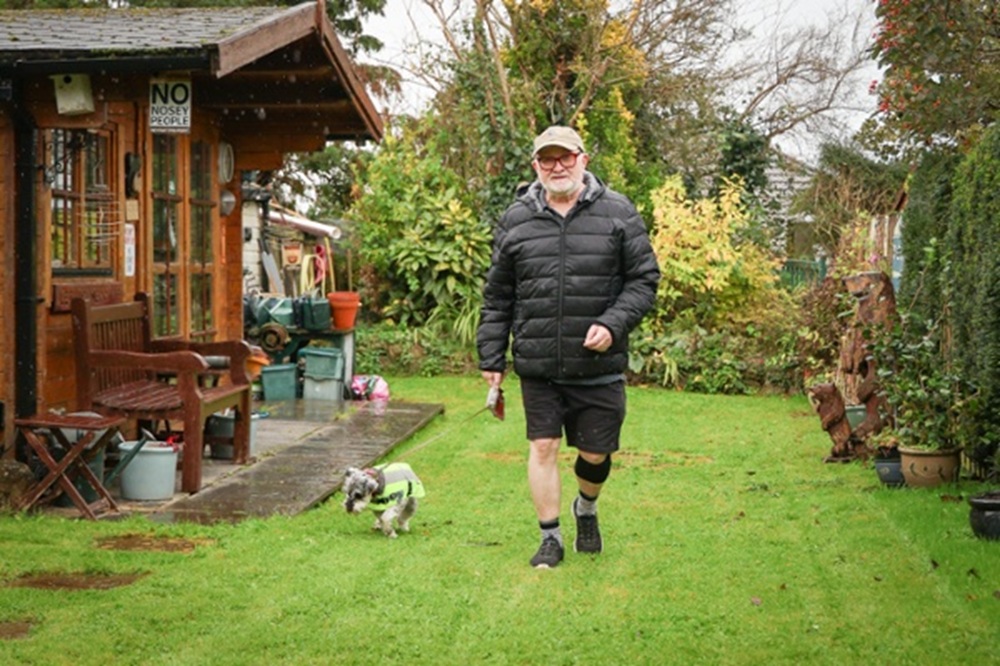
A 75-year-old man from Gower has regained his mobility after taking part in a pioneering trial using wearable technology to help people with Parkinson’s walk more easily.
Malcolm Sims, from Kittle, is one of 28 participants in the STEPS II study at Swansea Bay University Health Board’s Rehabilitation Engineering Unit.
The trial uses Functional Electrical Stimulation (FES), a therapy that sends small electrical impulses to muscles to improve movement and reduce the risk of falls.
Small pads are attached to a patient’s leg and connected to a switch in their shoe. Each time they step, the switch triggers the pads to stimulate the muscles, helping the leg to move more naturally.
Mr Sims said the treatment has transformed his quality of life. “It’s made such a difference – I’m back doing the things I enjoy and I feel more confident and steady on my feet,” he said. “Before, my friends noticed I was dragging my leg when walking. The device stops that sticky foot feeling when the muscles don’t respond properly. I can now keep up and walk miles.”
He added that the effects lasted even when not wearing the device. “I forgot to take it on holiday for three weeks, but the muscle memory was still there. I’m so glad I got involved with the trial and so grateful to the staff who have supported me.”
The STEPS II trial builds on earlier research led by Salisbury District Hospital in 2020, which found that FES helped people with Parkinson’s to walk faster, fall less often and gain greater confidence.
Around 200 people across eight UK sites are taking part, including in Swansea, north Wales, Leeds and Birmingham.
With around 60% of Parkinson’s patients experiencing at least one fall a year — costing the NHS an estimated £2.3 billion annually — the technology has the potential to improve safety and reduce hospital admissions.
Promising results
Dr Lorna Tasker, Consultant Clinical Scientist and Head of Rehabilitation Engineering at Swansea Bay University Health Board, said: “We’re delighted to see these promising results at such an early stage. The findings could help shape how FES is used in Parkinson’s care in future.”
Funded by the National Institute for Health and Care Research, STEPS II will continue recruiting until 2026, with results from the trial expected in 2027.
FES is already available in Swansea Bay as a treatment for stroke and multiple sclerosis patients.
Click here for more information or to register interest in joining the trial or email the team at [email protected].
Support our Nation today
For the price of a cup of coffee a month you can help us create an independent, not-for-profit, national news service for the people of Wales, by the people of Wales.



Brilliant results.