


Plaid Cymru ‘can become the natural party of government in Wales’, says Dafydd Wigley
Martin Shipton
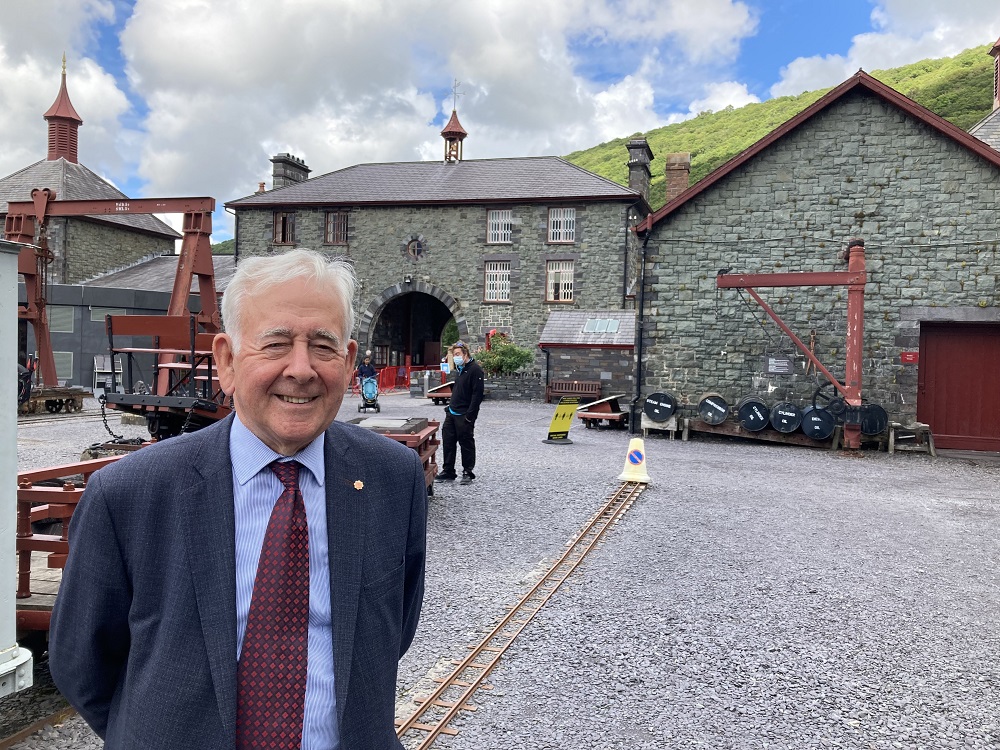
Former Plaid Cymru leader Dafydd Wigley believes the party has every chance of becoming the natural party of government in Wales.
He told Nation.Cymru: “The focus began with the Caerphilly by-election. In that by-election, we had a strong candidate with a good track record, a good organisation in the constituency and adequate resources, even though Labour and Reform spent twice as much as Plaid Cymru on the campaign.
“We were able to get a message across that if people wanted to stop Reform winning the seat, voting for Plaid Cymru was the way of doing that.
“I think one message that carried over into the national Senedd election six months later was the fact that Plaid not only could do that, but was acceptable to a sufficient number of people in Wales. They were willing to come to Plaid but would not possibly have gone to other parties. For example, they wouldn’t have gone over to the Tories to block Reform.
“In other words, Plaid has inherited part of the radical Welsh political tradition that makes it sufficiently attractive to a cross-section of voters, some who voted Labour in the past, and some who may have voted Lib Dem in the past. People who would have naturally wanted to stop Reform.”
He said that if a Plaid government came to be regarded as a competent administration, there was every chance the party could become the natural party of government in Wales.
Asked how he thought Rhun ap Iorwerth was performing as First Minister, and whether it was legitimate for the other parties to criticise Plaid for failing to deliver much tangible change in the party’s first 100 days in office, Lord Wigley said: “I think it’s been a fantastic period, and I would point out that some of the vox pop interviews done by the BBC on the street this week were a very unfair reflection of the situation.
“There’s a broad body of sympathy and support for trying to get stuck into the issues that we have flagged up during the first three months – things like the expenditure on the NHS, the childcare offer being brought forward, the Mark 2 WDA [Welsh Development Agency] being established to get the economy moving. The long-term agricultural support got a very favourable reaction from both farming unions. The additional money for social housing. Making homes more energy efficient, particularly at a time when electricity bills are going up. Extending free school meals in secondary schools. These are real issues.
“Now then, obviously the benefit of those are felt by the respective recipients – those that will be most aware of help for two-year-olds are those families that have got two-year-olds. If you ask a 70-year-old person about that, it’s not surprising that you get a rather blank look back. And therefore the vox pop that was undertaken, I thought was a very unfair reflection.
“I’m very, very happy with the way things are going. And Rhun himself has a very high recognition, not only in Wales, but across the UK by now. He has possibly the strongest recognition of any leader of the Senedd or the Assembly as was over the last 25 years.
“I could well understand other parties feeling they have to say something, or they have to point to something that they believe is a deficiency or a slowness in rolling out. But most people will feel that a three-month period is a rather unreasonable timescale, particularly when you think that when a party comes for the first time into government, the Civil Service hasn’t been used to working with that party and the party hasn’t had full access to the Civil Service – building up trust and mutual understanding takes more than three months, and therefore it’s far too early to make a judgement.
“What is important is the direction of travel on things like the NHS, on childcare, on the economy, on rural Wales. These are items where the direction of travel is where people want us to go, and it’s now a question of the government being able to show over a period of time, two or three years, that there’s been such delivery on those subjects that makes a difference for Wales.”
Supplementary budget
Asked about the difficulty in getting the Welsh Government’s supplementary budget through, he said that it would be necessary to make some kind of arrangement with another party, most likely Labour, although it could entail an agreement with the Conservatives relating to rural Wales.
Speaking about Andy Burnham and his approach to devolution, Lord Wigley said: “Quite clearly, Andy Burnham has a much better profile at this point in time than Keir Starmer did after two years. At the time of the election, Keir Starmer had a very good profile. I feel quite sorry for him because I think he was basically a decent man. But his forte was on foreign affairs, and they’re not the elements that generally win elections.
“Andy Burnham, in coming to Wales this week, has at least demonstrated an understanding of some of the subjects that have been controversial over recent years, such as the devolution of police to Wales. The fact that he is willing to look at that is good news. And to that extent, of course, a Plaid government in Cardiff would work with the Labour government in London to ensure that it is rolled out properly and that we get proper answerability, both on an all-Wales level, but also so far as the police services serving the various parts of Wales are concerned, so there’s a feeling that the police do belong to the communities.”
Some members of Plaid Cymru have not been happy with Burnham’s emphasis on boosting cross-border links between north-east Wales and the north-west of England, for example.
‘Economic reality’
Lord Wigley said: “Well, the economic reality has always been that we have to have a porous border. The idea of building a brick wall between Wales and England and stopping economic trade is absolute nonsense. It’s a fact of life, not only around Chester, it’s the reality when you come to places like Oswestry, which was the focal town for many Welsh farmers in mid-Wales, and when you come down to south-east Wales, the links through to Bristol.
“Those links are a reality. And what we’ve got to make sure is that the economy that is being developed in Wales is one that can serve the people of Wales, while taking advantage of any trade opportunities that are cross-border.
“I think a more serious and more difficult problem in parts of North Wales is the fact that the good people of north-west England, to a large extent, look to North Wales as a retirement area. Nobody would want to say: ‘Don’t come.’ Of course people are welcome to come to Wales, but it adds additional pressure on things like social housing, social services and the health service so that the pressure on those services is disproportionate to the base population.
“Those are the sort of issues that need to be sorted out, and they can be sorted out. And with goodwill on both sides, they will be.”
Support our Nation today
For the price of a cup of coffee a month you can help us create an independent, not-for-profit, national news service for the people of Wales, by the people of Wales.
Get more trusted Welsh news
Choose Nation.Cymru as a preferred source in Google News to see more of our journalism.



The great & esteemed Dafydd Wigley always speaks so much sense. Cymru lost the chance to elect the best of First ministers when the failed to support Plaid Cymru early on. Politically astute & pragmatic. If only we could choose to be a republic now, what a tremendous first president of Cymru he would make.! We are a strong & capable nation but our high levels of Stockholm Syndrome need to be addressed.
They can’t do any worse than Reform, whose strategy for supporting local businesses apparently stems from telling outrageous lies about them.
https://www.thesaintnewspaper.co.uk/post/local-restaurant-jahangir-seeks-legal-advice-following-reform-uk-work-visa-claims
I do hope Zia Yusuf gets sued by the proprietors of this restaurant. He will be able to afford it, but his political reputation will never recover.
I agree with Lord Wigley that plaid will remain the dominant force in Welsh politics. Largely because labour don’t offer a great deal and it’s hard to see them pulling voters back – bar some massive scandal in plaid. Welsh Labour has become synonymous with underachievement, and most their politicians come from a middle class public sector background – labour aren’t bad people and have the right intentions but they are hardly inspiring. I don’t think plaid offer that much either, just labour offer so little. Things might change at GE – where people might vote labour to keep reform… Read more »