


Plaid Cymru MP tables rail devolution amendment in Westminster Bill
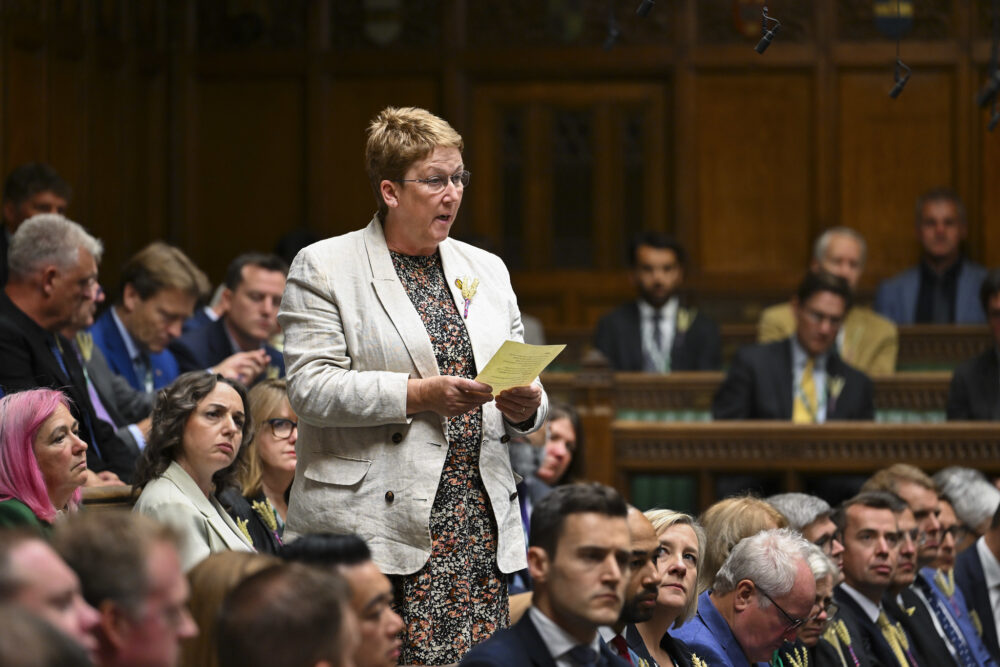
Plaid Cymru has intensified its long-running campaign for the devolution of rail powers to Wales, with the party’s Westminster transport spokesperson Ann Davies MP tabling an amendment to the UK Government’s Railways Bill.
Ms Davies said transferring full control of rail infrastructure and services to the Welsh Government is “essential” to address what she described as decades of underinvestment and structural unfairness.
The proposed amendment would require rail devolution to come into force no later than three years after the Bill receives Royal Assent, or earlier if agreed between the Secretary of State and Welsh Ministers.
It also calls for “commensurate funding” to accompany any new powers, ensuring Wales receives a fair financial settlement alongside responsibility.
The move comes amid renewed scrutiny of rail funding. The UK Government has previously acknowledged that Wales has been historically underfunded.
While £445 million has been allocated for Welsh rail over a ten-year period, critics argue this falls far short of what Wales should receive.
Plaid Cymru points to major infrastructure programmes — including HS2, East-West Rail and Northern Powerhouse Rail — which have been classified as “England and Wales” projects.
Despite no new HS2 track being laid in Wales, the designation means Wales does not receive full Barnett consequential funding. Estimates cited by the party suggest Wales could be missing out on as much as £6 billion.
Ms Davies said: “Years of underfunding and neglect have left our rail network in a dilapidated state, with regular cancellations, outdated infrastructure and illogical routes.”
“In very few countries do you have to leave your own nation to travel from north to south by train, yet that is the reality for Wales, and it is completely unacceptable,” she added.
Parity
Plaid Cymru has argued that Wales should have parity with Scotland and Northern Ireland, both of which exercise greater control over rail infrastructure.
The amendments also follow a significant intervention by the First Minister of Wales, Eluned Morgan, who in a speech in January called for a “new chapter for devolution.”
Addressing the Institute of Government, Ms Morgan demanded expanded powers for Wales, including control over rail, policing, youth justice, probation and the Crown Estate.
Ms Morgan also proposed a Constitutional Reform Act to protect devolution arrangements and an independent adjudicator to oversee fair funding across the UK’s nations.
“The new chapter must be underpinned by a ‘fair share formula’ so that Wales automatically receives its rightful share of UK resources in critical areas like rail, justice, and research and development,” she said.
However, the Labour UK Government has so far resisted calls to devolve those policy areas.
Support our Nation today
For the price of a cup of coffee a month you can help us create an independent, not-for-profit, national news service for the people of Wales, by the people of Wales.



Yes please devolve the matter so we can get away from this endless conversation. Again Plaid come in with the usual confused argument. Fact is you can only be owed consequentials for matters that are devolved. You cannot be lacking in devolution in an area and simultaneously be owed Barnet money on that basis. They need to stop with this classification obsession. They’re just labels of reserved spending it’s not a feature of the decision making process.
It might be better to introduce a private members bill that requires spending in reserved areas to be evenly distributed across all regions and nations. This should attract support from the three quarters of MPs who don’t represent London and south east England who are also losing out.
Evenly? On what basis should it be done evenly? Since the introduction of the Barnet formula Cymru/Wales has always received more than 100% of the average funding per person, the issue is how that has operated since the introduction of devolution. The Home Office and the Ministry of Justice, for example, regularly claw back money by informing their Wales based organisations to seek Health and Education funding from the Welsh block grant instead. Then there is of course the more well known declaring of projects, such as HS2 and the Oxford to Cambridge line, as ‘England and Wales’, not England… Read more »
Point is about investment not day to day spending. Pensions and benefits spending will vary “fairly” by region and nation for example because they are dependent on age and socioeconomic factors. This should also be true for health spending but isn’t, and that’s unfair.
Look at table A.3b for capital expenditure.
https://www.gov.uk/government/statistics/country-and-regional-analysis-2025/country-and-regional-analysis-november-2025
There is no top up, That’s just gaslighting. Wales is at or below the UK average for the last five years, but well down on Scotland and London.
This is the table that should be used to ensure everyone gets a legally mandated top up at the end of the year to match the highest figure.
Even better it should be linked to GDP per capita so regions and nations with lower GDP per capita get an even higher amount of capital expenditure.
You could even call it the Levelling Up bill.
You’re missing the point entirely. If Scotland get money for projects, then Wales should too, that’s part of the Barnett Formula. Classifying England only projects as “England and Wales” is a loophole to not have to fund projects in Wales. That’s why there’s a classification “obsession”, and long may it continue. No surprise you haven’t thought of this.
Incorrect. Barnett does not cover spending on reserved matters. This situation is a direct consequence of Welsh government rejecting the devolution of rail infrastructure 20 years ago. The “loophole” is of our own making – Jn jones is correct however inconvenient many find his argument.
The point I think you’re making is that devolution isn’t just about having the power to make better choices with the same money. It’s also essential to stop Whitehall trousering Wales’ population share of spending in non-devolved areas. The decision made 20 years ago wrongly assumed good faith in SW1.
Partly. There is no doubt that Wales is underfunded on rail; but the point is that it’s self inflicted to a large degree. The issue for Plaid now is on what terms would they take devolution in this area? With assets go liabilities, with responsibility goes risk, etc. Welsh Labour were too frightened of it 20 years ago. Is this any different? Same terms as Scotland perhaps? If not, what? Until they spell it out, this is no more than empty rhetoric.
if they were genuinely serious about rail devolution, these are the questions they should be asking. But instead, we end up with the daft social media claims about missing 4bn, which then changes to 6bn and then to 5bn without any reason. They’re just basically trying to enrage the voter base rather then engaging the serious points
If it’s happening that flagrantly for rail we should assume all reserved spending is being rigged in the same way but is being hidden behind higher costs that result from a failure to invest such as a higher benefits bill.
With respect, words like “flagrantly” and “rigged” imply that it’s all down to nefarious acts at Westminster. There is some justification for that; but it’s an increasingly lazy argument in my view. If we want to be treated as an equal partner, we need to move beyond gestures and sound bites with our politicians making proper arguments.
By classifying an Oxbridge shuttle as England and Wales spending Whitehall has stopped even pretending it’s a union.
See above for my proposed Levelling Up bill which addresses your other points.
I don’t think yours is the right approach. What you are basically saying (by using GDP per capita) is that Welsh government should be compensated for their own under performance in a devolved policy area. It just doesn’t fly.
The economy isn’t devolved.
Economic development is devolved; perhaps pointlessly if one takes the argument to its logical conclusion as the real levers are elsewhere I would agree. The same could be said of child poverty and other policy areas. It poses real issues about the current devolution settlement.
This is the crux of the issue. By some estimates responsibility for the economy in Wales is split 15/85 between Cardiff Bay and Westminster. There’s not much you can do with 15% if 85% is working against you. The original economic promises of devolution assumed a good faith partner in SW1. That didn’t happen. So the only solution is to even up that ratio. Which means more powers.
Or less arguably. Powers are pointless if unused (like income tax), not backed by cash and/or make no tangible difference for the reasons you say. For me, it’s back to my original point. Our politicians need to formulate serious proposals for more devolution rather than engaging in empty rhetoric. Sooner or later someone at Westminster might say, ok you can have the powers; but not a blank cheque. What then?
They need to be useful powers. Income tax isn’t an economic development tool, it’s a raising more revenue for public services tool. Now the ability to vary corporation tax on the other hand. That could be a game changer.
This UK gov is Toxic for Wales,and bleeding us dry,we need Independence, and right now,it won’t get better until we do.
Agreed, but don’t forget all the English companies that have stripped us of our wealth over the centuries and continue to do so.