


Plaid Cymru sets productivity target as measure of Wales’ future economic success
Martin Shipton
The Plaid Cymru government aims to improve prosperity in Wales by halving the productivity gap between Wales and the rest of the UK in a decade.
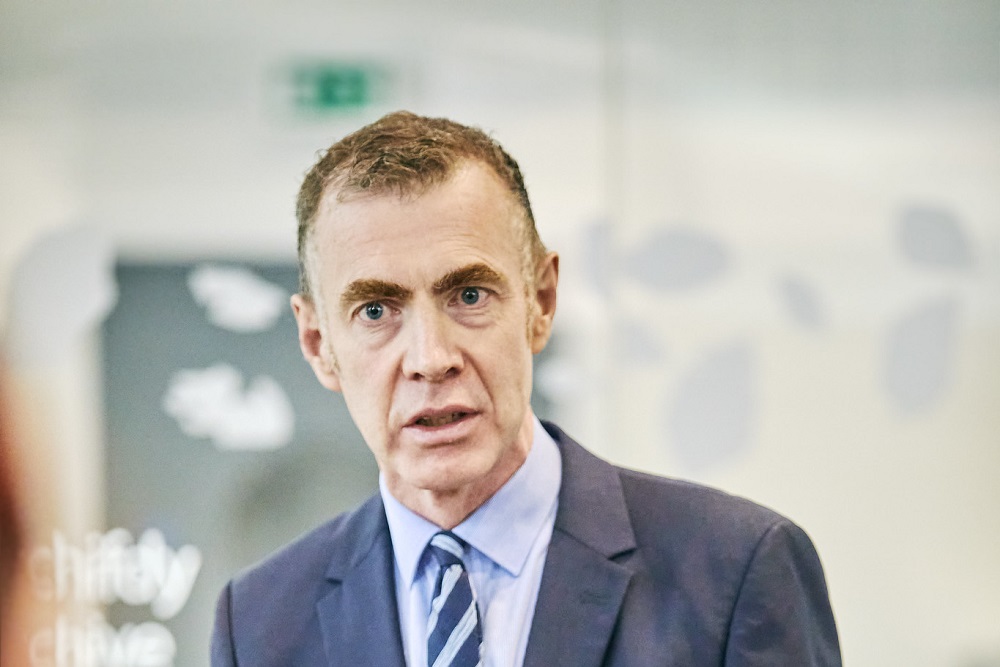
In an interview with Nation.Cymru, Enterprise Secretary Adam Price explained why it was necessary to have a target to aim at and why productivity was the chosen measure.
A trained economist himself, who has he notes wryly had the longest possible apprenticeship, he said: “It’s really important in any kind of economic plan that you have a goal, a target. And we haven’t had a headline goal for the best part of 20 years. You’re not going to achieve any consistent improvement unless you have a focus and a focus allows you to align everything you do as a government, for example.
“But this isn’t just a government mission. If we are going to achieve this ambitious goal, then the whole of Wales needs to align. And that’s not just government, but business and government working together – national government, local government and hopefully cooperation with the UK Government as well.
“The second point is which goal are you going to choose. Obviously there are a range of economic measures that were possible. We’ve chosen productivity for a number of reasons, the first of which is that it is the key driver of economic prosperity. It’s the fundamental engine, really, of everything else.
“Productivity sounds like a very abstract notion, doesn’t it? At some level it’s something that maybe just economists get excited about. But actually, what does it translate into? If you have higher productivity, you have higher wages, which is probably what most people think about in terms of improving living standards.”
‘Universal’
Asked whether productivity only related to manufacturing industry, Mr Price said: “No – it’s universal. What is it? In simple terms, it’s the amount of economic output, the amount of value that you create in an hour – and that’s true of you, me and everyone else. It’s true in manufacturing, but it’s true in the service sector as well. And it’s true in the public sector as well as the private sector.
“There is a direct relationship between the level of wages and the level of productivity. But it’s also, looking at it from our perspective, the measure which we in Wales at the devolved government level have more levers to be able to influence it and to drive it than other measures. To give you an example, economic growth – GDP or GVA – actually is influenced in many ways by what is done at a UK Government level.
“Skills are a very important element of determining how successful you are in terms of productivity. Education skills are wholly devolved. We don’t hold as many of the infrastructure levers as we would like, but we do hold some of them. Transport is important in terms of businesses, both in workers getting to jobs and businesses getting to market, but the energy infrastructure as well, making sure that is delivering productivity growth. And then there is innovation: what actually allows individual economies and businesses within it to thrive is often the take-up of new technology innovation as well as in the broader sense of management capability, etc.
“Those are things that are going to be absolutely mission critical to our new development agency. So many of these tools in the toolbox are ones that we own. And it’s that which leads us to say that productivity is the best way. We’re at 85% of the UK average at present, and we’d like to get up to 92% and beyond.”
Inspiration
He said it was important that Wales drew inspiration from places like the Basque Country in Spain, which in the 1980s was in a similar place to Wales in relative terms and had managed to close its economic gap between potential and reality.
In the public sector, said Mr Price, increased productivity could be measured in terms of inputs and outcomes: health outputs might be the number of people that you treat, and health outcomes would be judged by successful health outcomes.
Mr Price said: “I think we are aware that right across the world there is a sense of frustration at the inability of governments everywhere to provide the basic elements of a decent life.”
He sees AI as providing great opportunities to increase productivity: “There’s a lot of focus, understandably, on the downside risk in terms of its disruption, in terms particularly of people’s jobs in certain sectors. But there are also upside opportunities as well, which involve releasing people from tasks which are repetitive and allowing them to do what only people can do.
“Caring would be a great example of that. If you’re able to deploy the technology in a smart way to do what the technology can do best, then that releases people to do what people can do … Improved productivity helps you to achieve better quality public services with better outcomes, even working within the financial limits.”
Local authorities
When it’s put to Mr Price that many local authorities are hampered in what they can do because of extra demands on children’s services in particular, he says that won’t necessarily act as a dampener on increased productivity: “I think you can both employ more people and become more productive – and if you can do both, then of course that has huge value,” he said.
He’s enthusiastic about putting these ideas into practice in Wales, saying: “We should be able to do this really well. We’re a small country where we have one degree of separation, not six. We’re actually great team builders. Not to romanticise or generalise too much, but there’s something about the way we organise ourselves where ideas can flow well. Let’s build, let’s utilise that. Let’s utilise the fact that we can have short communication distances – government to business, business to business, because peer to peer learning is the best, isn’t it?”
M4
Echoing First Minister Rhun ap Iorwerth, Mr Price said that one issue seen by the business sector as a major impediment to connectivity – traffic hold-ups at the Brynglas tunnels on the M4 in Newport – would get a road-based solution.
The only option ruled out is the so-called Black Route of the M4 Relief Road, which was ruled out by former First Minister Mark Drakeford on cost and environmental grounds.
Accompanying Mr Price was his new special adviser Luke Fletcher. A Senedd Member in the last term, where he was Plaid Cymru’s economics spokesperson, he failed to get elected last month because he was only placed at number three on the party’s list of candidates for Pen-y-bont Bro Morgannwg. Only two of Plaid’s candidates won seats in the constituency.
Support our Nation today
For the price of a cup of coffee a month you can help us create an independent, not-for-profit, national news service for the people of Wales, by the people of Wales.
Get more trusted Welsh news
Choose Nation.Cymru as a preferred source in Google News to see more of our journalism.



If Adam Price can’t do it, I don’t know who can.
If he succeeds that would be fantastic but our productivity would still be the worst in the UK
Wales productivity is improving and gap with England is closing in recent years. Growth in productivity is rising fastest than than anywhere else the UK.
Is he picking a stat that he knows is improving to suit a narrative?
Luke Fletcher is a special advisor!
From what I have just read I do not think that productivity in Wales has shown any upward trend. This is a good target in that sense. A better target would be to match the UK average by the end of their first term in office because they will be on the ropes by then.
I agree that improving Welsh productivity is an important goal. But it’s noticeable that although Adam Price mentions the importance of energy and transport he does not mention climate or nature. Some road improvements are required, but it is well established that building more roads encourages car usage and will hinder transition to net zero and more active and public travel. Responding to a Senedd question from the Green MS Paul Rock asking why no Cabinet minister had specific responsibility for our environment, Rhun ap Iorwerth argued that silos were to be avoided and specifically mentioned the relevance of Adam… Read more »
Many on the right like to imply that low productivity is a measure of laziness, when it’s actually a measure of the low value of the goods and services produced. It has nothing to do with the hard work involved. So while some sneer at expensive restaurants charging rich American tourists £300 a pop, that’s doing far more to boost productivity than another McBurger chain store. We need more high end tourism, Aston Martins exported to China, expensive Welsh whisky, and aircraft wing manufacturing and fewer conveyor belts churning out plastic toys to go inside crackers. And while 92% rightly… Read more »
Good to see a Minister focusing on real indicators like productivity. Under the previous regime, far too much airtime was given to nonsense such as well-being objectives (whatever that meant).