


Plaid leader refuses to say if Union Jack would fly under his leadership
Emily Price
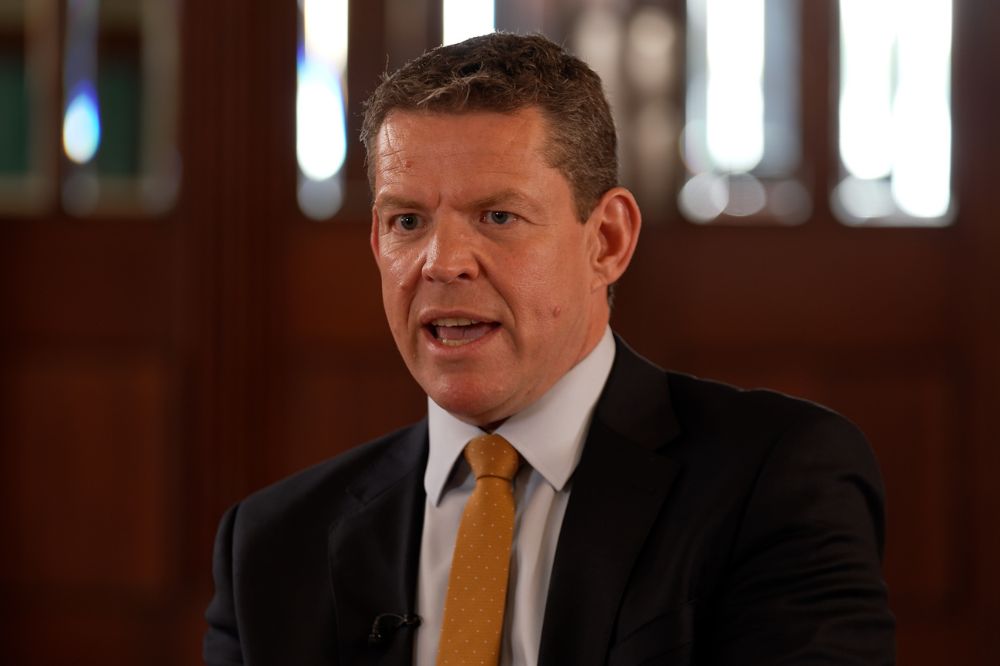
Plaid Cymru leader Rhun ap Iorwerth has dodged questions on whether he would fly the Union Jack flag above Welsh Government buildings if he becomes first minister.
Iorwerth’s remarks came during an interview with ITV’s Rob Osborne as part of a televised Welsh leaders series ahead of the May 7 vote.
The final episode in the series featured the musician-turned-journalist-turned-politician at home, drinking tea and playing guitar, as he discussed what is expected to be the most significant election since the start of devolution in 1999.
Asked about how people in Wales view their British identity, the Plaid leader was pressed on whether he would allow the Union Jack to be flown over Welsh Government headquarters if he became first minister.
Iorwerth did not answer the question directly, but said: “I’m pro-Welsh independence, so Wales is my nation.
“But I’ve talked about having a new kind of relationship between nations in these islands – a redesign of Britain.
“It’s not an anti-Britain thing, it’s a pro-Wales thing.”
Quizzed again on whether the Union Jack would be flying if he was the first minister of Wales, Iorwerth said: “Well the dragon of Wales is my flag.”
Pressed by Osborne a third time on whether he was indicating he wouldn’t fly the Union Jack over government headquarters in Wales, Iorwerth said: “My country is Wales, I identify as being Welsh.”
Asked what his relationship with the King would be like if he became first minister, Iorwerth said he had always maintained good relations with the royal family, but added that he did not believe the monarchy should form part of Wales’ political system.
Poll
A new ITV poll released on Tuesday (May 5) revealed that Plaid Cymru is on course to be the largest party in the Senedd with 33% of the vote share – four percentage points ahead of Reform UK at 29%.
Asked whether Iorwerth was taking for granted that he will be Wales’ first minister after the vote on May 7, he replied, “Absolutely not.”
“There are two parties likely to be leading the formation of government next time – It’s Plaid or Reform,” Iorwerth added.
ITV’s Osborne pointed out that Welsh Labour and the Greens were unlikely to back a government led by Nigel Farage’s party.
Plaid’s leader replied: “If we have the honour of forming a government – it’s leadership bringing others with us and looking for common ground and that invitation is to other politicians in the Senedd as well.
“If we want to get things through and we haven’t got a majority – we are going to have to work with you – that’s how mature politics works.”
Independence
Among Plaid’s manifesto pledges, the party has promised a White Paper on independence – rowing back on a previous commitment in 2021 to hold a referendum within the first term of a Plaid-led government.
Asked whether his U-turn reflected concerns that the promise of independence could be a vote-loser, Iorwerth said now was not the right time for a referendum because current polling suggested Plaid would be unlikely to win.
He said that while he hoped Wales could be ready for a referendum during a second term in government, it would not be something he would impose on Welsh people.
He said: “I want to guide people to be confident and think about how the relationship between nations in these islands could work better for all of us, not just for Wales.”
Pressed on whether he would seek to build support for independence by capitalising on public frustration if Westminster refused to work with a Plaid-led government, Iorwerth said he hoped to maintain a “constructive relationship” with whoever becomes the next Prime Minister.
He said: “It will be a relationship where he is very clear throughout. It is to the people of Wales and in getting the gains I think we need – on investment, on infrastructure, on HS2, on the Crown Estate, on the devolution of policing.”
Challenge
Plaid Cymru has portrayed itself as a party of change during the Senedd election campaign, despite cooperating with Welsh Labour on several policies over the years, including the tourism tax and the expansion of the Senedd.
When asked if Plaid was offering voters little more than a change of face at the top of government, Iorwerth rejected the characterisation.
He said: “There’s a significant difference in having a party that is based solely in Wales, responsible only for the wellbeing of the people of Wales, making a case and putting forward a vision, compared with a party that ultimately is a branch of a UK-wide party – and I think that’s what excites people.”
On the Welsh Government’s most significant challenge, the Welsh NHS, Iorwerth claimed his party could get rid of the longest waiting times “within a matter of months”.
“We expect within this Senedd term to cut maybe 300,000 people off waiting times altogether,” he said.
Welsh language
Plaid has proposed to recruit 100 new GPs to address the health crisis in Wales and reduce pressure on primary care. Iorwerth said his party had found the cash to recruit these new GPs within Wales’ health budget.
Turning to education, Iorwerth said his party would deliver literacy and numeracy reform, free school meal expansion and a review of the curriculum for Wales.
On his pledge for half of pupils to be educated in Welsh-medium schools by 2050, Plaid’s leader said too many children were leaving school without the ability to speak Welsh.
Asked whether every new school in Wales would be a Welsh language one, Iorwerth replied, “Not all, but some will.”
“We have to be setting these kinds of targets. I think we need to be brave. We need to be confident in our ability to be this bilingual nation – not one language taking over from another,” he added.
Plaid’s manifesto pledges include a universal childcare offer of 20 hours of free provision each week, alongside plans to raise school standards and create a new National Development Agency for Wales to boost the economy and support small and medium-sized enterprises.
But questions have been raised about whether Plaid will be able to afford these commitments.
Iorwerth said that during his time canvassing he had warned Welsh voters that if a politician offers the world, “don’t believe them”.
When asked if Iorwerth was guilty of doing this himself, he argued that his party’s plans were a focused program of government that recognised that things were tight.
Cuts
The Institute for Fiscal Studies has warned that delivering Plaid’s plans would, “deepen the cuts faced by unprotected services and/or require increases in devolved taxes”.
Asked whether people’s taxes would increase under a Plaid government, Iorwerth answered “no”.
He indicated he wanted to see more tax powers devolved to Wales and hinted that Plaid would look at re-banding Welsh homes to make the council tax system fairer.
Asked what he would do if Westminster rejected these proposals, Iorwerth said he would not simply accept that outcome, but added it did not mean he expected approval “immediately” whenever he asked for it.
At the end of the interview, Iorwerth was pressed on a series of existing Welsh policies and asked whether he would keep or scrap them.
On the controversial 20mph default speed limit, Iorwerth said he would keep the restriction – but said it had been implemented poorly by the current Labour government.
On 50mph average zones, Plaid’s leader said he would retain the ones that were working.
Public purse
Asked about the Well-being of Future Generations (Wales) Act 2015 and the role of the Future Generations Commissioner, Iorwerth said the legislation should be strengthened so it “does more”, arguing it has so far failed to challenge the government effectively.
On minimum unit pricing for alcohol, Iowerth said he would keep the “important health measure”.
When pressed on whether he would keep taxpayer subsidies for Cardiff Airport at the current rate, Plaid’s leader said “too much money had gone into the airport”, adding that it needed to be “less onerous for the public purse”.
On the new closed proportional list system for electing Members of the Senedd, which gives voters just one choice between a party or an independent candidate, Iorwerth said Plaid would scrap the changes, describing the reform as a “compromise” with Welsh ministers.
He said: “We support a different model that we think would be better – but we made sure that we were able to build into the legislation the ability to have a review – which will happen after the election.”
The full series of Wales Decides 2026 – The Interviews is now available to watch on ITV X.
Support our Nation today
For the price of a cup of coffee a month you can help us create an independent, not-for-profit, national news service for the people of Wales, by the people of Wales.
Get more trusted Welsh news
Choose Nation.Cymru as a preferred source in Google News to see more of our journalism.



The Union Jack is fraudulent. It purports to represent the UK but its composition certainly does not. The UK = England, Scotland, Northern Ireland, Wales. This flag features the Crosses of St George (England), St Andrew (Scotland), St Patrick (Ireland). Thus the Irish Republic – independent since 1922 – is still represented on it whereas Wales (a UK country) is not. The mismatch between the Union Jack and the UK couldn’t be clearer. As such, the flag should not be flown anywhere in the UK. If England was not represented on it the flag would not be seen anywhere in the… Read more »
Gwyn, St Patrick still represents Northern Ireland. But St Patrick was Welsh so with a bit of imagination you can say it represents Cymru.
But why are we seeing all this hatred about flags these days? I was at Airbus the other day and saw the Red Dragon flown alongside the Union Flag, along with the German, French, Belgian, Italian and Spanish flags , all at the same height. They symbolised respect and cooperation between the nations and that is how we should view the flags not as divisors.
Were they flying the EU flag given Airbus is widely considered an EU success story?
The blue in the Union Flag is pantone 280, Scotland’s Saltire uses pantone 300.
Interestingly Tenerife has a saltire, using pantone 300:
https://www.google.com/url?sa=t&source=web&rct=j&opi=89978449&url=https://en.wikipedia.org/wiki/Flag_of_Tenerife&ved=2ahUKEwjryZSn6aaUAxXbV0EAHc64N2sQFnoECBsQAQ&usg=AOvVaw2ikErcpDY1B3C1frsCBMsO
So Tenerife is better represented than Cymru, arguably Scotland too; given how much blue is in the field.
/s to eliminate doubt.
Big issues like which flags should be flying are what occupies all our minds at this vital time!!
Not really a concern. Who loaded the idea for ITV.
Rhun, please do not start turning into a politician that does not answer the question that is being asked. There are far too many politicians doing this at the moment. The answer was “NO!!!” ….. followed by: “Why should we fly a flag that we are not represented on?”
It doesn’t represent us, why would we fly it. There is no Saint David’s flag within it. Same with the coat of arms on our passports, but in that case England is represented twice.
I don’t know if it’s getting older but these sort of discussions just come across as so incredibly childish and belittling of the status of the Senedd.
We’ve had more articles on flags than education and health in this election….
I genuinely hope not.
That vile old rag represents genocide, theft and abuse. Decent countries should have nothing to do with it.
Should formerly colonised nations be compelled to fly the Union Jack? If they refuse to do so, will they be berated for harbouring “anti-English” sentiments?
It’s the empire flag because unlike most failed empires the same flag is still being used which implies the so-called union is simply the remains of empire. Certainly Whitehall’s London-first approach to governance supports this narrative.
The flag of the nation should fly over government buildings. This nation is Cymru. Y Ddraig Goch is foremost but other flags can join it. Croes Dewi Sant, Baner Glyndwr and on other occasions, flags of groups showing celebration and support but nothing that shows contradiction, oppression and second classing of the nations’ own flag.
If they want a culture war include the EU flag.
Flags are important coz they represent things. Throughout history, nations have planted flags to demonstrate their conquest of mountains, lands and extra-planetary objects. Arguing that flags are silly is a bit like saying racism is silly. Racism is objectively silly but no less deadly because of it! As for the butchers apron, I’d put it in the draw until it can be made to mean something nicer than it currently does.
You hardly ever see the Union Jack flying in Wales; why should Rhun ap Iorwerth be asked if he intends to fly it? No need to get defensive, Rhun, just say “No”
Why would you fly a flag that omits your nation? What a stupid question to ask. If I were Rhun ap Iorwerth, I’d reply: start flying Y Ddraig Goch on every government building throughout the UK – only then as First Minister will I consider it.
Questions like this are intended to illicit confrontation and controversy. The six counties demonstrate how these symbols can be political pawns designed to create dissention. The ‘butchers apron’ is not our flag!
Is this really an important issue at this time? We’re talking about a possible minority government in a Senedd with very few powers. We are nowhere near being an independent nation. This is a question designed to drive a wedge between Welsh people right at the start of a fledgling government. Things have to be done gradually. The Unionist media will be at full throttle to derail a Plaid government at every opportunity..