

Politics is not a vending machine
James Downs, Mental Health Campaigner
I am sure I’m not the only person in Wales who has been watching media coverage of the upcoming Senedd election with their head in their hands, at least some of the time.
There are lots of political reasons why people might feel energised (or exasperated) by the debates we see on television, online, and in our daily lives.
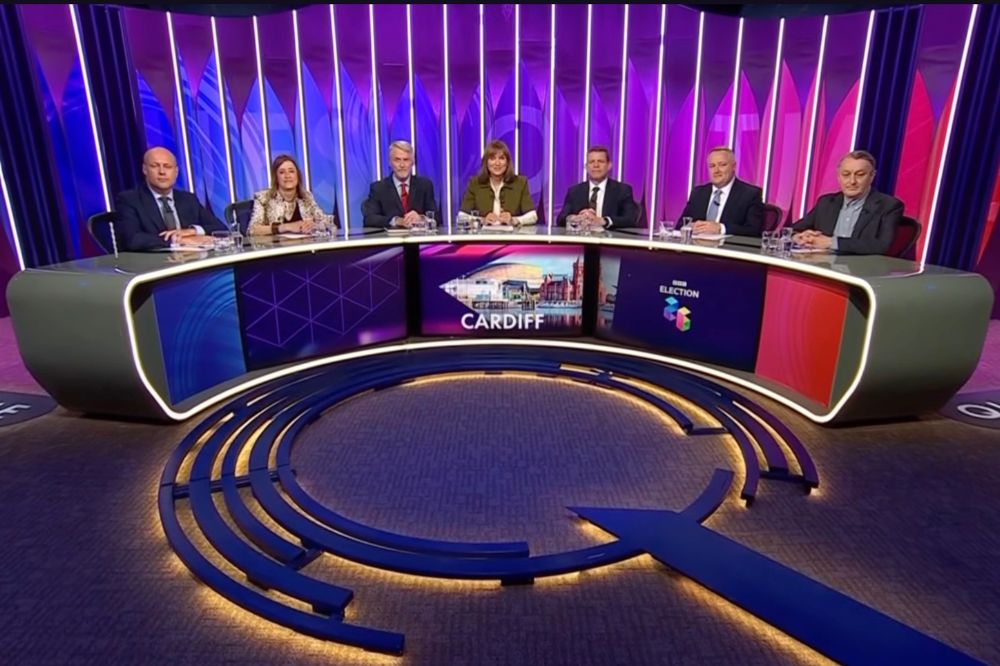
But, when watching the latest BBC Question Time from Cardiff, my own frustration was not primarily with the politics.
Yes, some of the panellists’ ideas about the problems facing Wales and the solutions we need made me want to bang my head against a wall. But what bothered me most was not simply what was being said – it was the way the whole discussion was being framed.
Again and again, the conversation returned to whether parties could show exactly how their manifesto commitments would be paid for. Fiona Bruce spent a large part of the programme pressing panellists on costings, affordability, and whether the sums added up.
Of course, questions of economic credibility and transparency are important. Public money is finite, and choices have consequences. But is the obsession with whether every manifesto line is fully costed the best question, or even an honest question, to ask?
A manifesto is not a budget
Party manifestos are routinely treated by the media as though they are finished governing programmes, ready to be delivered in full the moment the votes are counted. They are not.
A manifesto sets out priorities. It signals values. It shows where a party wants to put pressure, what it wants to argue for, what it hopes to take into negotiations, and what kind of government it wants to shape. It is not a budget or a spreadsheet.
It is not a guarantee that each line will appear intact in the final programme for government.
The elephant in the room during the Question Time debate wasn’t that some of the plans being put forward by parties in Wales may be unaffordable. It was that no party is likely to win an outright majority under the new Senedd system, especially in the light of recent polling.
That means no manifesto is going to be implemented cleanly or in full. What happens after the election will depend on negotiation between parties, compromise, pressure, trade offs, and the slow business of turning broad political priorities into an actual budget.
That budget has not been written yet. It certainly has not been voted on. So when journalists demand to know whether a manifesto is fully affordable as though it is already a governing document awaiting execution, they are asking parties to account for a process that has not yet happened. It is the wrong question.
What voters are actually choosing
Whether a manifesto survives some performative affordability test in a television studio might be important to the media, but in reality, voters are choosing between priorities. Manifestos signal that a party cares about.
They are opening arguments and statements of intent: the beginning of a process, not the end of one.
When we appreciate this, different questions for the political parties on offer might become more important: Where would they spend political energy? What would they fight to keep in a coalition agreement, a budget negotiation, or a legislative bargain? What trade offs are they prepared to make? What kind of Wales are they trying to imagine into being?
The discourse is part of the problem
This kind of discourse seems to depend on a mechanical idea of democracy. You vote for a party, the party wins, the manifesto gets enacted. If this does not happen, then perhaps the logical conclusion is that someone must have lied, betrayed, or failed.
Of course, this framing has traction. People are disillusioned, and often for very good reasons.
Politicians have promised more than they deliver, and they do speak as if electoral support gives them a simple mandate for action. Trust has been damaged repeatedly, and many people cannot afford to wait for politics to produce meaningful change and make their lives easier.
But doesn’t a discourse that keeps pretending politics is like a vending machine actually contribute to this disillusionment?
Is it not dishonest to perpetuate the idea that inserting your ballot will lead to a self-contained programme for government in a context where no party is likely to win outright?
In the case of the BBC, is it not part of their duty to inform people that this election will not be a simple, linear transaction, and that the outcome will involve a complex process of negotiation as well as a few sums?
If people are encouraged to think that manifestos are direct promises of implementation, they will understandably feel cheated when those promises are diluted, delayed, bargained away, or blocked.
If nobody explains that this is how multi-party democratic systems function, then compromise will look like betrayal and ordinary legislative negotiation like bad faith. This undermines whatever trust we might have left in politics.
Repairing trust requires honesty
I am not saying that the public should lower its expectations of what politics can deliver. We are right to want clearer plans, stronger accountability, and meaningful change. But a political discourse that pretends that politics is simpler than it is is not the way to achieve this.
Instead, we need to raise our expectations of public information, political debate, and the media. Public discourse needs to be more honest about what a vote can and cannot do, what a manifesto is and is not, and what democratic politics actually demands.
Our politicians need, at times, to be allowed to convey the reality of uncertainty without being condemned as weak or indecisive.
The media needs to be more candid about negotiation, and less addicted to binary framings of affordable or unaffordable, deliverable or undeliverable, promise kept or promise broken. These categories are too crude to describe what democratic politics actually involves.
Wales will not get better political answers by repeatedly asking the wrong questions.
James Downs is a mental health campaigner, researcher and expert by experience in eating disorders. He lives in Cardiff and can be contacted at @jamesldowns on X and Instagram, or via his website: jamesdowns.co.uk
Watch the latest episode of Question Time on iPlayer now.
Support our Nation today
For the price of a cup of coffee a month you can help us create an independent, not-for-profit, national news service for the people of Wales, by the people of Wales.



The two biggest ‘eating disorders’ in Wales is pensioners who have to choose between heating and eating because Labour snatched away the winter fuel allowance and children who go to school on an empty stomach because no other party except Plaid Cymru proposes free school meals for them. Such manifesto commitments do have to be costed, to say it is unnecessary is evasion.