


Pylon design for controversial pylon network changed in bid to woo Plaid Cymru ministers
Martin Shipton
An energy company has announced a major change to its plans for a new electricity network across mid Wales in a bid to attract the approval of the recently elected Plaid Cymru Welsh Government.
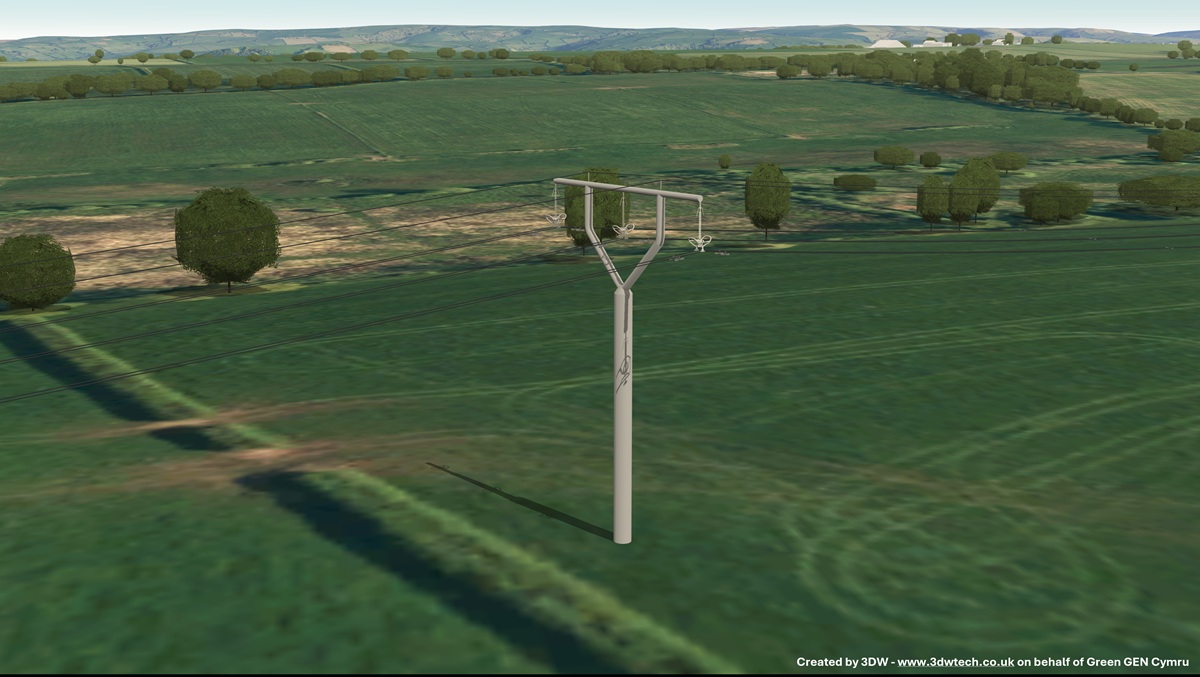
Green GEN Cymru (GGC) has unveiled a new “monopole” style of pylon for two projects that were previously intended to be supported by the more familiar steel lattice structures.
Monopole pylons around 22 metres tall are being proposed for the Tywi-Usk and Tywi-Teifi projects, around half the height of a typical 275kV pylon.
A prototype of the new design is expected to be ready in early 2027.
GGC hopes the design change will appeal to Plaid Cymru ministers, although the party has made it clear that its preferred option is the undergrounding of cables.
According to GGC, the monopoles, based on a Danish design, have been created specifically for the requirements of GGC’s developing 132 kV network, and with the Welsh landscape in mind.
The company says monopoles will now be considered alongside wood poles, lattice towers and underground cables as part of GGC’s infrastructure toolkit, with GGC also exploring opportunities for the structures to be manufactured and fabricated in Wales as part of its ambition to maximise the Welsh economic benefit from investment in new electricity infrastructure.
Monopoles are single-pole structures designed to carry significant electricity network capacity within a slim and compact profile. Their relatively small ground footprint can help limit land requirements during construction, while their form has been developed with the aim of limiting visual impact in the landscape.
The development of the monopole forms part of GGC’s wider programme of investment in Wales’ electricity network. GGC plans to invest nearly £1bn in new electricity infrastructure, and wants that investment to create opportunities for Welsh businesses, strengthen domestic supply chains and support high-value engineering and manufacturing capability in Wales.
In developing the design, consideration has been given to construction requirements, deliverability and the opportunity to draw on existing Welsh skills, fabrication capability and engineering expertise.
The monopoles will be fabricated from structural steel, requiring steel fabrication, forming and welding, alongside associated engineering and finishing processes.
GGC says it intends to engage with potential manufacturing partners across Wales as the design progresses, with the aim of developing a Welsh supply chain around the technology.
The company says the monopole has also been designed to reduce visual impact while providing additional network capacity to connect new energy generation and meet growing demand for electricity.
GGC has already secured approval and completed type-testing of the ACCC Cardiff conductor, which it says can carry significantly more electricity than conventional conductors while allowing slimmer structures. The conductor will be used on the monopoles.
The company says different technologies will continue to be assessed according to the requirements of individual projects and locations.
Where monopoles are considered appropriate, their greater capacity compared with wood pole solutions could mean fewer parallel overhead line corridors are required.
GGC says up to four separate wood pole corridors could be required to provide the same level of network capacity as a monopole solution.
Andrew Hardcastle, Executive Director at GGC, said: “As demand for electricity increases, Wales will need more network capacity to connect new energy generation, support businesses, strengthen communities, improve productivity and attract inward investment.
“Our focus is to deliver the right infrastructure, in the right place, at the right time.”
He said there was no single solution suitable for every landscape or community and that developing monopoles alongside wooden poles, lattice structures and underground cables would give the company greater flexibility.
‘Opportunity’
Stephen Rowlands, Head of Construction and Supply Chain at GGC, said: “Wales has a proud history of manufacturing and engineering, and we believe there is a real opportunity for Welsh industry to play a leading role in developing and delivering the next generation of electricity infrastructure.”
He said GGC wanted to use Welsh skills and manufacturing expertise as investment in the electricity network increased.
“Our ambition is to work with Welsh businesses and the wider supply chain to develop that capability, support high-value opportunities and ensure that as investment in Wales’ electricity network grows, more of the economic benefit is captured here in Wales.”
GGC says electricity demand in Wales could almost triple by 2050.
Monopoles
The proposed monopoles would be around 22 metres high and approximately one metre in diameter, although their final dimensions would depend on the network configuration.
They are being designed to achieve similar span lengths to L7 lattice towers, at around four structures per kilometre.
Wooden pole structures are typically around 12 metres high and require around eight or nine structures per kilometre, while L7 steel lattice structures are generally around 27 to 28 metres high.
Traditional 275kV steel lattice towers are typically around 36 to 38 metres high, while 400kV structures are generally between 45 and 50 metres.
The proposed change was immediately opposed by campaigners from the Llandovery Pylon Steering Group, who said the new structures were neither “low” nor “less intrusive” than the lattice pylons they would replace.
The group pointed out that the proposed monopoles would be more than twice the height of a typical nine-metre telegraph pole.
It also claimed the structures could require significantly closer spacing than lattice pylons, potentially every 160 to 180 metres compared with around 250 metres for pylons. Campaigners estimate this could result in between 150 and 220 additional structures along the Tywi-Usk route alone.
The group also criticised plans to continue using steel lattice pylons on the proposed Vyrnwy-Frankton project, despite a substantial proportion of the route being in Wales.
Manifesto commitment
Campaigners argue that the changes do not meet Plaid Cymru’s manifesto commitment to establish a presumption in favour of undergrounding 11-132 kV lines, with overhead alternatives permitted only where they involve low wooden poles or equivalent, less intrusive infrastructure.
A spokesperson for the Llandovery Pylon Steering Group said: “Replacing one form of massive, intrusive overhead infrastructure with another is not the undergrounding-led approach that was promised to Welsh communities.
“A 22-metre composite pole is not a low wooden pole, and it is not less intrusive infrastructure — whatever it is called, it is still industrial-scale transmission equipment marching across the Welsh countryside, and in greater numbers than before.”
The group called on Plaid Cymru and the Welsh Government to uphold the commitment to a presumption in favour of undergrounding.
It is also inviting elected representatives and members of the public to attend Green GEN Cymru’s consultation event in Llandovery on October 15.
Support our Nation today
For the price of a cup of coffee a month you can help us create an independent, not-for-profit, national news service for the people of Wales, by the people of Wales.
Get more trusted Welsh news
Choose Nation.Cymru as a preferred source in Google News to see more of our journalism.



I tend to think the monopole is more ugly than the traditional lattice structure. https://www.pylons.org/
If this company’s profits gets clobbered by placing cables underground, then we need to shed a tear for their bosses who would make a couple of pounds less on their multi million pounds salaries. Think about how much they would have to sacrifice from their difficult lifestyles. Now, they would actually have to cut out absolutely nothing.
You do have to question this company’s strategy as this design was available years ago but only now have they put this forward as a possibility. They obviously wanted the cheapest design to maximise their profit. This is infrastructure that will be with us all for the next century at least and as a society we should be able to insist that if the investment is made, it is made to the highest standard, as cost spread over that time period really is secondary, and yes that should include undergrounding in the most sensitive landscape areas.
https://cprw.org.uk/new-monopole-design-raises-further-questions-over-green-gen-cymru-plans/
They should commit to putting 10% underground and let communities vote on which sections disappear.
Monopoles are not a ‘new design’ and have been used for years, mainly for HV transmission in urban areas where land costs are higher. They, by design, require a much larger concrete base than the lattice equivalent and contain three times the amount of steel. This is a bizarre proposition.