


Rare butterfly egg numbers boom after landowners let hedges grow wild
Emily Price
Numbers of rare butterfly eggs have rocketed in parts of Wales after landowners let their hedgerows grow wild.
Volunteers for national charity Butterfly Conservation have counted record tallies of Brown Hairstreak eggs this winter in Carmarthenshire.
The butterfly is locally distributed in southern Britain and mid-west Ireland and has undergone a substantial decline due to hedgerow removal and annual flailing.
Found at woodland edges and along hedgerows the elusive insect spends much of its time in the treetops feeding on aphid honeydew – while caterpillars feed exclusively on blackthorn.
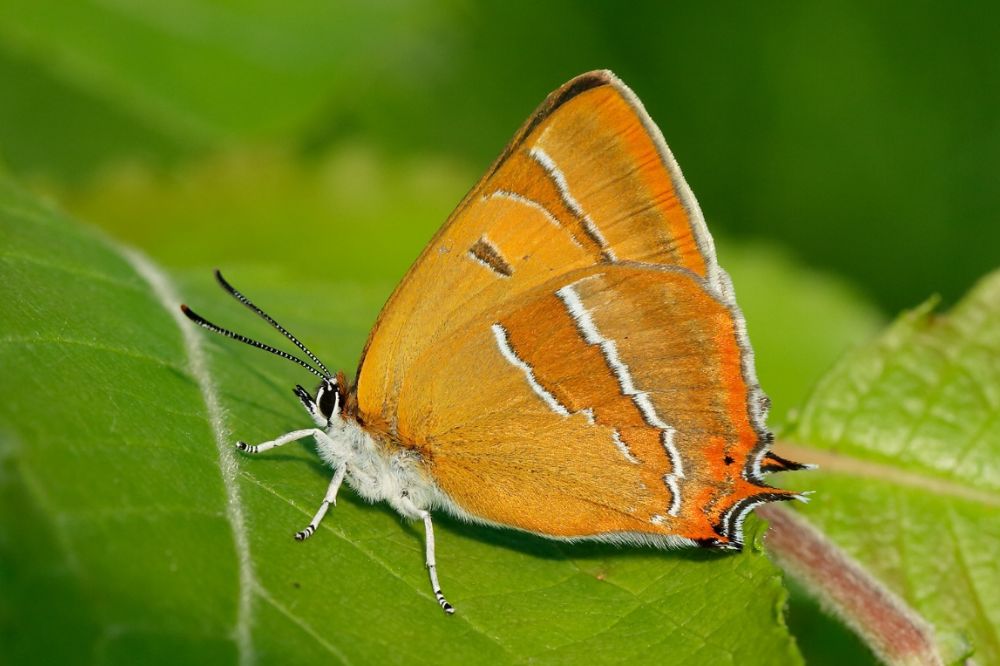
The brown hairstreak has brown upperwings and small ‘tails’ protruding from the hindwings.
Females have a brilliant orange patch in the top corner of each forewing.
The underwings are a distinctive bright orange, with two white lines streaked across them.
Butterfly Conservation volunteers say the species’ recent success in south Wales, is down to two partners – the National Trust and the South Wales Trunk Road Agent.
Both organisations reduced the amount they cut back their hedgerows, and that has allowed the Brown Hairstreak to thrive.
Richard Smith has volunteered with Butterfly Conservation’s south Wales branch for more than 30 years.
He said: “The volunteer team are really excited to find that, after a decade of heartache for Brown Hairstreaks in Carmarthenshire’s Tywi valley, there is at last signs of an upturn.”
Flailing
The Brown Hairstreak was once much more common across the UK but declined substantially due to farmers and landowners removing hedgerows and cutting them back by ‘flailing’.
The fast hedge cutting method uses a tractor-mounted, rotating, multi-bladed arm to cut or shred the sides and top of hedgerows to a uniform height.
Brown Hairstreaks will only lay its eggs on young shoots of the spiky blackthorn bush, often found in hedgerows. Flailing destroys them.
As recently as 2010, the species was present throughout most of the Tywi valley in Carmarthenshire, but over the next decade disappeared almost totally.
It’s believed this was due to increasing annual mechanical flailing of hedgerows and scrubby corners.
Hunt
Members of Butterfly Conservation’s south Wales branch have gone out each winter in December or January for years, armed with magnifying glasses, and spent hours hunting the hedges for the tiny white eggs.
They also work with farmers and partner organisations to raise awareness about the Brown Hairstreak’s plight.
The work is partly funded through Welsh Government’s Local Places for Nature biodiversity grant scheme.
This winter, their years of hard work have paid off.
Richard Smith added: “When we found a small remnant population in 2021 just west of Llandeilo, we set about annual egg counts and with help of two key partners, the National Trust team at Dinefwr and the South Wales Trunk Road Agency, who both got more blackthorn planted on their respective estates and got those two sites completely protected from annual flailing.
“Results have been improving year on year, and this winter has seen 50 per cent increases on such protected land, whereas sadly another group of fields nearby, which were unmanaged for four years, have now been severely flailed with a drop from 60 eggs per annum to just four this year.”
Dan Hoare, Butterfly Conservation’s Director of Nature Recovery, said: “The Brown Hairstreak will only lay its eggs on young new shoots of Blackthorn which is a key component of many hedgerows, and annual mechanical flailing destroys these shoots and the eggs on them. Small changes to the way we look after our hedges can help wildlife thrive and hedges function better for nature and people.
“We don’t want to stop anyone managing their hedgerows, but we would love more landowners to try cutting back on their cutting back: if hedgerows are only trimmed once every two years, or even every three years, it could make an enormous difference to the survival of the Brown Hairstreak and help many other species as well. The lovely Brown Hairstreak is an indicator of getting that balance right.”
Support our Nation today
For the price of a cup of coffee a month you can help us create an independent, not-for-profit, national news service for the people of Wales, by the people of Wales.


