

Rare Hen Harrier vanishes in Welsh ‘Bermuda Triangle’
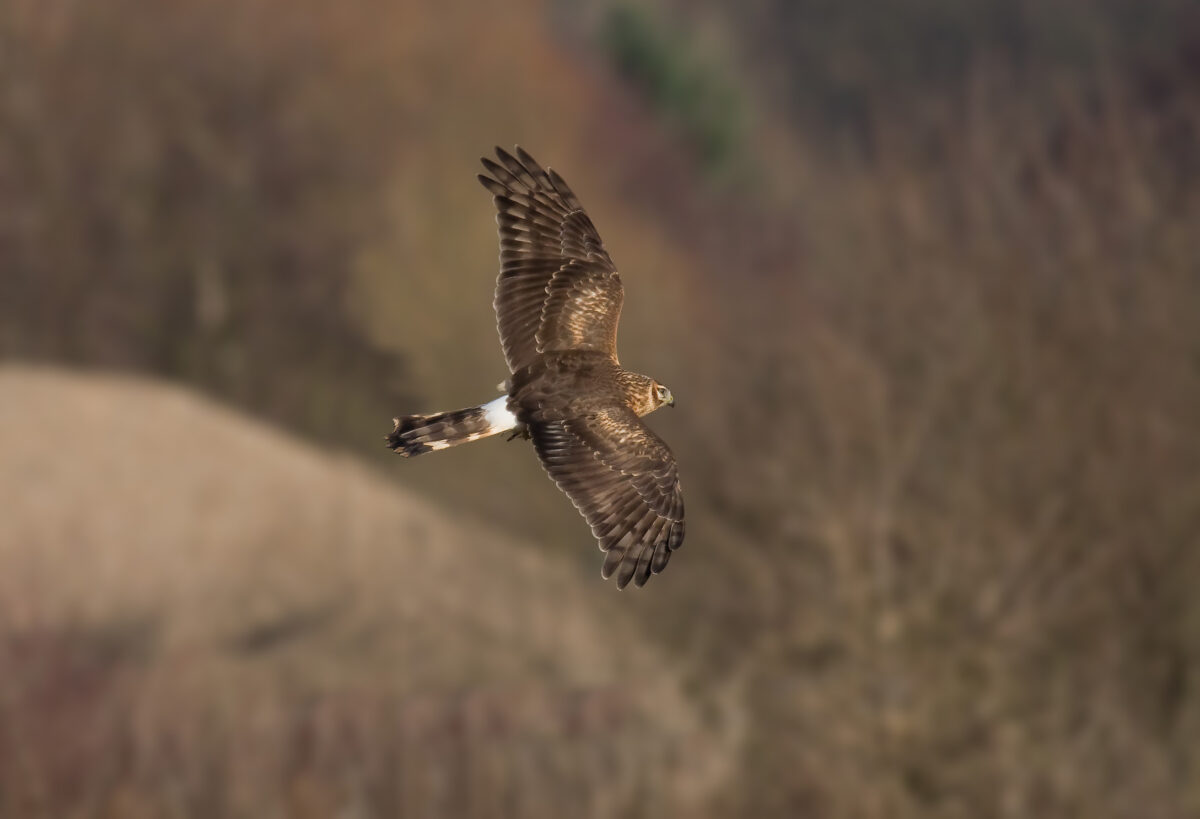
A rare hen harrier survived just three days after settling on a north Wales moor before vanishing in what conservationists describe as highly suspicious circumstances.
In late August 2025, a satellite-tagged female Hen Harrier vanished whilst on a driven grouse moor at Ruabon Moor near Wrexham.
The bird had fledged from a nest on the National Trust High Peak Estate in the Peak District National Park and was satellite tagged by the RSPB, funded by the National Trust.
In late August, data showed that the young bird had left the National Park, settling on Ruabon Moor, a driven-grouse moor in North Wales on 28 August.
On the night of 31 August the bird’s satellite tag data revealed that it was no longer alive.
A search took place and the tag was located on Ruabon Moor on 2 September 2025 but there was no sign of the bird’s body.
The tag was sent for forensic analysis by North Wales Police. Results revealed that the satellite tag’s harness had been deliberately cut (off) using a sharp implement, such as a knife. Despite searching, the body has not been found.
All wild birds are legally protected under the Wildlife and Countryside Act 1981. Anyone found to have killed or injured a bird of prey faces an unlimited fine and/or a maximum six-month jail sentence.
The Hen Harrier is a red-listed species in Wales and across the UK. Its UK recovery is being directly impacted by illegal persecution with most crimes associated with land managed for driven grouse shooting.
Decades of evidence such as the RSPB’s recently published Patterns of Persecution report, have shown that individuals on some gamebird shooting estates will illegally kill birds of prey to remove any perceived threat to their gamebird stock. This is done in an effort to maximise the number available to be shot, and the crimes are often financially motivated.
Ruabon Moor is recognised as one of the UK’s most notorious bird of prey persecution hotspots. Between 2018 and 2026 incidents include:
- The suspected persecution of five satellite tagged Hen Harriers. (The satellite tags from three Hen Harriers were recovered. Two had harness damage consistent wiith human involvement; satellite data from the third tag suggested that it had been interfered with prior to the bird’s death.)
- Satellite tags on two Hen Harriers suddenly and suspiciously stopped transmitting without sign of malfunction.
- The illegal poisoning of a Raven
- The use of illegal hawk traps found in two consecutive years
RSPB say these incidents are likely to represent only a fraction of the actual number taking place in this area in recent years as they are often committed at anti-social hours and in locations hidden away from the public.
Mark Thomas, RSPB’s UK Head of Investigations: “Sadly, this incident is a textbook example of Hen Harrier persecution and really shows the massive impact these crimes are having on this species.
“In this case a healthy young bird fledged from a safe area in the Peak District National Park and sadly chose to settle in Wales ‘Bermuda Triangle’ – the most notorious bird of prey persecution hotspot in the country.
“This three-month-old bird survived for just three days in the area before it vanished in highly suspicious circumstances.
“Based on years of evidence and intelligence, we suspect the criminal shot the harrier, cut the harness off the Hen Harrier’s body, discarded the tag and disposed of the body in separate locations to avoid detection. As recent incidents show, this area is a crime hotspot for Hen Harriers and other birds of prey and this has to stop.”
Julian Hughes, RSPB Cymru Head of Species: “We have provided a dossier of evidence to Natural Resources Wales and have asked the new Cabinet Minister for Rural Resilience and Sustainability to licence gamebird shooting in Wales.
“Without a clear deterrent and effective regulatory oversight, Hen Harriers and other birds of the prey will continue to be at risk.
“Through introduction of a statutory licensing system for all gamebird shooting in Wales these crimes could be effectively challenged – strengthening accountability whilst safeguarding the recovery of this species.”
Craig Best, General Manager for the National Trust in the Peak District: “We are devastated to learn of the fate of this magnificent bird that started its life on moorland in our care in the Peak District.
“Hen Harriers are an important species in the ecosystem of moorland habitats. We work hard to make sure these birds have good nesting and feeding grounds. Funding from our supporters helps us to restore the landscapes they need to give them the best chance of survival.
“If persecution is allowed to continue, we stand to lose a very important species that is crucial to the health of these landscapes and it can’t continue.”
Sgt Peter Evans of North Wales Police Rural Crime Team said: “In September 2025, North Wales Police received a report concerning the disappearance of a Hen Harrier on Ruabon Moor. Working in partnership with the RSPB and the National Wildlife Crime Unit, the harness was recovered and the investigation to date is inconclusive. Despite this, we can confirm that the harness had been intentionally severed, and the circumstances surrounding the bird’s disappearance are being treated as suspicious.
“Hen Harriers are a rare and protected species in Wales, making incidents of this nature particularly concerning. We urge members of the public to remain vigilant. If you witness any suspicious activity involving birds of prey, please report it to North Wales Police or the RSPB.”
Anyone with information relating to this crime cann call North Wales Police on 101 or report a wildlife crime on their website.
Members of the public can also submit a report to the RSPB via their online reporting form or by calling the RSPB’s confidential Raptor Crime Hotline on 0300 999 0101. Reports via the RSPB’s reporting form and Raptor Crime Hotline can be made anonymously.
Support our Nation today
For the price of a cup of coffee a month you can help us create an independent, not-for-profit, national news service for the people of Wales, by the people of Wales.
Get more trusted Welsh news
Choose Nation.Cymru as a preferred source in Google News to see more of our journalism.



Ban shooting estates. They only look after the money, not the environment.
‘Bermuda triangle’ implies something paranormal or supernatural. This is a wildlife crime perpetrated by human beings.
The rearing of, and shooting of wild birds for sport should be banned. Why is it considered ‘sport’ to treat animals in this way? Birds of prey regularly disappear on these estates, we all know why
How about licencing these shooting estates? The fee to be licenced needs to include a levy, so that NRW, RSPB, Police, etc, can pay more people – a lot more people – to act as wardens. Plus equipment – e.g. cameras, drones, etc, to help with surveillance.
They keep the land suitable for shooting, and release millions of birds every year to blow them to bits. Raptors are often missing near shooting estates.
https://raptorpersecutionuk.org/
No, no licensing for these barbarians, shut them down now, and let the scum who do their dirty work spend the rest of their lives on the dole.
And the people who do the shooting, like to think of themselves as civilised, educated, and nature lovers, guardians of the countryside. ” Big white hunter ” is alive and active in Cymru, shut them down now.