


Rare Roman treasure found by metal detectorists
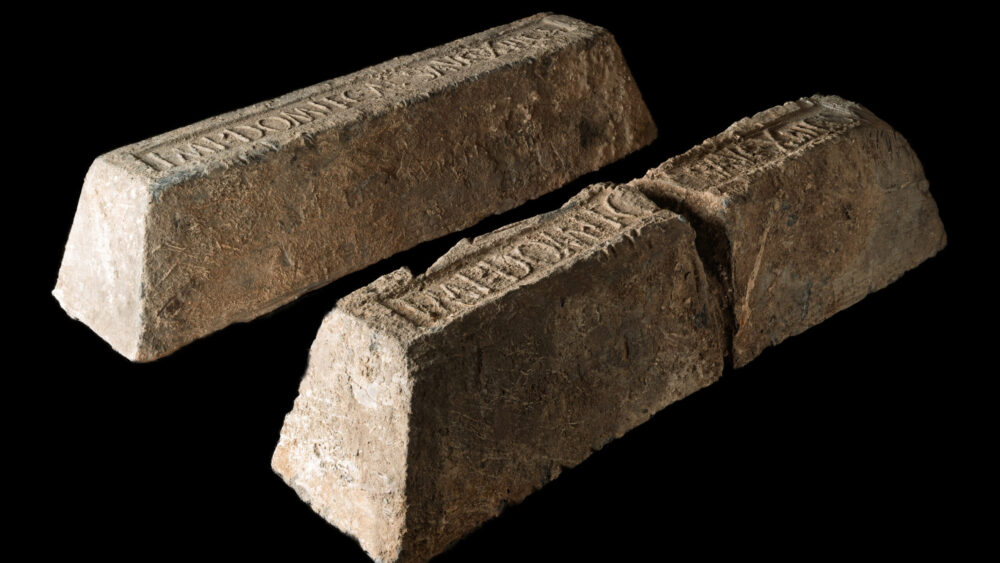
Two rare Roman lead ingots discovered in Ceredigion have been officially declared treasure, shedding new light on Wales’ industrial past under Roman rule.
The objects — known as lead “pigs” — were uncovered by metal detectorists in the Llangynfelyn area and are believed to date back almost 2,000 years.
Experts say inscriptions on the ingots point to a production date of AD 87, during the reign of Emperor Domitian.
The lettering referencing Domitian provides strong evidence that lead extraction was already underway in west Wales little more than a decade after the Roman conquest of the region in the mid-AD 70s.
The discovery marks the first time Roman lead pigs have been recorded in west Wales, giving the find particular archaeological significance.
The ingots were found by Nick Yallope and Peter Nicolas, who had permission from the landowner to search the site. The pair said they were delighted by the discovery.
Nick Yallope said: “I feel incredibly proud to have uncovered something so rare and important to our local heritage. Unlocking a new chapter of our area’s past is incredibly exciting.”
Peter Nicolas added: “I’m just trying to save history for the local community and future generations. I’ve always been very happy to donate my finds to the local museum for others to experience and enjoy.”
The ingots were recovered from grazing land at a depth of around half a metre and less than two metres apart. The land is owned by local farmer Geraint Jenkins.
Mr Jenkins said: “We were astonished when two local detectorists, Nick and Peter, who have permission to detect on our land, brought this discovery to our attention.
“Roman ingots are exceptionally rare and represent a tangible link to Wales’s Roman industrial past. Our priority is that the find is handled responsibly so its full historical, cultural and intrinsic value is properly understood and recognised.
“It’s remarkable to think that land we now farm organically once played a role in a much wider Roman landscape.”
Valuation
Under the Treasure Act process, the ingots have now been formally declared treasure. The next step will involve valuation and discussions with museums regarding possible acquisition and public display.
Carrie Canham, curator at Amgueddfa Ceredigion Museum, welcomed the find.
She said: “We are very excited at the prospect of acquiring these remarkable objects. Ceredigion’s rich mineral and ore deposits were a major reason the Romans sought to conquer this area.
“Lead mined here travelled across the breadth of the Roman Empire, and these lead pigs highlight Ceredigion’s significance in Emperor Domitian’s empire building.
“We plan to share this story in our new archaeology gallery opening in 2027, so the timing of this discovery could not be better.”
The find has also prompted renewed reminders to hobbyist detectorists about legal responsibilities.
Permission must be obtained before searching on private land, and any objects suspected to be treasure must be reported to the Portable Antiquities Scheme in Wales (PAS Cymru).
Support our Nation today
For the price of a cup of coffee a month you can help us create an independent, not-for-profit, national news service for the people of Wales, by the people of Wales.



Wales should have the same rights that apply in Scotland where anything declared as treasure trove belongs to the crown and goes to an ‘allocations panel’ appointed by their government. They decide on how it will be owned and displayed, usually in a Scottish museum. Unfortunately, here in Wales such finds come under the Treasure Act of England and Wales. So valuable cultural and national artifacts are auctioned off, usually snapped up by a London museum with lots of cash or private collector.
I’m a little surprised by that. I didn’t think the Romans had gotten that far west by AD87. Still the Dyfi was a navigable river and sheltered harbour. Seemingly the British roads (or “trackways” as the English archaeologists like to say) into Pennal were likely repurposed by the Romans.
I’m glad they will be displayed in a local museum