


Residents demand urgent action on city’s out-of-control tree roots
Ted Peskett, Local Democracy Reporter
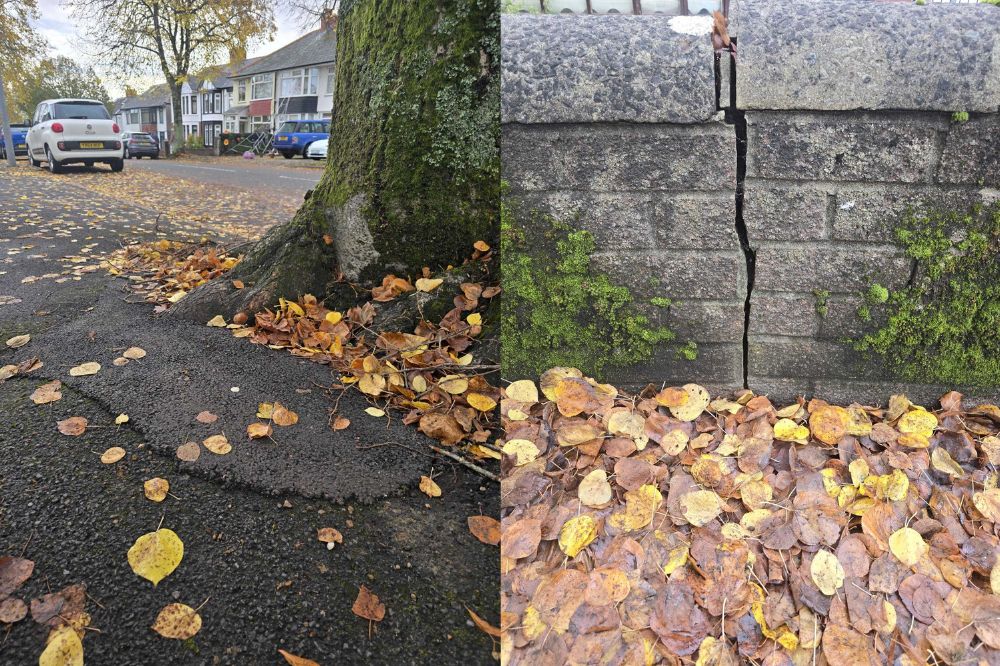
Out-of-control tree roots in a city street are causing pavements to warp and garden walls to crack.
Residents and a local councillor have complained to Cardiff Council about the current state of Bwlch Road in Fairwater and are demanding urgent action on the maintenance of trees there.
Cardiff Council said it has well-established procedures for managing trees in the city and in certain cases roots can be pushed back.
However it added this isn’t possible “without either damaging the tree or causing it to become dangerously unstable”.
Danger
A resident of Bwlch Road, John Parsons, said: “Some of us have lived in Bwlch Road for over 40 years and little has been done to maintain these trees; nothing in modern times.
“We love trees but they must be managed. They are now so large that they pose a danger.”
Chief among residents’ concerns are trip hazards caused by pavement and property damage, overgrown trees leaning on power lines and blocking sunlight, and the risk of serious injury.
However residents also claim there is a lack of leaf collection, road sweeping, and drain cleaning in Bwlch Road.
In response to concerns raised at a recent public meeting people living in the area have set up Tree Action Group (TAG).
Mr Parsons, who is also spokesman for TAG, added: “This campaign is about safety, accessibility, and protecting our homes.”
‘Worrying’
Cardiff Council ward member for Fairwater, Cllr Neil McEvoy, said: “It is worrying that the council continues to pour Tarmac over tree roots, weakening them and increasing risks during storms.
“Residents have been raising these issues for over 10 years with little meaningful action.
“The Tree Action Group will hold the council to account and is calling for safe, well-maintained trees suitable for Cardiff’s urban environment, protecting both residents and infrastructure.”
Cllr McEvoy and TAG are now urging the council to share its maintenance strategies, surveys, and risk assessments for Bwlch Road.
It is also demanding clarity on how tree conditions and risks are assessed citywide including how often inspections are carried out and what criteria are used to determine risk levels.
The group further requests details on actions currently being taken to address identified tree risks, particularly in residential areas such as Fairwater, and information on any tree maintenance work completed or planned for Bwlch Road during the past or current financial year.
Mitigation
Cllr McEvoy, who is also the leader of Propel at Cardiff Council, added: “We need a focus on risk with responsibility squarely placed on the council for mitigation.
“How many trees have fallen in Cardiff each year over the last 10 years?
“Have risk assessments, mitigation measures, or the risk register changed in that time?
“If incidents are rising but no proactive measures are taken public risk increases.
“Cardiff Council must be held accountable; this is essential to manage risks to properties and people and to prevent serious injury or worse.”
A council spokesman said: “The council has well-established procedures for managing its tree stock and follows a rigorous process involving detailed assessments undertaken by experienced, competent, and qualified tree inspectors and arborists.
“All street trees are inspected on a cyclical three-year basis or upon request where residents or local councillors contact the council with concerns about the condition, structural integrity, or health of a tree.
“The council does not prune or fell trees which encroach onto private land or block sunlight.
“However, under common law, residents may cut back any vegetation that crosses the boundary of their property, to the point of the boundary but no further.
“Council-owned trees will also not be pruned or felled because they are considered to be too big. A tree being considered ‘too big’ does not indicate it poses a risk.
“Where a council-owned tree is thought to be interfering with telephone wires residents are advised to contact British Telecom who own the lines. They may be able to suggest an alternative solution to reduce any interference being caused and, if not, a way leave grants BT the authority to prune council-owned trees if required.”
Tree preservation order
The spokesman continued: “Before carrying out any works to trees residents are advised check that the tree in question is not protected by a tree preservation order or located in a conservation area.
“If a resident believes that tree roots have damaged their property, they may make a claim for damage which can be submitted to the council’s insurance department with supporting evidence.
“If structural damage is confirmed the council will consider the information and respond accordingly on a case-by-case basis.
“Historically root barriers were not used when street trees were planted. This means that the roots of some mature trees can impact on highway infrastructure.
“In certain cases roots can be pruned back. However that is often not possible without either damaging the tree or causing it to become dangerously unstable.
“The council therefore focuses on minimising these issues.
“If slabs cannot be replaced effectively alternative solutions, such as using flexible materials like asphalt to cover the roots, are implemented to ensure the pavement remains accessible.
“Continual leaf fall throughout the autumn means it is not possible to keep streets entirely clear of leaves.
“However between October and December leaf fall is cleared bi-weekly and known flooding hotspots are also targeted to minimise any potential issues. Responsive leaf clearance also takes place where issues are raised by residents and local councillors.
“Well-managed trees provide significant benefits, helping clean the air we all breathe, providing important habitat for wildlife, absorbing carbon emissions, and making Cardiff a greener, more pleasant city to live in.
“The council is committed to increasing tree canopy cover through its successful Coed Caerdydd urban forest project, which has seen over 118,500 new trees planted in the last four years.”
Support our Nation today
For the price of a cup of coffee a month you can help us create an independent, not-for-profit, national news service for the people of Wales, by the people of Wales.



Total non-story and hot air from Neil