


Residents raise further concerns about toxic waste dumping highlighted in BBC documentary
Alec Doyle, Local Democracy Reporter
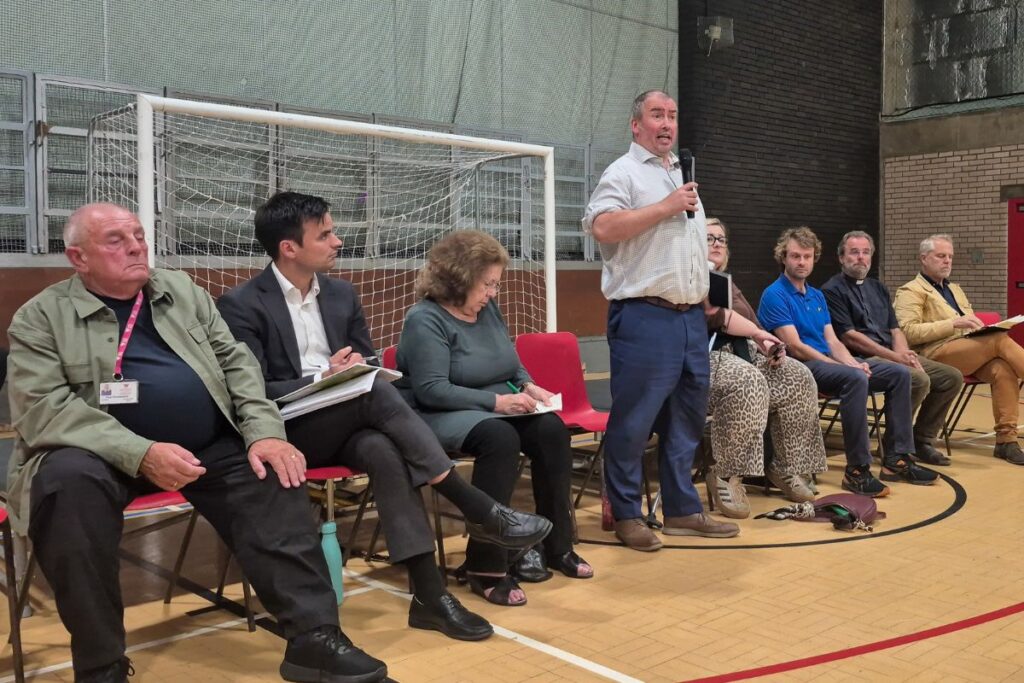
Around 160 residents concerned about the long-term effect of toxic waste dumping highlighted in a recent BBC documentary have come together to demand action.
At a meeting on Wednesday night members of the community living near Llwyneinion, Ruabon, Cefn Mawr, Trevor and Acrefair spoke with Montgomeryshire and Glyndŵr MP Steve Witherden, community councillors and legal representatives.
They wanted to know how the data revealed in Michael Sheen’s Buried documentary on forever chemicals could be used to get companies which knowingly dumped dangerous chemicals with long-term health impacts in their communities to clean up their mess.
The documentary focused on the historic dumping of chemicals including Polychlorinated Biphenyls (PCBs) – a known carcinogen which is slow to break down and poisons its environment – carried out by Monsanto in these areas from 1950 to 1980.
Other companies are believed to have also disposed of harmful waste in quarries, pools and farmland in Wrexham, with some sites now only remembered by a few people.
Mr Witherden said that the first step was to carry out more testing to find out exactly how contaminated the land in Wrexham is.
“The meeting revealed many sites where not only has testing not been carried out but also that there are many more sites that people remember being used for dumping waste that have been filled in and grassed over or flooded around Wrexham,” he said.
“I’ve been involved in trying to raise awareness and get action on this since I was elected. I’ve had multiple meetings with Natural Resources Wales about this. I’ve written multiple letters to Wrexham Council, I’ve raised it about half a dozen times at the Welsh Affairs Select Committee and it’s been very, very difficult for me and for others to get movement on this.
“Now the community has hope. Thanks to the documentary there is now a belief that by working together and getting organised we can finally get something done about a problem that continues to affect generations of people.”
Industrial disease claims
The group heard from solicitors Leigh Day – who specialise in industrial disease claims – about the ‘polluter pays’ principle, an established pat of environmental law where the company responsible for pollution covers the cost of remediation.
But before that Mr Witherden said that NRW and Wrexham Council needed to commit to more testing.
“The truth is we have known sites where little or no testing is going on and anecdotal sites which have never been tested to prove whether PCBs or other nasty chemicals are present,” he said. “So we cannot understand the scale of the problem or which companies were behind it.
“Even on the actual Monsanto site in Ruabon NRW is only testing in one specific location. The one site where there has been a lot of testing is Llwyneinion Acid Tar Lagoon.
“We know what is in there – PCBs, cyanide, arsenic etc. But there are two other sites near Llwyneinion – a woodland and a quarry – where testing needs to be carried out.
“What we need is for NRW to commit to testing the whole of every known site and to carry out investigations into reported sites. That will give us a starting point.
“It’s not just about testing the land. My feelings are that we also need blood testing and water testing.”
Asked how NRW, which has faced well-publicised financial pressures, could afford to carry out a more in-depth testing programme, Mr Witherden was clear.
“What is the cost of not testing he responded. “One of the really stark things about the documentary was where they were talking about cancer cases in our area and the higher than average levels.
“What’s the price of not addressing this for future generations? Of not finding out what’s in our communities and how dangerous it is?”
More testing
In response to the calls for more testing an NRW spokesperson said: “We understand that local people have concerns about historic waste sites and we take reports of pollution seriously.
“Under contaminated land legislation, local authorities are responsible for identifying and assessing potential contaminated land within their areas.
“These sites have not been designated as Special Sites for regulation by Natural Resources Wales. Responsibility therefore remains with Wrexham County Borough Council as regulator.
“We understand the council continues to carry out monitoring and inspections at the lagoon and is the appropriate body to consider any requests for further site investigations or testing.
“We will consider any new information shared with us by the local authority and, where appropriate, assess whether any further action is required in line with our regulatory responsibilities.
“We recognise that the BBC documentary has generated interest in historic waste sites across Wales. We remain committed to working with local authorities, Public Health Wales, Welsh Government, and other partners where appropriate, and we welcome the Welsh Government’s commitment to develop a Wales-wide approach to addressing the legacy of post-industrial land.”
Support our Nation today
For the price of a cup of coffee a month you can help us create an independent, not-for-profit, national news service for the people of Wales, by the people of Wales.
Get more trusted Welsh news
Choose Nation.Cymru as a preferred source in Google News to see more of our journalism.




Baffling that central government can find £6m to deal with a bit of fly tipping near Oxford but nothing to clean up some of the most toxic substances in existence. Arguably PCBs are worse than some radioactive waste because they never degrade and they become more concentrated as they enter and move up the food chain.