


Road crossings should allow more time for older pedestrians, researchers say
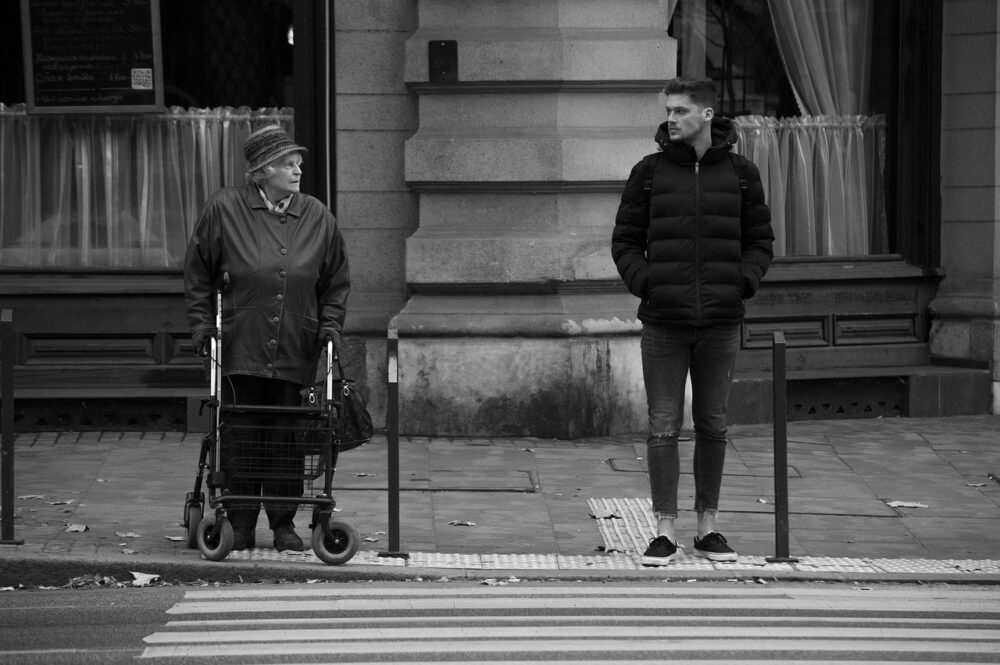
Pedestrian crossings should allow more time so people with mobility issues and older pedestrians can safely use them, researchers have said.
A study by the universities of Bath, Birmingham and Exeter found the time interval of crossings in the UK is more than two seconds shorter than some people need.
The research found just 1.5% of older adults with mobility issues walk fast enough at their comfortable speed to cross the road within the time normally allowed by pedestrian signals.
During the study, the walking speeds of 1,110 adults aged 65 and over were analysed.
Their average walking speed was 0.77 metres per second, well below the 1.2 metres per second assumed by most pedestrian crossing designs.
This means the average participant from the study would take 6.5 seconds to cross a five-metre road – more than two seconds longer than what the green crossing signal typically allows.
Dr Max Western, from the University of Bath’s Centre for Motivation and Behaviour Change, said: “Current crossing times might be unrealistic for many older people who face challenges with their mobility.
“This isn’t just a safety issue – it’s potentially a barrier to independence, physical activity, and social connection, all of which often decline in later life.”
The study found older age, lower strength and balance are associated with slower walking speeds.
More than half of participants would need to increase their comfortable walking speed by 50% or more to cross an average road safely, researchers said.
Reduced mobility
Professor Afroditi Stathi, from the University of Birmingham, added: “Older adults often face challenges staying active and connected, especially when mobility is reduced.
“Designing outdoor spaces that work for everyone – such as allowing enough time to cross the road – can boost confidence, support independence, and help them remain engaged in their communities – all key to a better quality of life.”
The researchers said adjusting crossing times to reflect a walking speed of 0.7 metres per second, which would allow more people to cross safely and confidently.
Their paper, Why Didn’t The Senior Citizen Cross The Road? Gait Speed In Community-Dwelling Older Adults With Mobility Limitations Relative To Pedestrian Crossing Times, is published in Age and Ageing on Monday.
Support our Nation today
For the price of a cup of coffee a month you can help us create an independent, not-for-profit, national news service for the people of Wales, by the people of Wales.


Reform to introduce a minimum speed limit on road crossings…
What needs to happen is more of a yellow signal, so traffic can cautiously cross after the pedestrians have crossed or perhaps they abandoned and headed elsewhere, leaving the lights on red. It’s annoying sure, but I definitely support (as a driver) giving anyone more time to cross.
I make sure that they’re well clear of me before I start moving anyway and if they’re coming towards me I don’t move traffic light or no traffic light.
Pressing the button twice could give extra time.
What pedestrian crossings really need are cameras on them so that drivers who fail to stop can be prosecuted for dangerous driving. As a pedestrian who regularly walks to work I experience such dangerous driving almost daily.
All signal-controlled junctions in Cymru are over-engineered, over-specified and energy-hungry. Reform should see energy savings of at least 25%, fewer light standards and displays, longer intervals (with a countdown where appropriate), faster responses and audible signals for pedestrians (with a countdown at inner city crossings) and secondary displays at lower levels for cyclists in urban locations.
Roundabouts should prioritised where space is available. But pedestrians need a better deal with less circuitous crossings.
Many newer pedestrian crossings have sensors observing the crossing, and will extend the pedestrian phase if they detect a person in the crossing, giving more time to cross for those that need it.
One example, if you want to observe this in action, is the crossing outside the college of music and drama in Cardiff. There are many others, but this is one that I remember seeing in action extending its pedestrian phase to allow a slower walker to cross comfortably.