


Senedd backs business rates revamp
Chris Haines, ICNN Senedd reporter
The Senedd has rubber stamped plans to cut business rates for about 13,000 smaller high-street shops in Wales while raising the amount payable for higher-value properties.
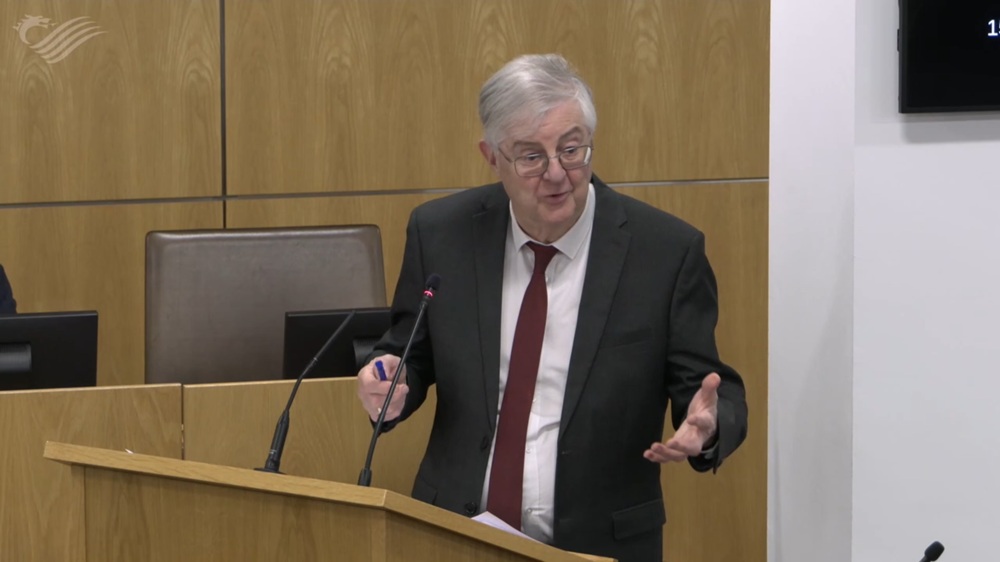
Finance secretary Mark Drakeford brought forward regulations to adjust the multipliers for business rates – officially known as non-domestic rates – for the first time from April 2026.
The Welsh Government will introduce a lower multiplier – a key determinant of bills – for smaller shops, kiosks, pharmacies and post offices with a rateable value below £51,000.
To offset the revenue lost from “bricks-and-mortar” shops, a higher multiplier will apply to about 3,200 bigger properties with rateable values of more than £100,000.
The higher multiplier would not apply to properties occupied by the public sector, including hospitals, surgeries, schools, colleges, museums, universities, courts and police stations.
But a consultation document warned it would not be possible to exclude more generic property types, such as office buildings occupied by public services.
‘Unique challenges’
The value of the retail and higher multipliers will be set by ministers in separate regulations, taking into account a revaluation of non-domestic rates which is yet to be concluded.
Prof Drakeford said more than half of business rate payers in Wales already benefit from £250m in permanent reliefs.
He told the Senedd: “A lower retail multiplier will be introduced to rebalance the non-domestic rates system in favour of small-to-medium-sized shops.
“This reflects the unique challenges faced by bricks-and-mortar retail shops – not least through their exposure to competition from online retailers.”
Heledd Fychan, Plaid Cymru’s shadow finance secretary, agreed with the need to tailor multipliers to relieve the tax burden on smaller, domestic businesses. She encouraged ministers to go further by including restaurants and pubs in the lower multiplier.
Ms Fychan reiterated her party’s calls for a vacant land tax in an effort to revive high streets, with the UK Government so far resisting calls for further powers to do so.
‘Status quo’
Prof Drakeford agreed: “There will be scope to do more… in future. To be clear, what these regulations do is to lay the scope for the use of these powers for the next financial year.
“The choice in front of the Senedd is not between this or more extensive use of the powers – it’s between this and staying with the status quo and there will be no further opportunity to vote on wider use of these powers later in this Senedd term.”
Senedd members unanimously backed the regulations.
Different systems already exist elsewhere in the UK.
In England, a lower multiplier applies to properties with rateable values under £51,000, and further lower multipliers for retail, leisure and hospitality properties are on the horizon.
According to the consultation document, the UK Government also plans to introduce a higher multiplier for properties with rateable values of £500,000 and above in 2026/27.
Scotland sets three differential multipliers and in Northern Ireland, a central rate is supplemented by a rate set by each district council.
Support our Nation today
For the price of a cup of coffee a month you can help us create an independent, not-for-profit, national news service for the people of Wales, by the people of Wales.



This is a sensible move, but won’t put UK retailers such as Marks and Spencer’s on a level playing field with the internet retailers who have tax breaks / sell products often at higher prices above / cause pollution with next day deliveries. I continue to be concerned that the local authorities have too much money and are not focused on economic development. Wales pension funds for public sector staff are valued at £25 billion. https://www.gov.uk/government/news/25-billion-powered-wales-pension-partnership-pool-to-deliver-growth-and-jobs-for-wales There are shortages of affordable accommodation across Wales and empty shops in central Swansea, Rhyl, Newport, Port Talbot, Machynlleth etc at locations within ten… Read more »
That’s a brilliant idea a vacant land tax, an example of how elected officials grasp at straws to balance the books of a small country after spending monies planting a million trees in some far off land and other give aways of public finances that should have been used within Wales.
Land banking blights communities.
Everything that Dripford touches turns to s–t
Beware of Greeks bearing gifts ( particularly a Drakeford one), a lot of small shops get relief now , I suspect the overall result will be yes in theory small shops with smaller multipliers or rateable values but they will end up paying much more than they do now .
Correct me if I am wrong, but wasn’t it Drakeford who removed the help afforded to businesses in the form of reduced rates after Covid ? whilst other countries in the UK continued to keep their rates lower.
The removal of the lower rates forced many Welsh businesses to become unviable and they folded.
Now out of the blue the same person who caused those Businesses to fail, has a bright idea to help businesses by lowering rates for them.
I know as you get old your memory starts to fail, but Mark Drakefords is selective.
Perhaps some businesses could choose between a fixed and a variable option, with the latter linked to turnover to help them survive downturns.