


Senedd backs calls for a ‘polluter-pays’ principle in dealing with contaminated land
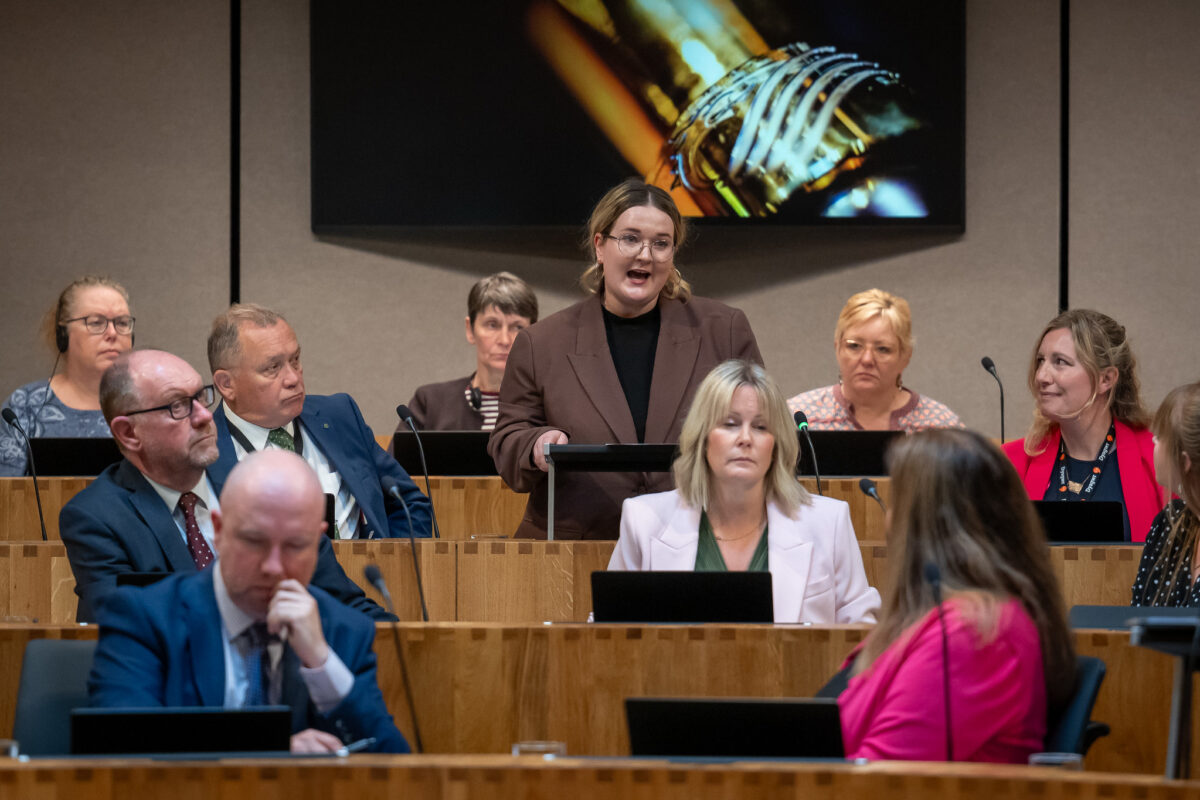
Ella Groves, ICNN Senedd Reporter
“Communities should not be left carrying the consequences of pollution they did not cause”, a Plaid Cymru MS has declared – as the Senedd backed calls for a national testing framework to look into potentially thousands of contaminated sites across Wales.
Blaenau Gwent Caerffili Rhymni MS Niamh Salkeld led a debate on the issue, a day after Caerphilly Council backed calls for a national inquiry into potentially contaminated land.
Ms Salkeld said: “Toxic substances left behind by historic industrial activity can remain in our ground for decades after that activity has ended, and in the case of some chemicals, they can be in our ground for generations.”
She said the consequences of contaminated land can spread further than the disposal site, potentially harming human and animal health and the wider environment.
She said research by Friends of the Earth Cymru identified more than 45,000 potentially contaminated land sites across Wales.
Ms Salkeld also questioned who should pay for the damage.
“The principle of ‘polluters pay’ should be at the heart of this approach,” she said. “Where the person or the company responsible for pollution can be identified and held responsible, they should contribute towards the costs of putting it right.”
But she acknowledged historical contamination cases are not straightforward, and noted the motion calls on the UK Government to introduce a dedicated funding mechanism for cases where the costs cannot be recovered.
“Poisonous chemicals”
Fellow Plaid Cymru MS Elwyn Vaughan, who worked closely with Ms Salkeld on bringing forward the debate, discussed the role of “agricultural giant” Monsanto.
He told members that Monsanto entered into partnership with Graesser’s chemical works at Cefn Mawr in 1919 to produce vanillin, salicylic acid, aspirin and later, rubber-processing chemicals.
He added the site was later operated by Flexsys, a subsidiary of Monsanto spin-off firm Solutia – but production ceased in 2010.
Mr Vaughan said: “The alleged dumping of PCBs, poisonous chemicals that do not break down but build up in the environment, animals, fish, and humans over time, are widespread.
“These chemicals were dumped in 12 known sites across Wales, including in Ruabon, Cefn Mawr and the infamous Llwyneinion acid tar lagoon near Rhosllanerchrugog.”
The Gwynedd Maldwyn MS said evidence gathered by campaigners and experts claims PCBs may have been responsible for spikes in rare cancers in those areas.
He added: “At the end of the day, it’s about people, about their and our environment. It’s about the potential threats on them, their families, children and future generations.”
“Straightforward answers”
Reform’s Andrew Griffin echoed Mr Vaughan’s comments and said: “Close to the north-eastern border of my constituency […] near Rhos, Cefn Mawr, Acrefair and Ruabon, is the former Monsanto chemical waste tip.
“This is not rumour or local folklore. Parliamentary records confirm that Monsanto chemicals were deposited there in 1964 and 1965”.
He said Wrexham Council has investigated the sites and maintain that while contaminants are present, the sites do not meet the legal definition of contaminated land.
Mr Griffin continued: “If you live close to somewhere like this, you want straightforward answers. What is in the ground? Is it getting out? Is there any risk to my family or my home, and if there is a problem, who is going to do something about it?”
He also echoed Ms Salkeld’s concerns surrounding payment, adding: “The fact that pollution is old doesn’t make it any less real.
“And it isn’t reasonable to leave one council and its council tax payers facing an enormous bill simply because the original polluter can no longer be pursued.”
“Stronger stance”
Conservative MS Janet Finch-Saunders demanded a “stronger stance” is taken against “illegal dumping that contaminates our land and threatens our natural environment”.
Ms Finch-Saunders suggested that often fines “aren’t enough”, with polluters simply adding it on as a business cost because “they make more money doing what they do than the cost of a fine”.
She called for a clear message to be sent out, adding: “You pollute our land in Wales and you will pay”.
“Committed”
Responding to the debate, rural resilience minister Llyr Gruffydd insisted the Welsh Government is “committed to ensuring real fairness for those most affected by our industrial past”.
He said: “Across Wales, far too many communities continue to live with the legacy of environmental degradation and damage.
“From old opencast mines and unsafe coal tips to historic waste sites, these sites not only pose potential risks to people and the environment, but also, of course, prevent economic regeneration and growth.”
Mr Gruffydd stressed the government wants to reduce “any potential harm” as a main priority, these problems could also bring opportunities.
He added: “Dealing with these sites may require new and innovative remedial techniques. This could require new research, manufacturing and job creation opportunities with specific skills.
“We shouldn’t see all of this as some implacable barrier; I’m keen to explore all options to move forward on this complex issue, and to do that on more than one level.”
The minister also agreed with the polluter-pays principle at the heart of the motion, describing it as an “important safeguard for communities and taxpayers” and an “essential part of delivering environmental justice”.
The motion was passed with no objections.
Support our Nation today
For the price of a cup of coffee a month you can help us create an independent, not-for-profit, national news service for the people of Wales, by the people of Wales.
Get more trusted Welsh news
Choose Nation.Cymru as a preferred source in Google News to see more of our journalism.



I mean yes, obviously. Going forward. But what if the polluter has gone out of business? Or died? Does that mean the burden will be passed to the community? Or the subsequent owner who may blameless but inherits the mess?
What if, say, Port Talbot Steelworks sells off some of its heavily contaminated land to another developer for, say housing or business? Who then holds responsibility for ground remediation and pollution events that may happen a a result?
It’s a really strange debate because there’s already laws about this. Reading the article makes me realise we have some incredibly inexperienced, maybe naive , people in the senedd. If you have a limited company and it becomes insolvent, then you can’t pass this cost onto the shareholders or directors. That’s pretty fundamental to the way we do business in the UK. So it’s always a public who becomes responsible for the cleanup. The steel works point is really interesting. Up north, if you ever get a chance to see the old Shotton works – which is long closed as… Read more »
And councils and quangos can rarely enforce environmental laws because they’re so underfunded
Does anyone have an idea why Rhun ignored and turned down the meeting with Michael Sheen about this case?
A very brave or stupid move on Rhun’s behalf. Michael is a Welsh hero, they’d be insane to ignore him.
Just do it.
There is a swathe of toxic sites where the original pollutants were in the 19 thc and a toxic pile on ever since including Councils
£000ms to clean up and sounds like £000ms of legal costs incurred trying to pin the tail on the donkey