


Senedd constituencies to be redrawn again under new rules
Mark Mansfield
Wales’ 16 Senedd constituencies are to be reviewed again less than four months after they were used for the first time in an election.
The Democracy and Boundary Commission Cymru has launched the process of drawing the constituency map that will be used at the next Senedd election in 2030, with initial proposals expected early next year.
Unlike the boundaries used in May’s election, the new constituencies will not have to be formed by pairing Westminster seats, giving the Commission greater flexibility over where the boundaries are drawn.
Instead, each constituency will generally have to contain an electorate within 10% of the average across Wales.
The Commission will also take account of local government boundaries, geography and local ties, while being required to minimise unnecessary change.
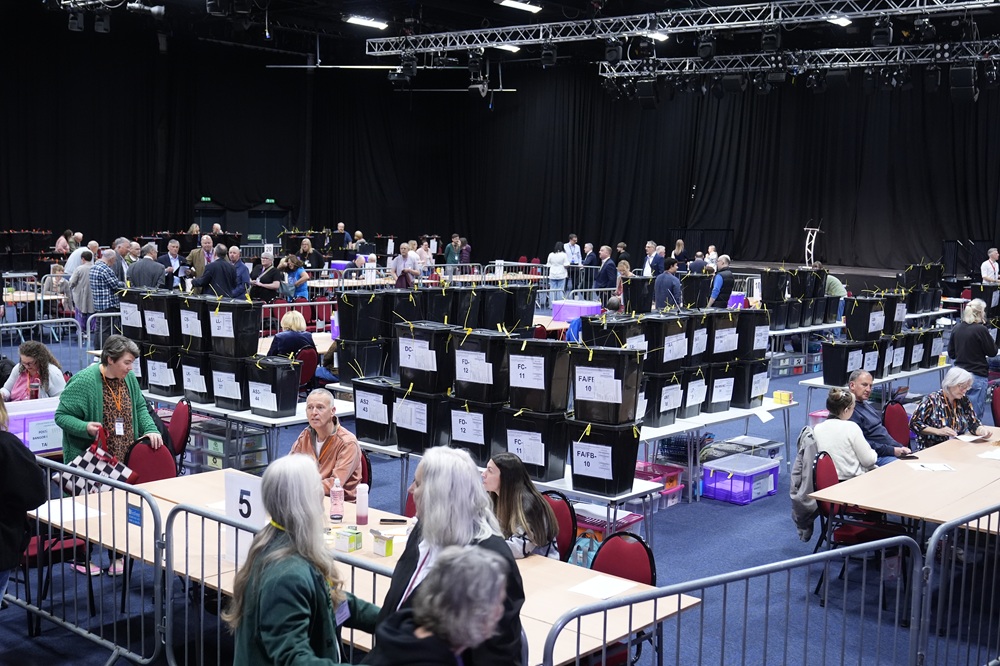
The review follows the biggest overhaul of Senedd elections since devolution.
May’s election was the first to use 16 six-member constituencies, replacing the previous system of 40 constituencies and five electoral regions.
It was also the first election for an expanded 96-member Senedd and the first conducted using closed-list proportional representation.
The boundaries used in May had to be created by pairing Wales’ 32 Westminster constituencies, meaning the Commission had considerably less freedom over their shape than it will have during the new review.
The election produced a dramatically changed Senedd, with 66 of the 96 MSs elected having never previously served in the institution.
Plaid Cymru won 43 seats with 35.4% of the vote, while Reform UK secured 34 with 29.3%. Together, the two parties hold 77 of the 96 seats.
Labour, which had been the largest party after every previous Senedd election, was reduced to nine seats after receiving 11.1% of the vote.
Turnout also exceeded 50% for the first time at a Senedd election, reaching 51.7%.
The Commission’s new review will retain 16 constituencies, each electing six MSs, but their boundaries could change significantly because of the different rules.
It will also be responsible for deciding their names.
Under the legislation, constituencies should have a single-language name unless the Commission considers that would be unacceptable. All 16 current constituencies have single names.
Consultation
The review will include three rounds of public consultation.
Initial proposals are due in early 2027 and will be followed by an eight-week consultation.
The responses will then be published ahead of a second consultation, during which people will be able to support or challenge submissions made during the first round. Public hearings will also be held.
If the Commission subsequently changes its proposals, revised boundaries will be subject to a further four-week consultation.
Final determinations must be submitted to Welsh ministers before December 1, 2028, with the new boundaries coming into force for the 2030 election.
Public feedback
Shereen Williams, chief executive of the Democracy and Boundary Commission Cymru, said: “The Commission is looking forward to holding a full review for the Senedd’s constituencies, with a greater opportunity for people to share their views and impact the proposals.
“Whenever the Commission holds a review, the public’s feedback, especially on their local area, is vital to making sure our determinations are the strongest possible.
“The move from pairing parliamentary constituencies to using an electoral quota does mean that some changes will be necessary at this review, but it also gives us an opportunity to respond with greater flexibility to the public’s views, while ensuring that we minimise changes wherever we can.”
Support our Nation today
For the price of a cup of coffee a month you can help us create an independent, not-for-profit, national news service for the people of Wales, by the people of Wales.
Get more trusted Welsh news
Choose Nation.Cymru as a preferred source in Google News to see more of our journalism.



Simple solution. (a) Use the existing 32 constituencies currently used for Westminster elections, and (b) elect 3 MSs per constituency via Single Transferable Vote system.
3 members is not enough of a spread for PR to work properly.
Not true. Ireland elects by STV and many constituencies have only three TDs. There is however, urban mega-constituencies in major cities like Dublin and Cork which have five. The way it works is explained here.
https://www.youtube.com/watch?v=YLz9c4sU_vM
The system tends to eliminate ‘piggy backing’ where an unpopular candidate gets in because they just happen to be a member of the same party as a popular candidate.
It is incorrect to give the impression that 5-seaters are rare in non-urban Ireland. The main criterion at play is a preference not to breach county boundaries, so highly rural counties like Kerry and Donegal can be represented by two 3-seaters or one 5-seater, depending on county population relative to the total. My personal opinion is that 32 3-seaters for Cymru would not be sufficiently proportional, even with STV.
Why should we define our constituencies based on what England decides the boundaries are?
It isn’t. The boundaries of the constituencies for the Westminster elections in Wales was, and is, decided by the Boundary Commission for Wales, the same body as that for the Senedd arrangements. The only dictate from England was that each constituency need be as close as possible to 74,000 voters.
That would give you a much less representative system and would especially penalise the smaller parties, STV works best in large constituencies with a high number of members.
Hopefully they’ll separate Carmarthen from Llanelli! Polar opposites politically and ‘Reformers’ make unpleasant bedfellows!
I think that’s called geremandering
The Reformers got in from Llanelli because Plaid Cymru has not yet fully recovered for an act of self-immolation a few years ago. Both seats have been held by Plaid Cymru in the past. Can do so in the future. Most recently they’ve recovered themselves in Llangennech.
A reasonable approach would be to use the traditional division into Cantrefi which were used in Wales before the imposition of the shire system. Historically there were circa 100 Cantrefi, with a few adjustments these could fit modern populations.
They would have vastly different populations, some would have over 100,000 people while others would have under 5000.
Any chance of introducing the much more transparent STV – rather than the ‘closed list monstrosity we currently have – by 2030 as well?
Very unlikely. It was hard enough to get PR through. 90% of people don’t bother looking at the candidate anyway. So if you want a choice of candidate, sign up to the political party.
STV please!
A very sensible solution. There’s no reason for Senedd constituencies to be tied to Westminster. Hopefully they’ll introduce STV at the next election as well.
Good luck scratching your heads, staring at the turnout figures and wondering why participation keeps sliding. We’ve only just gotten used to the set-up we have now. If it ain’t broke don’t fix it.
Participation isn’t sliding, turnout has risen at the last three Senedd elections and this year’s turnout was a record high.
The reason why people lost faith with FPTP is because the politicians kept tinkering with it leading to the feeling that their vote didn’t count and would never count even if feelings changed in their community.
PR or STV has the same risk, if politicians keep interfering there is a high chance it will ‘start’ back sliding, even if it hasn’t done so yet. Also 50%ish turn out is still not exactly a hill you want to die on. Where the heck are the other 40%?
I’m happy to look at proposals. Though honestly… I’d much prefer UK seats to mirror Welsh Senedd seats than the other way around. The timing being so early is… irksome and has the smell of political interference. Any commenting without the proposals seems to be a bit premature. Others seem to be asking for another voting format change to STV and while I agree with this in my heart, it’s much too soon for that. We’ve just switched to PR that will need to settle in first. I believe it has worked out reasonably well so far giving results that… Read more »