


Sensors fail to register landfill smells making residents’ lives a misery
Alec Doyle, Local Democracy Reporter
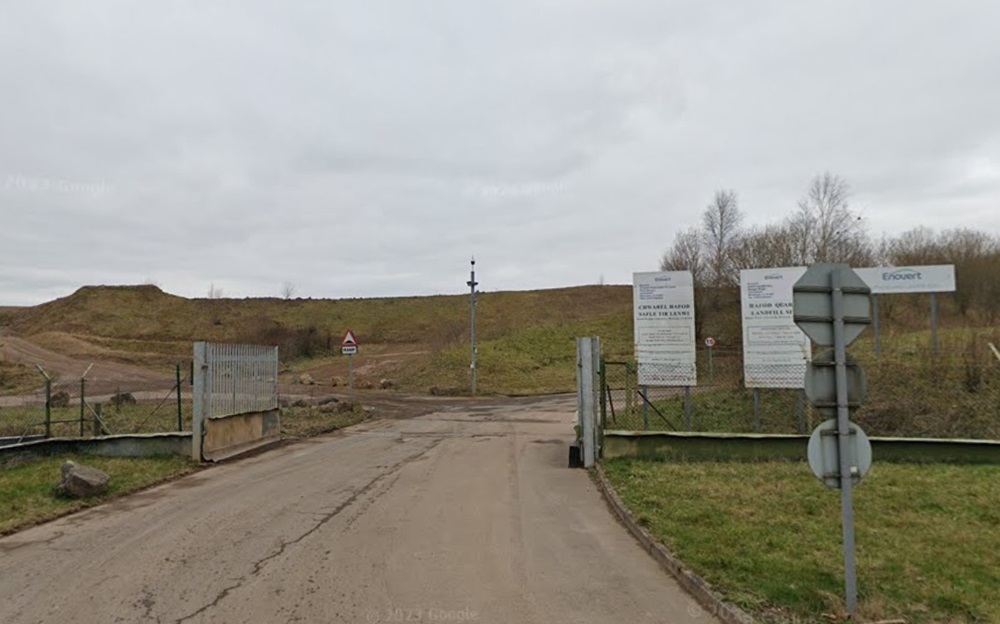
Residents enduring persistent smells from a landfill have been told that sensors installed to monitor the problem cannot reliably detect the gas at levels that cause a nuisance.
The monitors around Hafod landfill, near Wrexham, cannot accurately measure hydrogen sulphide below eight parts per billion, although unpleasant odours can be noticeable at lower levels.
Campaigner Steve Gittins has questioned their usefulness after obtaining correspondence from the firm responsible for calibrating them.
Wrexham Council says the sensors still provide valuable information and were never intended to test compliance with regulatory standards.
The gas, which is generated as waste breaks down, creates an unpleasant smell. Hydrogen sulphide levels of just one part per billion (ppb) create a smell that humans can detect. When levels reach 5ppb the odour is clearly noticeable.
Campaigner Steve Gittins has now revealed correspondence between himself and Geotechnology – the firm responsible for calibrating the AQMesh monitors – showing that the sensors cannot detect anything below 8ppb.
An excerpt from the letter explains: “The value of 8ppb should not be used as an air quality benchmark or threshold metric. The 8ppb value only specifically relates to the effective detection limit of the AQMesh Pods.
“At no point is this value presented as a value that should be used for assessing air quality.
“Concentrations falling below 8ppb have increasing levels of uncertainty. This is why the pods are not suited for compliance monitoring.”
‘Pointless’
Mr Gittins said he believes this makes the AQMesh monitoring pointless.
“I couldn’t believe it,” he said. “It was a clear admission that the sensors cannot accurately measure levels of odorous gas that are impacting residents’ lives.
“These sensors were supposed to be part of how we held the site operators to account over nuisance smells coming from the landfill site – to help us monitor and address concerns over the persistent smells that have had such an impact on the area.
“Yet they cannot detect the very thing we have been complaining about until the level far exceeds nuisance levels.
“The local authority needs to rethink community monitoring to ensure it is actually capturing relevant data. If residents are experiencing nuisance odours and the data gives the impression they are not then what is the point?”
A spokesperson for Wrexham Council admitted the AQMesh pods were not able to measure below 8ppb – but said they were never intended to.
‘Indicative monitoring’
“The AQMesh units installed in the communities around Hafod were never intended to act as regulatory compliance monitors,” they said. “They provide community‑level indicative monitoring, which is exactly what they are designed for.
“It is correct that the practical limit of accuracy for hydrogen sulphide is around 8ppb. This has been established following calibration work undertaken in line with the manufacturer’s recommendations.
“Odour annoyance can occur at lower levels, typically around 5ppb, but no commercially available community sensor can reliably measure at those concentrations.
“This is a limitation of current technology rather than a limitation of the council’s approach. The AQMesh network still provides valuable information on trends, peaks and correlations with community reports.
“The council does not agree that the monitoring is ineffective. It provides continuous real‑time data and combined with other information it helps us understand when and where odour episodes occur. We keep our monitoring arrangements under review, and if new technology becomes available that can reliably measure at the very low odour‑threshold levels, we will consider it.
“For context, the World Health Organisation’s (WHO) odour‑annoyance threshold is around 5ppb. WHO has not set a health‑based ambient guideline for hydrogen sulphide, and clear health effects begin at concentrations thousands of times higher than those associated with odour.
“Community monitoring serves its intended purpose – helping us understand nuisance odour, which is distinct from health risk.
“It’s important to note that while there may be no evidence of a health risk, we fully recognise there are negative impacts on residents as a result of odours from time to time, and the council is working hard and beyond any statutory requirement to support all agencies in improving the lives of residents.”
Support our Nation today
For the price of a cup of coffee a month you can help us create an independent, not-for-profit, national news service for the people of Wales, by the people of Wales.
Get more trusted Welsh news
Choose Nation.Cymru as a preferred source in Google News to see more of our journalism.



If there is an odour then that should be enough.
Where are these sensors located. In order to reach residents at 5ppb the gas must be well over 8ppb close to the source.