


Solar power will generate over £2 million for council this year
Alec Doyle, Local democracy reporter
Solar power will generate over £2.2 million in revenue for a north Wales council this year.
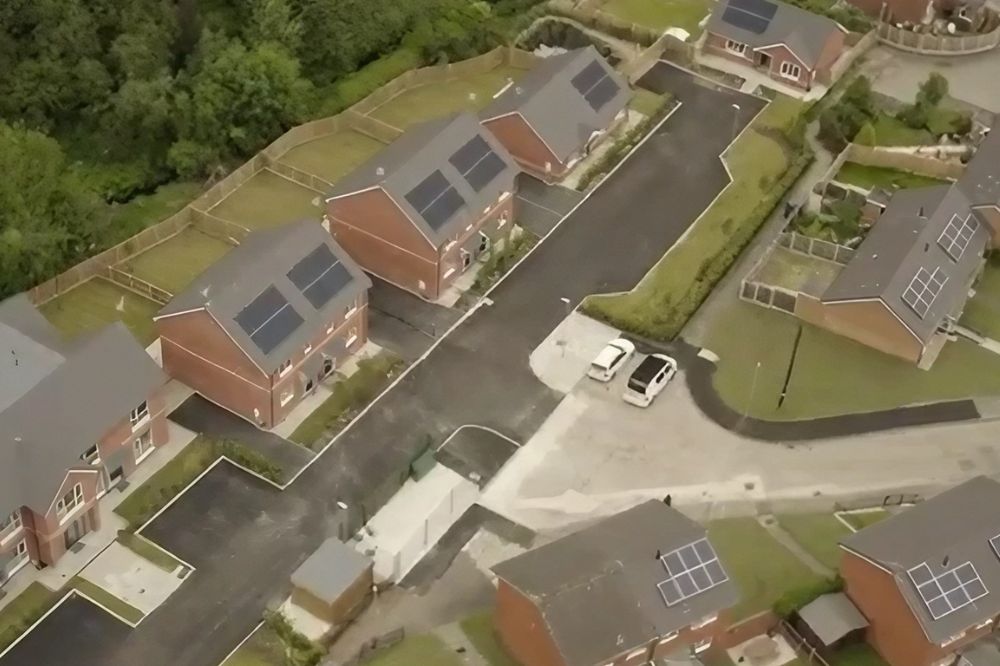
The boost – a result of Wrexham Council’s strategy of installing solar on all new-build social housing – comes as it wrestles with a £2.9 million financial deficit.
After social housing rent, income from the feed-in tariff – where excess solar energy is sold back to the National Grid – was the second-biggest revenue generator for Wrexham Council’s Housing Revenue Account.
By the end of 2025/26 it will have generated around £2.2 million for the authority, eclipsing the annual income earned from garage rentals, traveller plots and warden fees which is just under £1.2m for 2025/26.
Lead member for Housing and Deputy Leader of Wrexham Council Cllr David Bithell said the authority was now looking at increasing its solar power generation to boost revenue further.
“It’s generating quite a significant income per year,” he said. “Every new property we build now, we put solar on.
“Obviously there’s a cost to setting it up so we need to conduct feasibility studies and ensure we are getting value for money.”
Previous studies saws the authority prioritise south-facing homes and buildings for solar to maximise revenues. The latest photovoltaic cells – or solar panels – are much more efficient and do not have to be south facing to generate reliable power.
Cllr Bithell also confirmed the authority was looking at opportunities to retro-fit solar to some properties – and it has recently published a tender for works to install solar at its Lambpit Street, Wrexham Library and Wrexham Guildhall buildings worth £100,000.
“We are still focusing work mostly on newer builds where properties have already been modernised,” said Cllr Bithell. “Those are the most cost-effective installs.
“But we do look at the the stock condition surveys of the properties as well. If we can install solar, we will because it’s income for us. So if we can maximise that, why wouldn’t we do it?”
The benefits of solar come at a time when Wrexham Council finds itself once more wrestling with a financial deficit.
The latest revenue report to go before the council’s Executive Board this week showed that savings found between October and December had reduced the authority’s financial deficit from £4.6m to £2.9m.
“We’ve had improvements across some of our forecast areas,” said Chief Officer for Finance Richard Weigh. “For example the school transport forecast is better, the education placements forecast is better but we’ve seen an increase in demand in children’s services that’s offset some of that.
“Overall the bottom‑line position is better than it was in quarter two. Every council in Wales has got pressures over the same things. The extent of those pressures just varies between authority.”
Wrexham Council Leader Cllr Mark Pritchard said that council departments were still looking to bridge the gap through efficiencies and potential grant funding for specific departments.
He added that he was reluctant to commit to using the council’s reserves to bridge the deficit.
“I’m really pleased with the work that everybody’s done from the officers, the senior strategic team and ourselves, the lead members and all members for helping and supporting get the budgets in,” he said.
“I don’t know what will happen in quarter four. Out of county placements, pressure on school transport, they’re live, they’re real, it happens. We’ll see what the forecast brings.
“I don’t like using reserves to fund a deficit. If we have to use reserves, we would have to use them. That’s just the position we’re in. But you can only use them once and it’s not very good financial planning.”
He also repeated his plea to Welsh Government to deliver multi-year financial settlements to help authorities manage their budgets more strategically when facing unpredictable statutory costs such as social services and out of county placements.
“We were really pleased with extra money we received from Welsh Government in next year’s Revenue Support Grant,” he said, “It wasn’t everything we wanted, it was only 50%.
“I believe that there will be a new administration after the Senedd elections – what that administration will be made up of, I don’t know. We’ve already had meetings with the Welsh Local Government Association to discuss how we make representation very early to the new administration on funding local authorities across Wales appropriately.
“Let’s hope that they give us a multi‑year settlement over three years. Then we know what we have so we can forecast, we know what we’ve got to spend and that’s how it should be – no surprises.
“Something has to change. It can’t carry on like this.”
Support our Nation today
For the price of a cup of coffee a month you can help us create an independent, not-for-profit, national news service for the people of Wales, by the people of Wales.


