


Starmer and Zelensky discuss US-backed peace plan
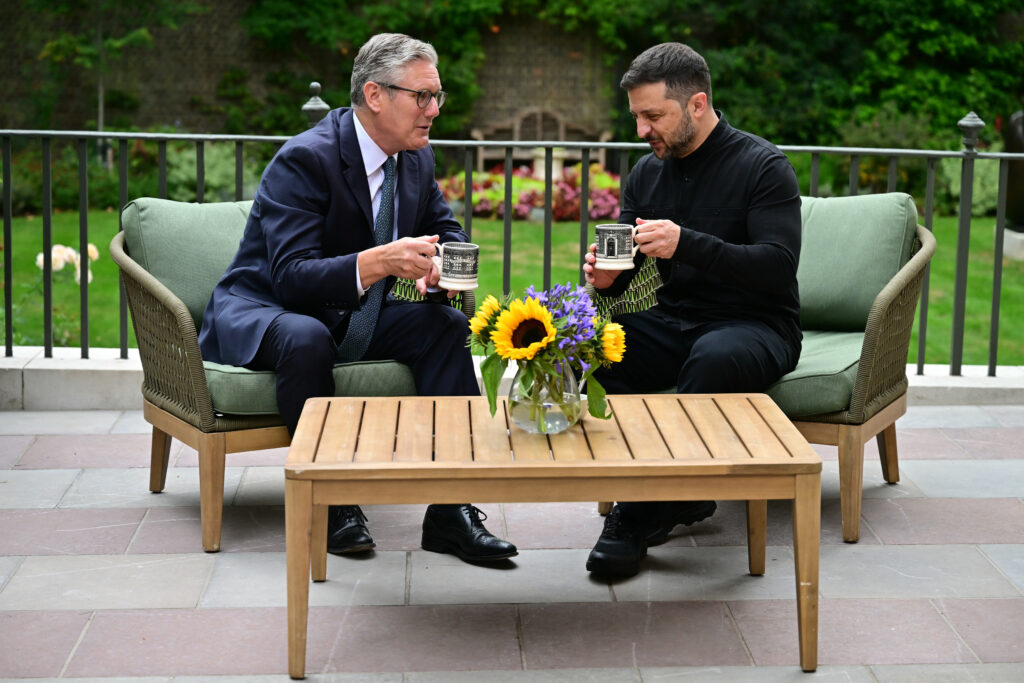
Sir Keir Starmer spoke to Ukrainian president Volodymyr Zelensky on Friday amid reports the US has been secretly negotiating a plan with Russia to end the war in Ukraine.
The Prime Minister had previously stressed that “the future of Ukraine must be determined by Ukraine” after it was reported that the White House had pressed Kyiv to accept an agreement negotiated by Donald Trump’s envoy Steve Witkoff.
Reports said the agreement would see Ukraine forced to give up territory and accept limits on the size of its army in exchange for peace.
On Friday, Sir Keir held a call with Mr Zelensky as well as French president Emmanuel Macron and German chancellor Friedrich Merz to discuss the proposal.
In a post on social media, Mr Zelensky said the men “value the efforts of the United States, President Trump, and his team” and were “co-ordinating closely to make sure that the principled stances are taken into account”.
He said: “We are working on the document prepared by the American side. This must be a plan that ensures a real and dignified peace.”
Sir Keir spoke to Mr Zelensky from South Africa, where it is thought he intends to use his attendance at the G20 summit to shore up support for Kyiv.
On the flight to Johannesburg on Thursday night, the Prime Minister told reporters: “My position has always been focused on a just and lasting peace. That’s why we have done so much work on the Coalition of the Willing.
“But that is premised on the principle underpinning that, which is central to me, which is that the future of Ukraine must be determined by Ukraine and we must never lose sight of that principle underpinning the just and lasting peace that we all want to see.”
Territorial concessions
US president Donald Trump’s plan for ending the war in Ukraine would cede land to Russia and limit the size of Kyiv’s military, according to a draft obtained by The Associated Press.
The proposal, originating from negotiations between Washington and Moscow, appeared decidedly favourable to Russia, which started the war nearly four years ago by invading its neighbour.
If the past is anything to go by, it would seem untenable for Ukrainian president Volodymyr Zelensky, who has opposed Mr Trump’s previous calls for territorial concessions.
A side agreement aims to satisfy Ukrainian security concerns by saying a future “significant, deliberate and sustained armed attack” by Russia would be viewed as “threatening the peace and security of the transatlantic community”.
The agreement, which was detailed by a senior US official, does not obligate the US or European allies to intervene on Ukraine’s behalf, although it says they would “determine the measures necessary to restore security”.
Mr Trump’s push to end the war could drive a wedge between himself and European leaders, who are likely to oppose any agreement that could be seen as rewarding Russian president Vladimir Putin for his aggression, leaving him emboldened rather than defeated.
For example, the proposal would not only bar Ukraine from joining Nato but would also prevent the alliance’s future expansion.
Such a step would be a significant victory for Moscow, which views Nato as a threat.
Mr Putin would also gain ground he has been unable to win on the battlefield. Under the draft, Moscow would hold all the eastern Donbas region, even though approximately 14% still remains in Ukrainian hands.
Ukraine’s military, currently at roughly 880,000 troops, would be reduced to 600,000.
The proposal opens the door to lifting sanctions on Russia and returning it to what was formerly known as the Group of Eight, which includes many of the world’s biggest economies.
Russia was suspended from the annual gathering in 2014 following its annexation of Crimea, a strategically important peninsula on the northern coast of the Black Sea that is internationally recognised as part of Ukraine.
The US team began drawing up the plan soon after US special envoy Steve Witkoff held talks with Rustem Umerov, a top adviser to Mr Zelensky, according to a senior administration official.
The official added that Mr Umerov agreed to the majority of the plan, after making several modifications, and then presented it to Mr Zelensky.
US army secretary Dan Driscoll was also in Kyiv on Thursday and discussed the latest draft with Mr Zelensky, according to a senior administration official.
Mr Zelensky offered a measured statement on social media about it but did not directly speak to the substance of the proposal.
“Our teams — of Ukraine and the United States — will work on the provisions of the plan to end the war. We are ready for constructive, honest and swift work,” he wrote.
Under the proposal, Russia would commit to making no future attacks, something the White House views as a concession.
In addition, 100 billion US dollars (£76.44 billion) in frozen Russian assets would be dedicated to rebuilding Ukraine.
But handing over territory to Russia would be deeply unpopular in Ukraine. It also would be illegal under Ukraine’s constitution. Mr Zelensky has repeatedly ruled out such a possibility.
Russia would also be allowed to keep half of the power generated by Europe’s largest nuclear power plant, Zaporizhzhia, which it captured from Ukraine early during the war.
The draft calls for a Peace Council that Mr Trump will oversee.
The council is an idea that Mr Trump snatched from his lengthy peace plan aimed at bringing about a permanent end to war between Israel and Hamas in Gaza.
If either Ukraine or Russia violated the truce once enacted, it would face sanctions.
As reports about the draft emerged, blindsided European diplomats insisted they and Ukraine must be consulted.
European leaders have already been alarmed this year by indications that Mr Trump’s administration might be side-lining them and Mr Zelensky in its push to stop the fighting.
Mr Trump’s at-times conciliatory approach to Mr Putin has fuelled these concerns, but Mr Trump adopted a tougher line last month when he announced heavy sanctions on Russia’s vital oil sector that came into force on Friday.
“For any plan to work, it needs Ukrainians and Europeans on board,” European Union foreign policy chief Kaja Kallas said at the start of a meeting in Brussels of the 27-nation bloc’s foreign ministers.
She also suggested that the draft would be too favourable towards Moscow.
“We haven’t heard of any concessions on the Russian side,” Ms Kallas said.
Support our Nation today
For the price of a cup of coffee a month you can help us create an independent, not-for-profit, national news service for the people of Wales, by the people of Wales.



Legalised theft isn’t a deal. Perhaps the EU could transfer all frozen Russian assets to Ukraine as fair payment for any land transferred.