


Oil price falls as Iran says Strait of Hormuz ‘completely open’
Iran has said it has reopened the Strait of Hormuz to shipping in a move welcomed by US President Donald Trump.
The vital oil and gas shipping route has been effectively closed since the US-Israeli bombing campaign began in Iran at the end of February, forcing up energy and fuel prices around the world.
The news led to sharp falls in global oil prices on the expectation of increased supply if tankers can get through.
Brent crude fell more than 10% to just over 89 US dollars a barrel in afternoon trading on Friday, and stock markets across Europe also soared.
The FTSE 100 index lifted 0.6% to 10,656, while the Dax in Germany surged 2% and France’s Cac 40 was 1.7% higher.
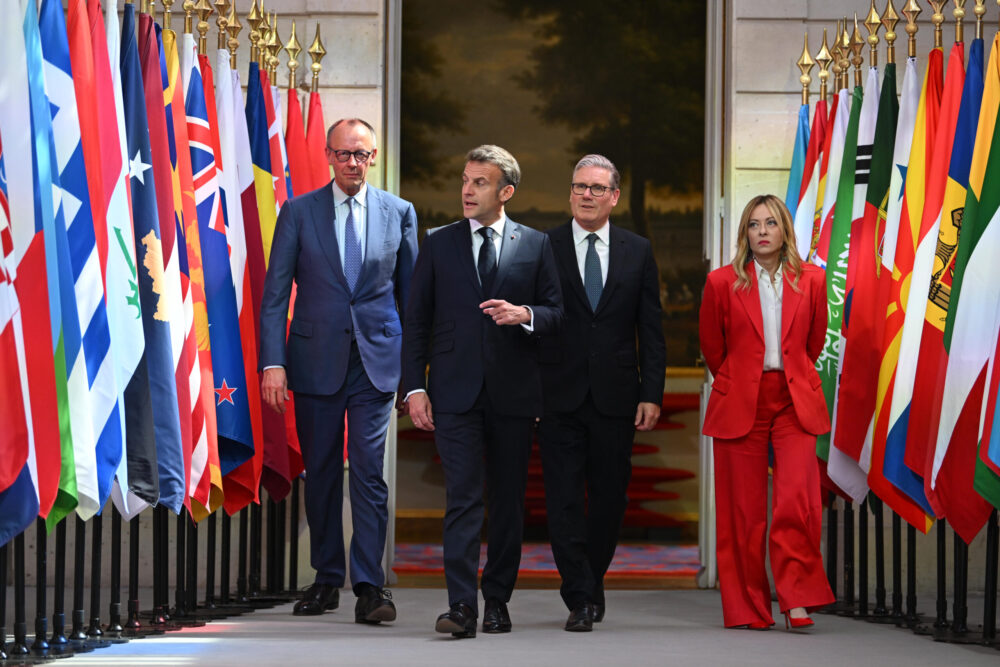
The announcement on reopening the strait came as Sir Keir Starmer and French President Emmanuel Macron hosted a meeting in Paris aimed at safeguarding the flow of trade through the maritime chokepoint once hostilities in the Middle East cease.
The US and Iran are in the middle of a fragile truce which is due to last until April 22, while Israel and Lebanon have begun a 10-day ceasefire.
Iran’s foreign minister Abbas Araghchi said: “In line with the ceasefire in Lebanon, the passage for all commercial vessels through Strait of Hormuz is declared completely open for the remaining period of ceasefire, on the co-ordinated route as already announced by Ports and Maritime Organisation of the Islamic Rep of Iran.”
Mr Trump said Tehran had announced the “strait of Iran” is “fully open and ready for full passage”.
But he said the US blockade of Iranian ports would remain “in full force and effect” until “such time as our transaction with Iran is 100% complete”.
In Paris, Sir Keir pledged to do “everything I can” to reopen the route as he joined the international talks, which do not feature the US, Israel or Iran.
Friday’s meeting at the Elysee Palace brings together 40 countries and the International Maritime Organisation to formulate plans for a multinational mission to protect freedom of navigation.
The Prime Minister and the French President met in the courtyard of the Elysee Palace, Mr Macron’s official residence, where they shook hands warmly before posing for photographs.
Sir Keir said: “It is very important that we build a coalition of countries around the principle that the ceasefire should be permanent, there should be a deal, and that the Strait of Hormuz is open.”
Accompanied by Foreign Secretary Yvette Cooper and Chief of the Defence Staff Sir Richard Knighton, the Prime Minister was calling for a “multinational initiative to protect freedom of navigation”.
“We must reassure commercial shipping and support mine clearance operations to ensure a return to global stability and security,” he said.
The talks in Paris will be followed by a multinational military planning summit at the UK’s permanent joint headquarters in Northwood, north-west London, next week.
But it remains highly unlikely that any of the countries taking part on Friday will deploy ships to the Strait of Hormuz until the war is over.
Such a move is deemed too dangerous because of the risk that vessels could be attacked from Iran’s shoreline.
Support our Nation today
For the price of a cup of coffee a month you can help us create an independent, not-for-profit, national news service for the people of Wales, by the people of Wales.
Get more trusted Welsh news
Choose Nation.Cymru as a preferred source in Google News to see more of our journalism.


