


The army of workers from Wales building the UK’s newest nuclear power station
Richard Youle – Local democracy reporter
Rachel Lister said she can sometimes see cranes at the vast Hinkley Point C construction site across the Bristol Channel from Penarth and Barry.
She has been involved with the project on the Somerset coast for years and is one of many from Wales who are helping to build the UK’s newest nuclear power station.
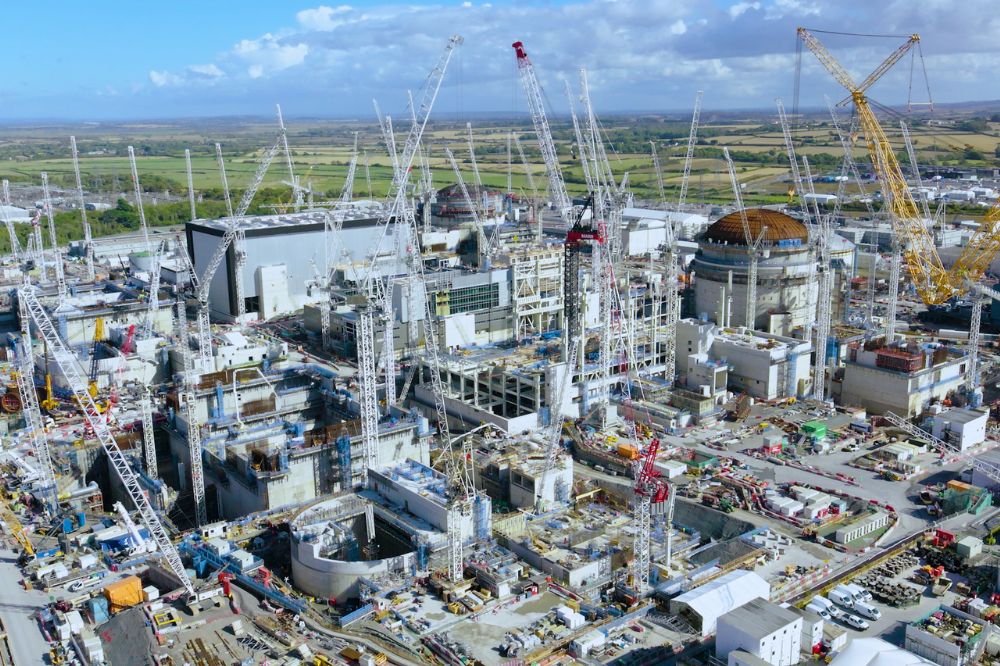
Those huge cranes, including a 250m high one known as Big Carl which can lift 5,000 tonnes, seem like beacons luring an army of skilled workers from across the border.
EDF, the French-owned company building Hinkley Point C, said close to 2,500 people from Wales are currently working on the project out of a 14,000-strong workforce – almost one in five. The workforce is expected to peak at around 15,000.
Contractors can stay at purpose-built accommodation adjacent to the site or at larger campuses in nearby Bridgwater and Brean. A fourth campus could open next year.
Close up Hinkley Point C is a hive of activity. Security is stringent although there is no fissile – or nuclear – material on site yet. The main canteen is packed with contractors. Numerous others are at work outside. To an outsider it feels like organised chaos.
Lee Jones, of Neath, greets almost every employee as he walks around. He is an area health and safety lead and started at Hinkley Point C 11 years ago after stints in the water and construction sectors. He also worked at the former Atomic Weapons Establishment and at the London Olympics in 2012.
The 50-year-old has spent many years on projects outside Wales and met his wife, Emma, while working away. The couple have a daughter Tia, 13, and son Ki, 12, and Lee, who lives in a campervan in Somerset, heads home along the M4 when he can.
“Every day here I see feats of engineering,” he said. “Each day you see the size of the site, and it still gives me buzz. There are over 100 nationalities working on this project. It’s like my second family.”
Pay
The lure of good pay is clear when talking to workers. There is also a sense they would willingly return to Wales if a significant infrastructure project was in the offing.
Concrete supervisor Julian Elkins, of Seven Sisters, in the Dulais Valley, joined his father and brother at Hinkley Point C over four years ago.
“The money and the stability of the job keep me here,” said the 35-year-old father-of-two. “Being away from your kids is the worst part, but it’s for their future. My daughter is 12 – she wants to be an engineer.
“My plan is to stay here as long as possible. I’m just programmed to be away. This is an interesting place to work. You won’t see nothing like it.”
Brendan Edwards, 30, of Kidwelly, is a general operations supervisor and lives in the adjacent accommodation. “It suits me – there’s a gym, cafe, restaurant, pub,” he said. “The big thing here is job security.”
Brendan said he’s picked up different skills from the various trades on site, and that safety was on “another level”. He said: “Compared to working on a big housing site it’s totally different.” He added: “The scale of this place is hard to explain to people.”
Bernard Driscoll, of Mayhill, Swansea, said: “When I first came here it was just a massive hole in the ground. I didn’t think I would be here this long.” He reckoned Hinkley Point C was around the size of Swansea suburb, Morriston. “You get buses from one area to another,” he said.
Bernard, 48, is a slinger, meaning he ensures materials are moved safely and acts as the eyes and ears of a crane operator. He has three daughters. “When this place is switched on I can tell my kids I helped build it,” he said.
Rigger
Michael Rosser, of Skewen, started working as a rigger at Hinkley Point C eight years ago and left to retire in 2023.
He worked for Dutch heavy lifting company Mammoet, helping to set up a crane which could lift well over 1,000 tonnes. That particular job took seven weeks. He was involved in other work such as the installation of 40-tonne pipe sections.
“When I arrived they’d started building it (Hinkley Point C) , and there were holes everywhere in the ground,” he said.
His shift pattern was nine days on, four days off. While at the site he stayed in the adjacent accommodation. “I went back to Skewen every chance I got,” he said. Asked about being away from home, he said: “The family is the hardest part, obviously.”
The married 58-year-old has a grandson and 31-year-old son, but he’d worked away previously as a mechanical fitter and again after retraining as a rigger – a role that took him to Scotland and the Shetland Islands.
Did he miss his graft of old? “You miss the atmosphere, the craic with the boys, but I don’t really miss the work,” he said.
EDF said around £190m has been spent on companies in Wales thus far. It’s a big number but it’s dwarfed by the £5.3bn spent on businesses in the south-west of England and £6bn from those in the south-east, according to an EDF socio-economic report this year. More than £280m has been spent on Scottish firms.
Inflation
Much has been written and said about Hinkley Point C’s cost overruns and delays, and how much bill payers will be on the hook when electricity starts flowing from it.
EDF’s latest cost estimate for the project in 2024 was £31-£34bn but, confusingly, this was expressed in 2015 money terms. While this won’t mean much, to provide some sort of comparison the estimate in 2016 was £18bn expressed in 2012 terms.
Speaking in 2024, EDF chief executive officer Stuart Crooks said: “Like other major infrastructure projects, we have found civil construction slower than we hoped and faced inflation, labour and material shortages, on top of Covid and Brexit disruption. Running the project longer will cost more money and our budget has also been affected by rising civil construction costs.”
Consumers will help finance the private sector project through their energy bills when the reactors are switched on. This is the result of a so-called contract for difference agreed between EDF and the UK Government in 2016, which provides EDF a guaranteed minimum price for the electricity.
Spike
This £92.50 per megawatt hour contract will last for 35 years and go up in line with inflation. The £92.50 price is also a maximum ceiling, so if prices spike wildly like they did when Russia invaded Ukraine in 2022 any surplus will be returned to the Treasury. EDF said it was forecasting the first reactor to be switched on between 2029 and 2031 and the second one 12 months afterwards.
There has been opposition to Hinkley Point C on several grounds by, among others, a group called Stop Hinkley. It feels the cost of nuclear power is too high and that renewable forms of energy are the way forward.
Around 900 workers will remain at the Somerset power station when it’s operational – more when it’s refuelled every 18 months. By then many others will be at EDF’s next nuclear site – Sizewell C in Suffolk – where groundworks and other pre-construction operations are under way.
The UK Government is taking a £14.2bn stake in Sizewell C, which it hopes will create 10,000 jobs. Sizewell C will be a copy of Hinkley Point C and will earn money from selling electricity at a level fixed every five years by energy regulator Ofgem.
A spokeswoman for the UK Department for Energy Security and Net Zero said: “We are launching a golden age of nuclear because taking back control of our energy will protect family finances, boost energy security and create thousands of good, skilled jobs.”
Those jobs aren’t just the riggers, the slingers, the sparkies, the welders and the like. There’s an awful lot of compliance, legal, transport and other work.
Rachel Lister, from Cardiff, started on the Hinkley Point C project in January 2013. She said: “I wasn’t looking for a job at the time but I saw the advert and thought, ‘wow, that would be cool.’ I was aware of the project and did know some of the people involved.
“When I started it [the site] was fields and some Portakabins. We were quite a small team, but you could already hear Welsh voices.”
Materials
Rachel moved from Cardiff to Somerset to establish the transport infrastructure to support the workforce. Hinkley Point C has several park and rides, buses on site taking workers here and there, and a jetty where materials are delivered by boat.
She is employed by EDF and liaises with the Highways Agency, Somerset Council and the nearby community.
As transport planning lead she ensure policies and procedures are in place which comply with the project’s development consent order. There are targets for things like maximum HGV movements for a given time period, the percentage of workers getting to the site by bus, and car-sharing.
Referring to the latter two, Cardiff University graduate Rachel said: “It’s about trying to reduce car movements. It is challenging.”
Now back living in Cardiff, Rachel has a seven-year-old daughter and four-year-old son and works part-time, mainly from home. “When you’re in Penarth and Barry you can look to Hinkley Point and see the cranes,” she said.
Rachel said she felt a sense of purpose having seen the project evolve from its early days. “It would be really good to see it through as well,” she added.
Asked if a role at Sizewell C in Suffolk would be tempting, she replied: “I would say pre-kids… yes. If they let me work flexibly then I would, but they might want me there full-time.”
Ishy Akhtar joined the project in November 2024 and a month later visited the site for the first time. He said: “I’m not easily impressed but my first thought was, ‘wow – the scale’. It’s massive, it’s like a village. It puts it all into perspective.”
In his role as corporate compliance assurance lead at EDF, he is responsible for compliance assurance in areas such as fraud and bribery, and modern slavery. He’s part of the corporate, commercial and regulatory team – there’s also a construction team – which sits within an over-arching legal unit. “There are about 25 of us in total,” he said.
Ishy, of Canton, Cardiff, joined EDF after a 12-year stint with accountancy firm Deloitte. “I thought it was time for a bit of a change, and I wanted to do something impactful,” he said.
Home straight
Ishy commutes a couple of times a week to an EDF office in north Bristol and works from home. He said it felt like the project was heading “down the home straight”.
Asked if he felt a sense of mission about it, he said he did. “This is a once-in-a-generation project,” he said. “It’s going to contribute to the UK’s future energy security and its net zero goals. I’ll be able to say I had a very small part to play.”
For younger workers like Kieron Salter, 26, nuclear energy is all they’ve ever known. Kieron grew up in Anglesey, where the Wylfa nuclear power station had been generating electricity since 1971.
It shut down completely in 2015 but plans for a new Wylfa power station were progressing, and Kieron was taken as an apprentice for the company behind it – Horizon Nuclear Power – in 2016. Things then changed. The new Wylfa plans fell through, but Kieron was offered a degree apprenticeship by EDF. He moved to Somerset in 2019 for the four-year course, which included a year working abroad, and learned various aspects of the nuclear business.
Now an electrical engineer Kieron continues to work for EDF and lives in Bridgwater. Although his main office is in Gloucester, he visits Hinkley Point C and said he was always struck by how the site changes.
Kieron said: “Nuclear is one the cleanest forms of energy and provides a good [power] baseload. To contribute to that, it’s quite interesting. For me personally I know nothing different.”
Asked if he would return to Anglesey if a new nuclear project was to get under way at Wylfa, he said: “One hundred per cent – I would be the first person back up there.”
He was speaking to the Local Democracy Reporter Service before the UK Government’s announcement in November that Wylfa will be the site of the UK’s first small modular reactors (SMR).
Kieron has welcomed the Wylfa SMR announcement. “It’s exactly what Anglesey needs after years of uncertainty,” he said. “The project will bring generations of jobs from all disciplines, allowing people to stay local and not having to look for high skilled, high paying work elsewhere.”
Hinkley Point C’s twin-reactor plant is expected to generate the equivalent electricity used by six million homes. Its predecessor Hinkley Point B ceased operating in 2022 following two lifespan extensions. Prior to that Hinkley Point A generated power until 2000.
Like all forms of energy generation there are pros and cons with nuclear power, which provides around 14% of the UK’s electricity.
Cost
The wider backdrop is a drive by the UK Government to reduce its use of planet-heating fossil fuels, bolster energy security and keep the cost of bills manageable. All this at a time when demand will rise as transport and heating systems are electrified and data centres churn through what seem to be mind-boggling amounts of electricity.
The cost and politics of dealing with spent nuclear waste are likely to be tricky to navigate. The UK Government hopes to develop a multi-billion pound “geological disposal facility” in the future for this purpose. Two potential underground areas have been identified in Cumbria.
The Local Democracy Reporting Service asked two energy organisations about the pros, cons, and costs of nuclear power and both suggested we contact the Nuclear Industry Association.
The association’s chief executive Tom Greatrex said: “Large nuclear stations like Hinkley Point C and Sizewell C provide huge amounts of home-grown, low-carbon electricity around the clock, which strengthens Britain’s energy security and reduces reliance on volatile international gas markets.
“They operate for 60–80 years and potentially longer, giving long-term stability to the energy system while supporting tens of thousands of skilled jobs and major UK supply chains.
“Once nuclear plants are up and running, they provide stable, price-predictable and reliable electricity for decades. That long-term certainty is something neither gas – whose price can swing sharply on global markets – nor weather-dependent renewables can offer on their own.
“Baseload nuclear helps keep wider system costs down by providing firm power that doesn’t need the expensive balancing, storage or back-up required with intermittent sources of power.”
What about the comparative costs when nuclear waste treatment and price support mechanisms as well as grid balancing costs were calculated?
Mr Greatrex replied that nuclear’s overall value was still “very strong”. He added: “The cost of managing nuclear waste is already fully built into the pricing framework for new projects, and the UK has a clear, regulated long-term plan in place. With all system costs included, nuclear remains a competitive, reliable and essential part of a clean, secure and affordable electricity mix for the UK.”
For now there is much to do at Hinkley Point C before the army of workers decamps and moves on to the next project.
Support our Nation today
For the price of a cup of coffee a month you can help us create an independent, not-for-profit, national news service for the people of Wales, by the people of Wales.



yeah, the massively over budget mess that we could probably have done better with green with all the money sank into foreign hands before we even see a single watt out of it.
The foreigners paid for it. We pay them once they start generating electricity
Imagine instead that your pension fund had chipped in, guaranteeing your pension payments for decades to come rather than all this expensive electricity propping up a different economy.
Christ, not on Hinckley. Are you mad? It’s a terrible model for pension funds. High upfront costs and no income for 25 years. This alone would destroy moat pension funds. EDF has already taken a 13 bn hit on Hinckley due to delaya
Sizewell C’s RAB model is designed to attract pension funds
Government should borrow to build infrastructure then sell it on when it’s ready to go without the risk. It’s an ideal investment for pension funds which people start paying into 40 years or more before they expect to see returns. Perhaps you’re confused by the state pension Ponzi scheme which uses contributions to pay for current retirees.
If you wind back to the 2010s it was already clear that nuclear projects often overrun massively and UK governments had bad experiences (e.g. past nuclear PS). There were virtually no companies willing to build nuclear in the UK and the UK has no companies. The philosophy was the transfer construction risk to EDF and its partner. As it stands, it’s looking quite a good deal given the massive cost overruns on Hinckley which has saved the tax payer 15 bn and likely to reach 30 bn by the end. If you also remember, it was just after financial crash,… Read more »
You pay one way or another. What makes involving the private sector expensive is risk. The bigger the risk the bigger the rewards need to be to attract interest. Better the government takes on the risk, especially given it controls many of them like planning, and pay less in the long run. This is another example of lazy short-termist government that is the reason nothing works and everything is expensive. The attitude that all debt is bad debt is a nonsense. Markets respect investment. They don’t respect spending money with no clue how it’ll be repaid. The free marketeers love… Read more »
Righty ho.
Just a note. It doesn’t control planning in the case of nuclear.
the rest is gibberish.
https://commodity.com/data/singapore/debt-clock
Not gibberish because Singapore’s debt to GDP ratio is currently 182% yet they have the highest AAA credit rating from the four largest credit rating agencies. This is because they only borrow to invest, not to run the country. They have zero net debt.
Uh thats how pensions work… no payout for about 50 years…. looks like a marriage made in heaven.
Pensions arent savings accounts you can just dip in and out of, they are long term investments
Yes but pensions have to pay out as well. If someone is 65, they can’t wait 20 years for a nuclear power station to be built! Also people die, where do you find 2m in life insurance if you have no income for 20.
If Hinckley was remotely attractive to pension funds, they would have invested. As it was they didn’t touch with a barge pole, hence it took so long to find foreign investors
The sums will have us customers paying back and then some with the strike price.
You got it correct the second time around
I am a proponent of green energy, but we do need a stable supply of atmosphere friendly energy to supplement the green energy. Green energy fluctuates a lot, there is no getting around that.
I agree with you. Nuclear has to be part of the mix. There is potential for renewable plugs storage to power 100% of UK grid but this is 30 plus years away. Nuclear fills the gap. If it gives jobs, all the better
Jeff,
typical of U.K. government projects.
But it is the totally unsuitable green, i.e. wind and solar that has destroyed our grid.
The sooner they are shown to be unsuitable the better.
Good for them. The Anglesey project will hopefully provide them with more work.
A lot of people trained at coleg menai went down there. Hopefully it comes to an end, they have jobs in wylfa to come back to
No to Nuclear.
Its not cost effective.
Government is not innovative enough. They keep building yesterday’s technology. This type of nuclear power is super expensive and the waste at the end is radioactive for 10,000s of years, we don’t even have a place to put it long term yet! How they can say that the costs of dealing with he waste are factored in I don’t know because we don’t even know what the solution is yet, you can’t factor in costs for something that’s not been been designed yet, never mind built. We should be investing in building the next generation of nuclear, fast reactors that… Read more »
Nuclear power. How very 1950s.
This massive, overbudget, delayed mess is the reason why small modular reactors are the future.
As an experimental technology SMRs will come with their own cost overruns and delays. It’s energy storage we should be focused on innovating so the limitless wind power can be stored for use on still days.