The Dannie Abse Collection: Ash on a Young Man’s Sleeve
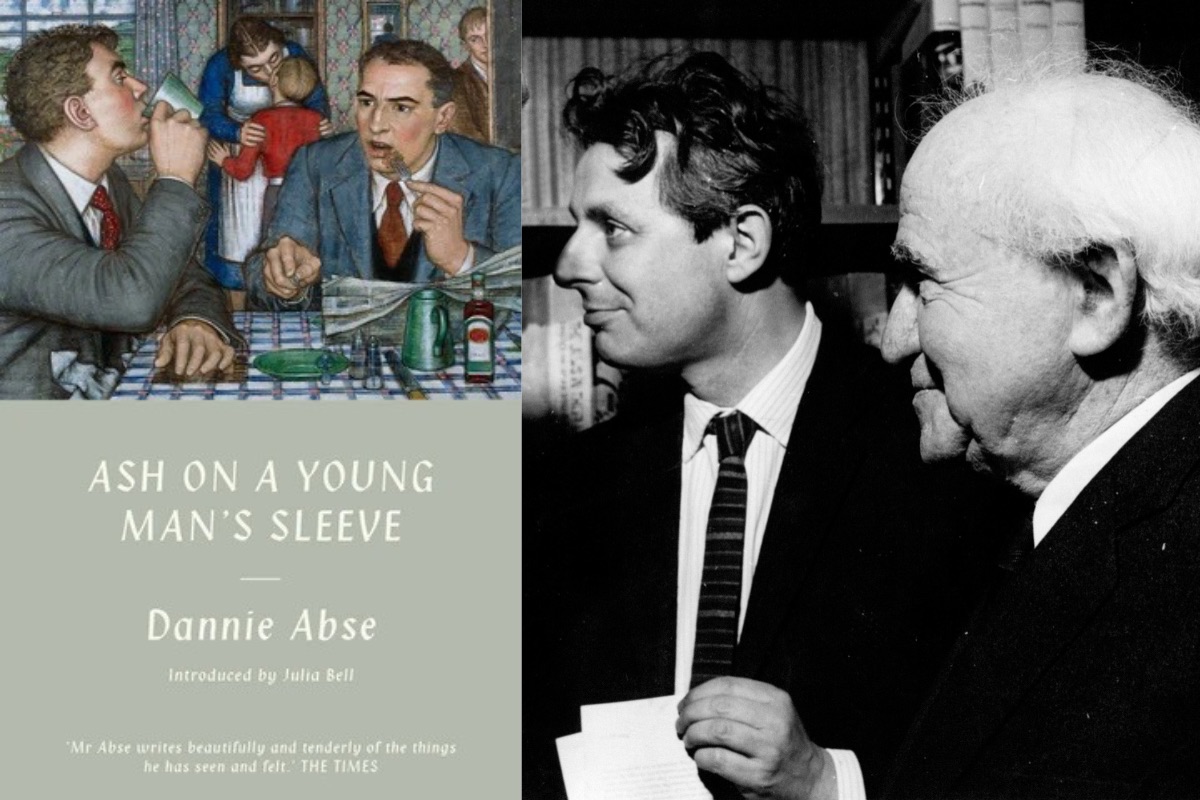
Julia Bell
The first thing any reader will notice about this novel is how close to autobiography it appears. The voice of the young protagonist Dannie sounds like the voice of an author mid-reverie, remembering the streets, the people, the voices, and particularly his Jewish family in Cardiff during the 1930s. But despite its historical setting and the fact that it was published in 1954 there is something very modern, almost post-modern in the experience of reading this novel, particularly in the slippery relationship between fact and fiction which in the contemporary moment we might call autofiction.
The term is attributed to the French writer Serge Doubrovsky from the cover of his novel Fils (1977). “Fiction, d’événements et de faits strictement reels; si l’on veut autof iction” ‘Fiction, of strictly real events and facts; autofiction if you like.’ This autofiction is especially popular in modern European literature – think Marguerite Duras, Édouard Louis, Annie Ernaux, Karl Ove Knausgaard, and has been increasingly adopted by contemporary writers in English too – Teju Cole, Sheila Heti, Rachel Cusk, Ben Lerner to name a few. Autofiction exists on the borderline of memory and storytelling. It’s a slippery, liminal space between truth and fabrication, where the author makes a persona out of themselves to carry the story, embellishing as they go, blurring the line between what happened and what is invented.
Abse is on record as saying he was frustrated to find his most successful book classified as autobiography: ‘People have come up to me, after reading that book, saying, “I’ve read your autobiography,” when in fact my actual autobiography is Goodbye, Twentieth Century. And it’s a shame really, because I want people to read the autobiography that is actually my autobiography, and read Ash on a Young Man’s Sleeve as a novel, because it is a novel.’
But he doesn’t make it easy, at least to begin with, to orient ourselves as we might in a novel. Our main character is called Dannie so it’s easy to assume that this must be Dannie Abse himself who is speaking from memory. The two brothers are called Leo and Wilfred as they were in real life, the characters he encounters – his best friend Keith, his pugilist Uncle Bertie, the irascible Uncle Isidore – as vivid as in any autobiography. And yet as the piece progresses, there is a sense of the elaboration of the creative eye, the extension of a poetic gaze, which renders the prose into scenes where facing an oncoming thunderstorm, the sun is ‘dressed in cracked, rose-coloured mirrors’ where ‘whole hundredweights of clouds had piled up in the distant skies. The garden was electric, opulent but doomed, in the swooning air.’
Under the pressure of such phrasing the book takes on the pleasure of poetry. His writing shows an ear for the music of language which extends beyond memoir into something more sensory and startling. There is also the influence of Dylan Thomas here too. It’s the kind of prose that hums with the exactness of a metaphor where a man in the synagogue has a ‘spade-shaped beard’, the closed piano is a ‘coffin of music’, the train to Newport ‘a chain of lights, like a glimmering thought, across the blank mind of the countryside.’ All this speaking to the great poet that Abse would go on to become, and perhaps rather than the coming-of-age of a Bildungsroman, this book is better understood as a Künstlerroman, or artist’s novel. It shows the making of the poet from his experiences – the boy who notices everything, alive to all that he sees and feels and hears. The story is divided up into scenes rather than chapters – a trip to Barry Island that is disturbed by watching a man have a fit on the train, a date with the much-admired Lydia Pike, writing a love letter for the ‘disabled but threatening boy-child’ Lol, almost like a collection of poems, snapshots of a childhood, from boyhood though adolescence to nascent adulthood.
Abse went on to train as a doctor and work as a physician in a chest clinic in London, writing his books and poetry alongside. This interest in the physical is, like the poetry, present in the writing throughout. The body and its fragile mortality threaded through the scenes and descriptions. ‘X-rayed trees’, the disused quarry like a ‘gouged-out eye’. His nascent understanding that ‘everything had to die’ neatly illustrated through a sickly frog that he keeps in a glass jar, and as the bodies pile up in Europe, the frog dies too.
The political context also gives this book a modern, rather than nostalgic edge: the rise of fascism as seen by a Jewish Welsh family in Cardiff. In the background is the relentless march of the news – the Spanish Civil War, antisemitism in Europe, the unsettling speeches of Oswald Mosley. These moments seem to echo our current political moment, and we recognise that this is how it is: the domestic interrupted by the sudden conniptions of the political, the whiff of trouble to come, the background hum of anxiety. Discussion around the dinner table, idle asides and comments. At the railway station on the way to stay with his uncle Bertie: ‘the mechanical voice of the loudspeaker floated disembodied over Smith’s bookstall … The voice said Newport, Swindon, Reading, Paddington. It seemed the voice of Fate. More appropriately it should have called out Abyssinia, Austria, Czechoslovakia, Spain. Dead, dead, 1939.’ And then life goes on, as it must.
One of the scenes at the heart of the piece is where he imagines the moment where Herschel Grynszpan assassinates the German diplomat Ernst vom Rath on November 7th 1938 in Paris. An event which the Nazis used as a pretext for Kristallnacht – the pogrom which destroyed Jewish homes and businesses and synagogues across Germany. When he asks his brother Leo who Herschel Grynszpan is, Leo replies ‘Not a person … but a condition of history.’ And the scene goes on to imagine, blow by blow as Herschel takes his steps into the embassy, gets out his gun and ‘pointed his revolver at [vom Rath’s] mouth that had fallen open in stupid surprise.’ As the story progresses the condition of history becomes louder and louder until finally in the later sections of the book, war breaks out.
Abse’s ear for speech comes in great ricochets of dialogue. Exchanges which are both funny and acute, and which show a deep appreciation of the sound of spoken language and Welsh idioms in particular. He talks to his mother and his father and his brothers and asks religious questions of Rabbi Aaronovitch, he speaks kindly to the disabled Lol:
‘You pick mushrooms, Lol?’
‘Yes. It’s easy. You find ’em, then you pick ’em.’
‘And you’re on your own?’
‘Natcherly. It’s nice, mun. Fresh air. Mist. Bloody birds singing.’
I laughed and he smiled at me benevolently.
‘What you going to do when you grow up? I asked him.
‘I’m ’aving elecuit lessons.’
‘What lessons?’
‘You knows, for speaking proper,’ he said.
‘You mean elocution lessons,’ I said.
‘Yes, ’em,’ he nodded vaguely.
‘What for?’ I asked.
He took a blade of grass out of his mouth once more and looked at me with bright eyes.
‘Goin’ to be a film star,’ he said proudly, and he threw back his head, closing his eyes, pointing his finger at me.
‘Bang, bang, bang!’ he bellowed.
But the person he speaks to the most is his best friend, Keith. Keith with the drunkard father and dead mother who is Dannie’s companion as he grows up and into adulthood. These exchanges are almost like little plays, full of wry self-knowledge and compassion as they consider everything from the best beach in south Wales to the mysteries of the opposite sex, to the league prospects of his beloved Cardiff City. They witness each other’s humiliations and desires in a way which is both tender and recognisable, and it is the course of this friendship which provides the spine of the piece.
This book is a modern classic which speaks keenly to our present moment, both in its autofictional style which gives the book a recognisably modern point of view, and in the background hum of anxiety about tyranny and mortality as it impinges on the everyday. They say the past is a foreign country, but in Abse’s 1930s, the past is surprisingly familiar territory, bittersweet, fragile, tenderly alive.
Julia Bell is a writer and Professor of New Writing at Birkbeck, University of London. She is the author of novels, poetry and non-fiction. Her memoir in verse Hymnal (Parthian, 2023) was Welsh Book of the Month and returns to the hymns and religious language of her childhood. Her other books include the essay Radical Attention (Peninsula Press – reissued in 2026), the novel Massive, and most recently Between the Lines (Simon & Schuster, 2026); she co-edited the widely taught Creative Writing Coursebook (Macmillan). Her essays and criticism appear in the national press and in anthologies, and she writes the Substack Between the Lines.
Dannie Abse (1923-2014) was born in Cardiff. He began his medical studies at the Welsh National School of Medicine and qualified as a doctor from Westminster Hospital, London in 1950. While still a student, Abse’s first book of poems was published and his first play performed. Further poetry volumes followed over the decades, culminating in his final collection Speak, Old Parrot in 2013 (shortlisted for the TS Eliot Prize) and Ask the Moon: New and Collected Poems 1948-2014. His first novel, Ash on a Young Man’s Sleeve, appeared in 1954 and his most recent, the Booker longlisted The Strange Case of Dr Simmonds and Dr Glas in 2002. Three prizewinning plays were collected in The View from Row G (1990) and his autobiography, Goodbye, Twentieth Century, was published in 2001. Recognised internationally as a poet, Abse was President of the Poetry Society and of the Welsh Academy of Letters, and among his awards were the Wales Book of the Year for The Presence, the Wilfred Owen Award and the Roland Mathias Prize. He was appointed a CBE in 2012.
Support our Nation today
For the price of a cup of coffee a month you can help us create an independent, not-for-profit, national news service for the people of Wales, by the people of Wales.
Get more trusted Welsh news
Choose Nation.Cymru as a preferred source in Google News to see more of our journalism.