
The speech that saw the Senedd rise to its feet for the Llywydd
Emily Price
The Llywydd received a standing ovation after delivering a passionate 15-minute defence of his role as the Senedd’s official referee – but what did he say to provoke such a reaction?
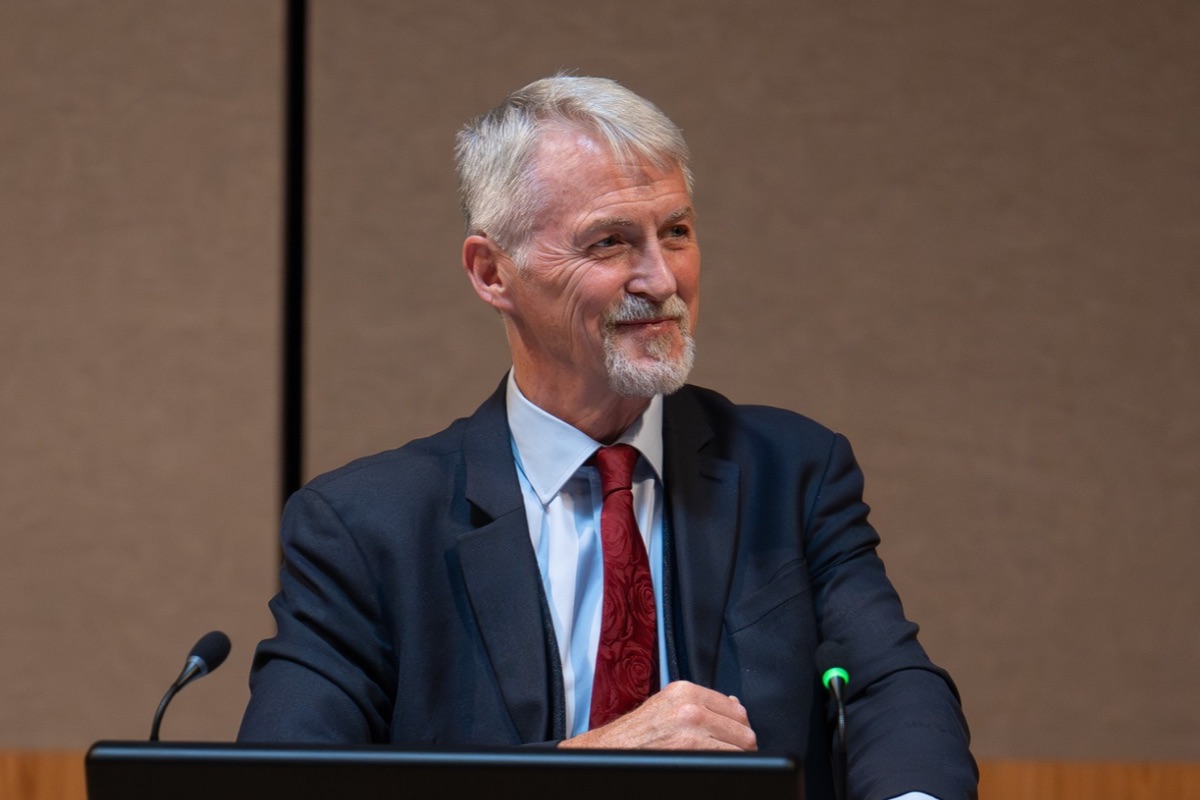
Huw Irranca-Davies’ stirring address came during a debate on a Reform UK motion calling for his removal from office on Tuesday evening (November 24).
Reform had tabled the motion in defence of Joe Martin who was banned from speaking by the Llywydd after he breached the Senedd’s standing orders.
After the Llywydd survived Reform’s bid to remove him, with Members voting 55 to 29 against a motion of no confidence, the party has expressed anger over the positive reaction Irranca-Davies received following his speech.
Shadow cabinet minister Cai Parry-Jones claimed the address had been generated using Artificial Intelligence (AI), describing it as “virtually all written by ChatGPT”.
Parry Jones suggested he had been able to prove this by using an AI “checker”.
But, he has faced criticism for making the claim, as AI detectors are not reliably accurate and cannot provide definitive proof of authorship.
Most detectors produce high rates of false positives and false negatives, and their scores vary widely depending on the AI model used.
Sources close to Irranca-Davies pointed out that the Welsh Labour politician has more than two decades of political experience and was writing parliamentary speeches long before ChatGPT and other AI tools existed.
Although Reform announced its plans to oust Irranca-Davies at the start of Plenary on Tuesday, Nation.Cymru understands that the Llywydd had heard rumours late last week that Reform might seek his removal.
He therefore spent the weekend preparing a speech to defend his impartiality and explain in his own words why parliamentary rules are necessary to protect free speech.
At the end of his address, Members from Plaid Cymru, Welsh Labour, the Welsh Conservatives, the Liberal Democrats and the Welsh Greens rose to their feet in a standing ovation.
Reform UK’s Senedd Members remained seated, watching on stony-faced.
So what did the Llywydd say in the speech that prompted such a reaction from Senedd Members?
Nation.Cymru has reproduced his address in full below:
Members, I welcome this motion. Indeed, I welcome it because it gives us an opportunity, finally, to resolve this matter. For weeks, attention has been drawn away from the work of this Senedd and towards a dispute that, in truth, raises questions far larger than any individual Member, any individual ruling, or indeed, any individual Llywydd.
And perhaps I should begin with a reflection. I’ve long admired the tradition in another place, whereby a newly elected Speaker is dragged reluctant and protesting to the Chair. When I first entered Parliament in Westminster, I regarded it as a colourful piece of parliamentary pageantry.
The longer I have spent in legislatures, the wiser that tradition appears. Because anyone who truly understands the responsibilities of a Presiding Officer knows that no sensible person should seek such a role for popularity or prestige or for an easy time. The duty of the Chair is not to please, it’s not to flatter, it’s not to avoid controversy, it is to apply the rules fairly and impartially, irrespective of pressure, of popularity or of political consequence.
That is the task. And that task, not any personal grievance or political disagreement, is what is really before us today. Because this motion is not fundamentally about me, it’s about a much larger constitutional question: can parliamentary democracy function if Members reserve to themselves the right to decide which rules they will obey and which rulings they will accept? That is the question before us, nothing more and nothing less.
Members, I’ve spent much of my adult life in parliamentary institutions. I’ve served in Westminster and in this Senedd, I’ve served in Government and outside Government. I’ve served as a Minister, a whip, a committee Chair and, like you, as legislators.
And across those years, I’ve seen fierce disagreements, Governments challenged, oppositions challenged, policies torn apart, Ministers held to account, and I would defend every Member’s right to participate in that tradition of robust, democratic argument. Because Parliament is not designed to eliminate disagreement, Parliament exists to manage disagreement, to channel conflict into argument instead of force, and to ensure that competing views can be heard, tested and challenged under—under—agreed rules. That is the genius of Parliament.
But every Parliament worthy of the name rests upon a simple bargain: Members—all of us—are granted exceptional rights and, in return, we accept exceptional responsibilities. Indeed, one of the central lessons of parliamentary history is that parliamentary freedom and parliamentary order are not opponents, they are partners; each depends on the other.
The protections enjoyed by Members do not exist independently of this institution, they exist because the institution creates and protects and sustains them. That is true in Westminster, it’s true in Holyrood, it’s true here in this Senedd, and it is true in democratic institutions throughout the world.
Now, much has been said in recent weeks about free speech. Some have suggested that what is at stake here is freedom of speech itself. I respectfully disagree. Not because free speech is unimportant, but precisely because it is so important. I am an unapologetic defender of freedom of speech.
The right to criticise Government, the right to challenge authority, the right to express unpopular opinions, the right to dissent, these are essential democratic liberties. And nowhere—nowhere—are they more strongly protected than in parliamentary chambers like this.
Parliamentary privilege provides protections for speech that are unique in their scope and their importance. Members may speak here with freedoms that exist in few other places, and those freedoms exist for a reason. They exist so that Governments can be challenged, so that difficult questions can be asked, so that minority voices can be heard and so that truth can be spoken without fear. But parliamentary privilege has never meant that anything goes. It has never meant speech without standards. It has never meant rights without responsibilities.
Every democratic legislature recognises this reality. The House of Commons, the House of Lords, the Scottish Parliament, this Senedd recognises it, and legislatures right across the world recognise it for a very simple reason. Because the alternative to regulated parliamentary speech is not more freedom, it is less freedom.
Without rules, eventually it is only the loudest voices that are heard. Without rules, intimidation begins to replace persuasion. Without rules, scrutiny deteriorates into shouting. Without rules, minority voices lose their protection. Without rules, privilege itself begins to lose legitimacy.
The Standing Orders of this institution are therefore not constraints upon free speech; they are among the protections that make our free speech possible. They ensure that a newly elected Member has a voice alongside a party leader. They ensure that a backbencher can challenge a Minister. They ensure that a minority can challenge the majority. They ensure that disagreement can flourish without descending into disorder. Rights and responsibilities rise or fall together. That principle is not an enemy of liberty; it is one of liberty’s strongest safeguards.
Now, there is another distinction that Parliament and this Senedd must defend. Parliament is not social media, Parliament is not a television studio, Parliament is not the comments section below a newspaper article, nor should it be. The incentives are different. The purpose is different. Social media often rewards outrage. Parliament should reward argument. Social media often rewards performance.
Parliament should reward persuasion. Social media rewards escalation. Parliament should reward scrutiny. The public do not send us here merely to express anger; they send us here to exercise judgment. They do not elect us merely to generate attention; they elect us to interrogate policy, scrutinise legislation, examine budgets, hold power to account. Because Parliament serves a different purpose, so Parliament requires different standards.
Its language, therefore, must be robust, fearless and honest. But it must also be disciplined, ordered, governed by procedure, respectful of the rights of all others, and respectful of the very institution through which those freedoms are exercised. The defining characteristic of a parliamentarian is not simply the freedom to speak, it is the willingness to accept the rules that allow everyone else to speak as well.
So, let me deal directly with the question of impartiality. Well, the facts speak for themselves. The very first Member invited into my office for a private conversation and an apology was not a Reform Member, it was a Labour Member. More recently, a Plaid Cymru Member overstepped the mark in this Chamber and, to that Member’s credit, apologised promptly and publicly. Only last week, the Conservative business manager worked constructively with Members within their own group regarding standards of conduct expected in this Chamber. None of these examples are exceptional.
Indeed, they are entirely unremarkable, and that is precisely the point. This is how parliamentary institutions work. Members will occasionally overstep the mark, the Chair intervenes, a discussion takes place, an apology is made where necessary, and business resumes.
The point is not that Members never make mistakes; the point is that they recognise the authority of this institution where those mistakes occur. No party has a monopoly on virtue. No party has a monopoly on error. The rules apply equally to all of us: Government and opposition, frontbench and backbench, senior Members and newly elected Members. They apply equally to everyone, and they must continue to do so.
But let me make something else absolutely clear: this motion is not objectionable because it criticises me. Criticism of the Llywydd is entirely legitimate. Indeed, disagreement with the Llywydd is entirely legitimate. Arguments about procedure are entirely legitimate. Seeking changes to Standing Orders is legitimate. Even seeking the removal of a Llywydd is entirely legitimate. That too forms part of parliamentary democracy.
So, the issue before us today is not whether Members may challenge authority—of course they may. The question is whether they continue to recognise the authority of the institution while doing so. That distinction matters because Parliament is not built upon agreement. Parliament is built upon consent to common rules despite disagreement. No Presiding Officer is infallible. No ruling is beyond criticism. No office holder is beyond scrutiny. But no Parliament can function if rulings become optional. The moment compliance depends solely upon personal agreement, institutional authority begins to dissolve. And once institutional authority dissolves, parliamentary democracy itself is weakened.626
So, Members, the Standing Orders of this Senedd did not emerge by accident. They did not appear overnight, nor were they created for the benefit of one party or another, one Government or one Presiding Officer. They are part of a constitutional tradition, stretching back far beyond this Chamber—a tradition that reaches through the history of parliamentary democracy across these islands and far beyond. Every generation inherits that tradition.
We may improve it, we may amend it, we may modernise it, but while rules remain in force, we are bound by them. That is what self-government requires. That’s what parliamentary democracy requires. That’s what being parliamentarians requires. The authority of the Chair is therefore not personal authority; it belongs to this institution. It is exercised only on behalf of this institution. Its purpose is not to protect the Chair, its purpose is to protect this Parliament itself. And, through Parliament, it protects the right of every single Member, including, and especially, those whose views may be unpopular or controversial.
So, today, I ask Members not to consider me at all; I ask them to consider something larger. Long after every one of us has left this Chamber, this Senedd must endure. Long after today’s controversy is forgotten, its authority must endure. Long after any individual dispute has faded long from memory, the principles upon which parliamentary democracy rests must endure. Those principles are not complicated.
Free speech matters, dissent matters, scrutiny matters, challenge matters, but also rules matter, standards matter, conduct matters, Standing Orders matter, and no Member, no party and no office holder stands above them. Members have to decide whether parliamentary democracy rests upon agreed rules applied equally to all, or upon the willingness of individuals to comply only when they happen to agree. If it’s the latter, then no Parliament, this included, can survive. If it’s the former, then this motion should fall.
So, I ask Members not to support me; I ask them to support parliamentary rules and this Senedd. I ask them to defend the principle that parliamentary freedom and parliamentary order are inseparable.
I ask them to defend the principle that rights and responsibilities travel together. I ask them to defend the principle that the authority of parliaments ultimately depends upon the willingness of parliamentarians to submit themselves to common rules. And I ask them, not in defence of a person, not in defence of an office, but in defence of this democratic institution to which we all belong to reject this motion.
For in the end, the true test of any parliamentarian is not whether they accept rules when those rules favour them, but whether they accept them when they do not.
Support our Nation today
For the price of a cup of coffee a month you can help us create an independent, not-for-profit, national news service for the people of Wales, by the people of Wales.
Get more trusted Welsh news
Choose Nation.Cymru as a preferred source in Google News to see more of our journalism.