

The statue of a man and his dog that symbolises Wales’ democratic progress
Martin Shipton
The long-awaited statue of former First Minister Rhodri Morgan has finally been unveiled to unanimous acclaim within sight of the Senedd in Cardiff Bay.
Mr Morgan, who was respected and liked across the political spectrum, served as First Minister for most of the then National Assembly’s first decade from 2000 to 2009. He has often been referred to as the godfather of devolution, providing stability and leadership after a false start.
Shortly after his death in 2017, Morgan’s friend Dilwar Ali, a Cardiff Labour councillor, had the idea of raising funds for a statue as he was walking along the Great Wall of China.
At first there was some scepticism about the idea, with close friends saying Morgan wouldn’t have wanted such recognition, but eventually it was decided that the fact that he wouldn’t want a statue of himself was a good reason to create one.
An appeal was launched, and after eight years of fundraising interrupted by the pandemic, the statue has now been delivered by renowned sculptor Andy Edwards, who was chosen to create the public artwork.
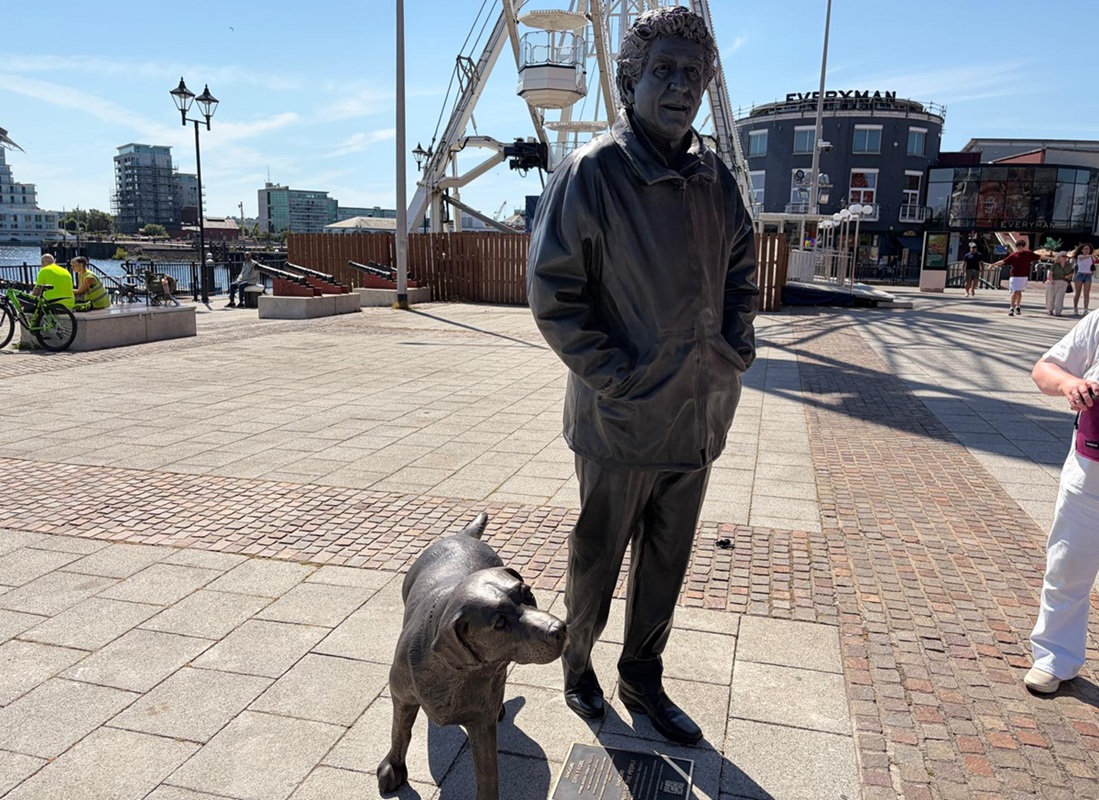
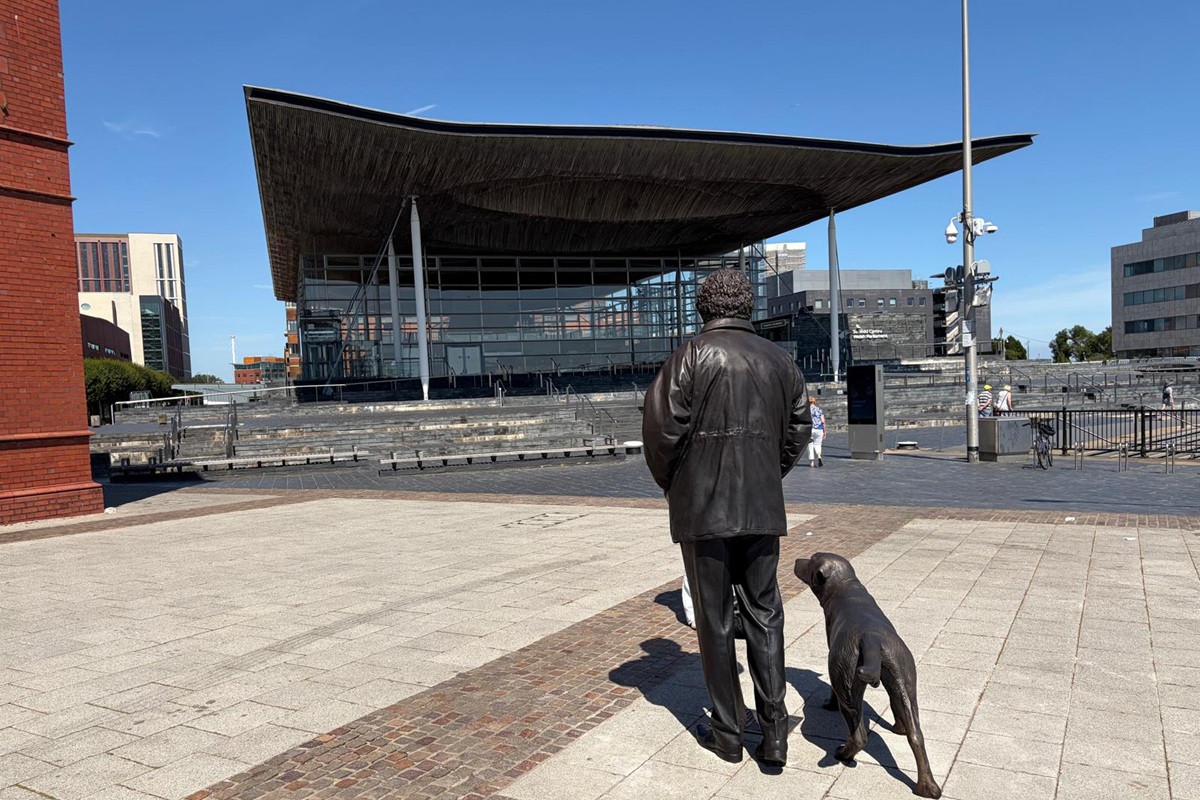
The statue was unveiled outside the Senedd’s Pierhead Building by members of Morgan’s family, including his great-grandchildren. It depicts Morgan in casual winter clothes taking his dog Tell for a walk in the direction of the Senedd.
Asked by Nation.Cymru how he had approached the project, Edwards said: “I think I just listened – I listened a lot to what people said about Rhodri. And it was all coming from the same place.
“This was a highly unique man in that he was at people’s level. He was an everyday person. All it would take was a gentle tug on his sleeve for him to engage the everyday business of under-represented people. I’ve just tried to illustrate that condensed version of what people told me and what I knew already, and just focus on that aspect. So he’s not on a lofty plinth, he’s at an accessible level. And that’s the key to the narrative of the piece. He’s a man first, a politician second. And he’s at ground level on the same level as the people he represented.”
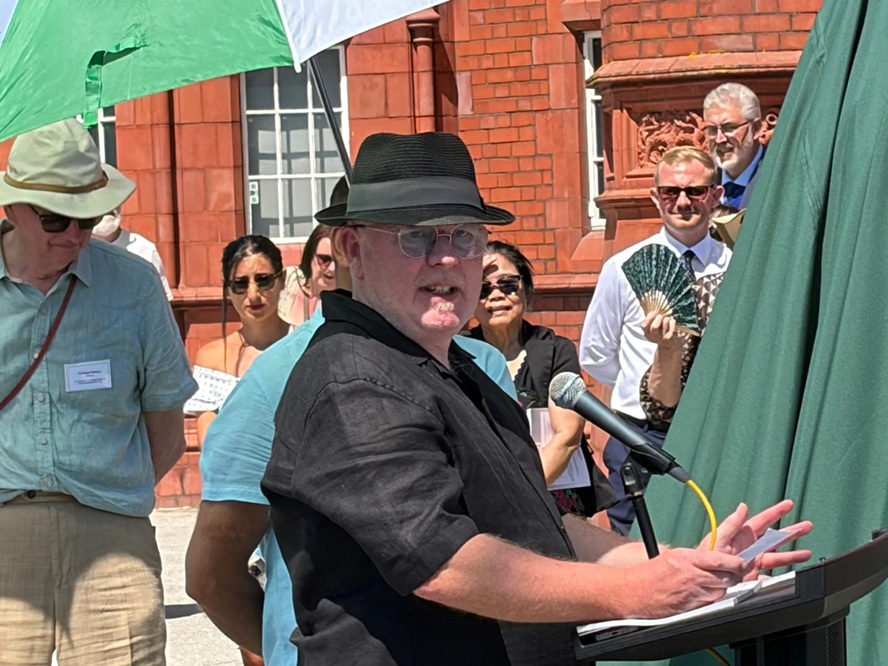
Edwards said that when developing his successful pitch for the commission, he made a scale model because I find it easier to visualise things in 3D than 2D. He added: “I spent a lot of time looking at the site here on the page. And when everyone else was inside the Senedd, I was sat outside just looking around trying to get a feel for the place, the way that people move through that space. So it’s a product of that process really – of sitting and thinking and listening.”
In terms of the impact he would like the statue to have, Edwards said: “I think it’s really important to keep Rhodri part of the conversation. He still needs a presence here in the heart of Wales, right by the Senedd. And I think not just as a visual reminder, but as a reminder of what it feels to be that proud of where you’re from, and to continue with the narrative that Rhodri started.
“I know a lot of care has gone into the exact position for Rhodri’s statue, and it’s part of a thoroughfare. I think that he feels part of active, everyday life. And that’s something that I really enjoy, and I hope other people will enjoy that feeling too.”
Former Presiding Officer and current Plaid Cymru Finance Minister Elin Jones is one of only two remaining Senedd Members from the first term, joining it with Rhodri Morgan in 1999.
She told those present at the unveiling ceremony: “Looking towards his Senedd, Rhodri may have been a reluctant supporter of the Senedd building itself, but he was chief builder of the Senedd in the hearts and minds of the people of Wales. I know how determined he was to make sure that this new Parliament and its government worked in such a way that nothing it did jeopardised its place in the architecture of our nation. And he succeeded.
“I heard Julie [Morgan’s wife] this morning on Radio Wales say that he would probably not have been too keen to have a statue of himself, but of course the statues he would have known would have been the statues of the 20th and 19th centuries, statues erected often to war, to empire and to wealth. 21st century Wales builds statues to recognise equality, diversity, achievement and to recognise Wales.
“I think Rhodri would probably have been really chuffed to know that he is commemorated by his country alongside Betty Campbell, Billy Boston, Elizabeth Andrews, Max Boyce and others. This statue will tell the story of Rhodri the person, of course, but it will also tell the story of Wales, of us as a modern, confident democracy in the world.”
Recently elected Labour MS Shavanah Taj, the former General Secretary of TUC Cymru, said: “Rhodri really was a giant of politics, a proud socialist, and for many of us, the godfather of devolution. He believed firmly that when it came to decisions affecting Wales, they should actually be made in Wales. But he also understood that when it came to devolution, devolution was never about creating yet another layer of politics. It was about creating real opportunities – good fair work jobs, stronger public services and a fairer, more just society for us all.
“Many people obviously played a big part in winning devolution, but Rhodri did more than perhaps anyone else to make it actually work in practice. He took a fragile new institution and helped turn it into a confident national parliament.
“He showed that decisions made in Wales could deliver a distinctly Welsh way of doing things, and in doing so, he helped ensure that an entire nation found its voice. Long before the days when people talked about brand politics and Brand Wales and so forth, Rhodri really was championing Wales on the world stage, whether that was attracting inward investment, promoting Welsh talent or, of course, backing Welsh businesses.
“He had that real, unwavering belief in our nation – about our potential, about our people. But Rhodri’s patriotism was never narrow, and it was never actually just inward looking. He believed that a confident Wales should also be an internationalist Wales. He believed that initiatives such as the Wales for Africa programme helped shape a real vision for Wales that reached beyond its borders and stood in genuine solidarity with communities around the world.
“He was a bridge builder long before it became fashionable to talk about inclusion and diversity. He understood that Wales really was stronger when everyone felt that they belonged. He saw that in Butetown and in the docks, communities that have welcomed people from across the world for generations. He understood that Welsh identity was neither narrow nor exclusive: it was actually broad enough to embrace every single person who chose to call it their home.
“He understood that strong communities are built better when the everyday person has a seat around the table. He really was the champion of social partnership, bringing together government, employers, trade unions to ultimately solve the problems collectively, but also to build a brighter, bigger future for Wales. And he did it with so much style and so much humour.
“He had that real, genuine, unique ability to walk into a room, just kind of show up, maybe a bit late for something, and start talking about something really random that was not connected to what was on the agenda. But somehow everyone understood what the mission was, and they would always walk away thinking: ‘Oh my God, where is this place called Wales? We need to get over there. We need to visit this amazing place.’
“So this statue is going to honour a Welshman, a proud socialist, a bridge builder, and a nation builder. But more than anything else, it will remind us of the confidence that Rhodri gave Wales to speak for itself, to govern itself, to play its part in the whole world, and to never think too small. That was Rhodri Morgan’s gift to Wales, and that is a legacy that will endure for generations to come.”
Support our Nation today
For the price of a cup of coffee a month you can help us create an independent, not-for-profit, national news service for the people of Wales, by the people of Wales.
Get more trusted Welsh news
Choose Nation.Cymru as a preferred source in Google News to see more of our journalism.


