

The surprising religious origins of Welsh profanities
Nation.Cymru Staff
Welsh may have plenty of colourful ways to express anger, shock and frustration, but some of the language’s most familiar profanities have surprisingly religious origins.
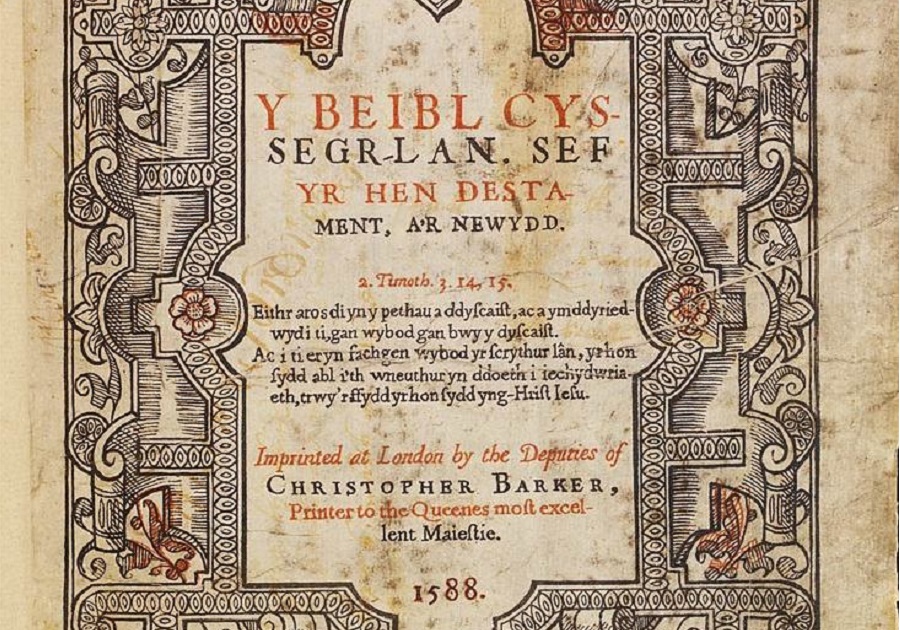
In an article for We Learn Welsh, Erin Williams writes that, following William Morgan’s Welsh translation of the Bible in 1588: “Religion was a fundamental aspect of how [Welsh] developed and survived over time – not just linguistically, but culturally, too.
“With Welsh being seen as the ‘poor man’s’ language due to Wales increasing its political relationship with England (which eventually led to Welsh being banned in school with the introduction of the Welsh Not), it found its refuge within Christianity – apart from it being spoken within the home, the church was the main place where the Welsh language could be spoken.
“Because of this, the language hasn’t modernised like English has. If you’re already learning Welsh, you’ll know that it’s a traditional language with some very old-fashioned elements – and this is very much reflected in how we tell people to bugger off!”
Unlike many common English swear words, a number of traditional Welsh expressions draw on biblical ideas and figures, with references to the devil, hell, God, Jesus and even bishops appearing in everyday exclamations.
Though she notes that some of the expressions would traditionally be considered inappropriate in religious settings, Erin also explains that few Welsh-language profanities carry the same level of offence as their English counterparts.
“A lot of them are interchangeable based on the context,” Erin writes. “For example, you’ll hear them used in any usual context where one might swear…
“I’ve heard them in heated arguments, under someone’s breath in frustration or in between tears of sadness. I’ve also heard them through laughter in a pub, in a warm embrace between good friends and in the comforting of a loved one.”
“It’s difficult to say how and when these should be used, as although they are considered profanities, they simply cannot be compared to their English counterparts. The truth is, they’re used all the time, and nowadays, instances where people get offended by these profanities are few and far in between.”
So, what are some of these distinctly Welsh ways of swearing, and what do they actually mean?
1. Diawl
Meaning ‘devil’ in English, diawl, diawch, or jawch can be used for someone who is “mischievous, cheeky or unruly”.
The expression be ddiawl? literally means “what the devil?”, while dos i’r diawl, or “go to the devil”, is used in much the same way as telling someone to “go to hell”.
But this doesn’t always have to be insulting. Someone who has made a fool of themselves might jokingly be called a diawl gwirion, or “foolish devil”, Erin explains, while a troublesome pet could affectionately be described as a diawl bach, meaning “little devil”.
2. Uffern
Erin writes that uffern, meaning ‘hell’, can carry more force than diawl when used as a profanity, while the word itself is also used when referring to hell in a religious context.
Used as uffar in north Wales and yffach in south Wales, it can be said in more innocent contexts to mean ‘very’. Erin gives the examples of yffach o sioe (hell of a show) and uffar o foi (hell of a bloke).
Lle and be uffar/yffach can be used to mean ‘where the hell?’ and ‘what the hell?’ respectively, but the writer also notes that it’s more intense than diawl, aligning more closely with f*** in English, which she attributes to its “vocal oomph” in pronunciation.
3. Ar f’enaid i
4. Arglwydd and Rargian
Another term that can be used is arglwydd, meaning ‘lord’, with arglwydd mawr meaning ‘dear lord’ or ‘good lord’.
The next, rargian, from yr argian, is thought to have developed from arglwydd. Erin describes it as an informal spoken expression which consequently did not appear in formal written texts.
It can be used in much the same way as arglwydd, for example ‘rargian fawr’ and ‘rargian dafydd’ (lord David), when you are frustrated or shocked.
5. Iesgobanwl
The next term Erin includes is iesgobanwl, which combines the Welsh words yr esgob annwyl, meaning ‘dear bishop’.
More commonly heard in north Wales, the expression can be used to convey frustration, while the shortened iesgob may also be used in much the same way.
6. Iesu and Duw
Finally, Iesu/Iesu Grist and Duw are often used in the same way as their English counterparts, Jesus and God.
However, Erin explains that they have a few forms unique to the Welsh language too, including Duwadd annwyl / Duwadd anwl, meaning ‘dear God’, Iesu mawr and Iesu bach, Iesu Gwyn, and Duw Duw.
Commenters shared their own anecdotes of learning and using the profanities Erin listed, with one writing: “It always tickled me that my grandmother, who considered swearing as a serious profanity and would never ‘take the Lord’s name in vain’ would swear in Welsh and consider it acceptable.”
“My gran used to say ‘mochyn bach’ when I came in covered in mud!” another replied.
Others thanked Erin for shining a light on the origins of the common phrases, writing: “Growing up in the Rhondda I used ‘jawch’, and still do, but I wasn’t aware of its derivation ’til now. Diolch.”
The full article, Profanities in Welsh, is available to read here.
Support our Nation today
For the price of a cup of coffee a month you can help us create an independent, not-for-profit, national news service for the people of Wales, by the people of Wales.
Get more trusted Welsh news
Choose Nation.Cymru as a preferred source in Google News to see more of our journalism.




I was twelve before I was forced to swear in English…LoL
The classic religious swear word in English is, somewhat surprisingly, “bloody”, which is a compression of the phrase “By Our Lady”. This refers to Mary Mother of Jesus and by changing it to “bloody” it was no longer considered blasphemous.