

Think tank questions how Plaid Cymru would afford its ‘giveaways’
Martin Shipton
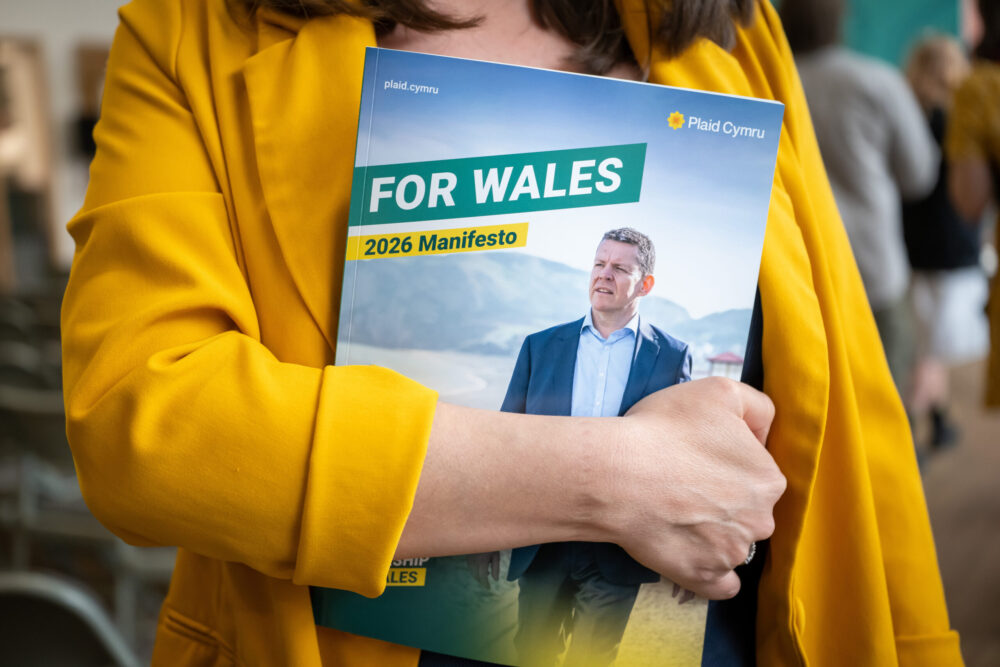
Plaid Cymru’s manifesto offers more support for families with children, but has important question marks over how to fund its giveaways, according to a leading think tank.
David Phillips, Head of Devolved and Local Government Finance at the Institute for Fiscal Studies (IFS), said: “Plaid Cymru have been criticised by some for pledging a myriad of reviews of health and education policy and performance. In fact, this is a strength of their proposals: Welsh public service performance is poor and understanding why and how to address this is important.
“Turning to more concrete measures, Plaid Cymru proposes increasing spending on childcare by around £400m a year by the end of the parliament. Despite the party’s leader having claimed that he ‘know[s] it is money that we can afford’, and claims that plans are fully costed, the manifesto does not spell out where the money would be found. The same is true of a number of other commitments, such as expanding free school meals to more secondary school pupils, a potential £10 per child per week top-up to universal credit for families with children, and a range of initiatives aimed at improving NHS performance.
“Plaid Cymru have previously highlighted recently confirmed top-ups to Welsh Government funding from the UK Government as a result of changes to spending on special educational needs services in England. However, with Welsh NHS spending currently set to fall in real-terms in the current financial year, 2026–27, much if not all of this top-up to funding will likely need to be allocated to the NHS, both this year and in future, just to maintain let alone improve performance.
“The overall ‘giveaways’ in Plaid Cymru’s manifesto are not huge, but in the context of a Welsh budget already likely to be under strain post-election – particularly in 2027-28 –, delivering these plans would deepen the cuts faced by unprotected services and/or require increases in devolved taxes.”
Looking at the tax side of the budget, Plaid Cymru, like Welsh Labour say they would make council tax “fairer”. Mr Phillips said: “This could be achieved simply by going ahead with the already planned revaluation in 2028, although as we have previously argued, there is the opportunity for further beneficial reform too.
“The manifesto says that business rates would be reformed, ‘reducing high street rates while ensuring out-of-town retailers pay their fair share’. Whether shifting the burden of business rates in this way would be fair – given small, lower-rent retail properties already benefit from a lower tax rate, than large, higher-rent retail properties – is in the eye of the beholder. But both economic theory and evidence suggests that reductions in business rates for particular locations increase the demand for properties in those locations – pushing up rents and transferring most of the benefit to landlords instead.
“On income tax, Plaid Cymru say that they would push for further tax devolution so that the Welsh Government can set income tax bands as well as rates, and use this power to make income tax ‘more progressive’. This means shifting the balance of taxation so that higher income taxpayers pay a relatively higher share of the tax burden and lower income taxpayers a lower share. Whether they would do this in a way that would be revenue-neutral, increase revenues, or reduce revenues compared to current tax rates is not explained.
“More obviously a potential revenue raiser is a pledge to push the UK government to devolve powers to levy a ‘vacant land tax’ on land with planning permission but where development does not actually happen – something the UK Government has agreed to run a joint consultation on with the Welsh Government. The main aim of such a policy though is to discourage land banking, and the revenues it would yield would be modest.”
Spending
Turning to the spending side of the budget, Mr Phillips said: “The big ticket item is a substantial expansion of funded childcare provision. The Welsh system currently offers 10 hours of funded early education per week for all 3- and 4-year-olds, an additional 20 hours of funded childcare per week for 3- and 4-year-olds in most working families, for 48 weeks per year. Some 2-year-olds in poorer areas are eligible for 12.5 hours per week under the Flying Start program during term time, with an ongoing expansion to cover all 2-year-olds.
“After completing the existing roll-out of 12.5 hours for all 2-year-olds, Plaid Cymru would gradually expand coverage to 20 hours of funded childcare per week for 48 weeks per year, for all children aged 9 months to 4 years. Plaid would also retain the more generous offer of 30 hours per week for 3- and 4-year-olds in working families. Compared to the Green Party’s proposals, Plaid’s offer would prevent 3- and 4-year-olds in working families from losing out, but would not incorporate additional subsidised hours above these entitlements (nor an ambition to move from 20 to 30 hours a week).
“Plaid Cymru’s proposals would represent a big increase in government spending in the early years. The cost of offering funded hours to children under 2 might even be larger than the party expects – England’s recent expanded offer proved far more popular than forecast. Plaid Cymru justifies this extra spending on the grounds of children’s development, parents’ ability to work, and families’ cost of living. Expanding funded childcare provision would help reduce costs for families already paying for childcare. But both improving child development and boosting labour supply at the same time through childcare subsidies is tricky and expensive, and much will rest on the design of the programme.
“Plaid Cymru also propose trialling and then, if successful, rolling out nationally Cynnal, a Welsh child payment of initially £10 per child per week for children in families in receipt of universal credit. This would modestly reduce child poverty. As we discussed in a recent report, it is unclear whether existing powers allow the Senedd to legislate for such regular, general top-ups to benefits – social security is explicitly reserved to the UK Parliament in the case of Wales. Perhaps with this in mind, Plaid Cymru say they would ‘press the UK government on devolving welfare powers to Wales, on a par with Scotland’, which does have the power to provide general top-ups to benefits. It is unclear whether such powers would be granted.
“Another pledge aimed at addressing the cost of living for (some) families with children is expanding free school meals to all secondary school pupils in households claiming universal credit – matching a recently announced policy in England and a proposal by Welsh Labour and the Green Party.”
Increase in spending
In a section headed “Paying For Their Plans”, Mr Phillips states: “Taken together, these plans would amount to a notable increase in spending – by more in the coming Senedd term than implied by Welsh Labour’s plans, for example, although less than implied by the Green Party manifesto. Unfortunately, Plaid Cymru provides little information on how they would pay for these increases.
“As it stands, the outlook for Welsh Government funding implies that cuts to at least some services will be needed to maintain let alone improve health and social care services as costs and demands grow. Spending £400 million a year more on childcare, with more to boot on a Welsh child payment, expanded free school meals and better primary healthcare would require either deeper cuts to unprotected services, a substantial slowdown in core health and social care spending, or as-yet unmentioned tax rises.
“Plaid Cymru therefore does not appear to have faced up to the fiscal reality facing the next Welsh Government. And if the party knows how it would afford its pledges, it has omitted to explain how in its manifesto. This is disappointing, especially given Plaid Cymru’s recent complaints about unfunded promises by other parties.
“The manifesto repeats previous claims that Wales has suffered ‘historic underfunding’ as a result of the Barnett formula, and says Plaid Cymru would push for more funding. However, as discussed in a recent IFS report, the officially agreed method for assessing Wales’s relative funding suggests Wales receives more funding per person compared to England than the latest assessment of needs implies would be required.
“This funding advantage is set to shrink over the next few years, the relative needs assessments are now based on data almost 20 years old, and other methods for assessing relative funding suggest it is not as generous as the official method implies. Even so, it would seem premature to bank on a ‘needs-based’ funding system leading to an increase in Welsh Government funding to fund the manifesto’s ambitions.
“Plaid Cymru are on more solid ground when they highlight the relatively low share of (reserved) rail capital investment that Wales has received – although its argument for a population-share of such investment is arguably inconsistent with its more general criticism of population-based funding allocations elsewhere.”
Support our Nation today
For the price of a cup of coffee a month you can help us create an independent, not-for-profit, national news service for the people of Wales, by the people of Wales.


