


Traditional town centre business model is ‘dead’, ex-minister warns
Chris Haines, ICNN Senedd reporter
A former minister warned the traditional business model for Welsh town centres is “dead”, dismissing “magic bullets” such as free parking and abolishing business rates.
Labour’s Lee Waters argued the economic reality of online and out-of-town shopping means a new purpose must be found for struggling high streets.
Mr Waters described town centre regeneration as a “gnarly, knotty problem”, with economics at its heart, during a debate in the Senedd on October 15.
Warning of an “unfair, unlevel playing field”, he told the Senedd: “The business model of the town centre that we all grew up with is dead.”
The former transport minister said the business model has been “enormously disrupted” by supermarkets, out-of-town shopping, online retail and the pandemic.
‘Complex tapestry’
Mr Waters warned of little evidence to support free parking which would take revenue from councils and fail to address the 25% of people who do not have access to a car.
“The world as we knew it has gone,” he said. “And simply abolishing business rates or providing free car parking is not going to bring it back. It’s a far more complex tapestry we require… and I’m afraid our rather glib debate on these things is getting us nowhere.
“But the fix is much more complex and involves far more partners in a granular way.”
The Labour politician, who is standing down in May, said it is much cheaper for a business to build out of town than to redevelop a town centre property.
He also explained how housing trends have changed the social and economic fabric of town centres, leaving them to cater to a different demographic.
Calling for a long-term plan, including the public and private sectors, Mr Waters raised an example of “disjointed” government leading to a college in Bangor moving out of town.
‘Plugging holes’
The debate was tabled by Plaid Cymru’s Luke Fletcher, who painted a similarly bleak picture of high streets with “vacant retail units, shuttered shopfronts and boarded-up windows”.
He warned government schemes were merely “plugging holes, not rebuilding foundations”, with Wales having the second highest rate of vacant shops in the UK.
The shadow economy secretary argued the real issue was “ownership”, calling for a community right to buy to tackle the problem of absentee landlords.
Plaid Cymru’s motion called for a comprehensive strategy for town-centre regeneration, preferential business rates, long-term funding and a law on “right to buy” powers.
Delyth Jewell, the party’s deputy Senedd leader, said: “These buildings… tell the stories of our past…. It is a covenant with our past that is being corroded with these closures.”
‘Fantasies’
The Conservatives’ Joel James warned Labour policies have driven businesses on high streets to extinction, with high business rates amounting to “economic punishment”.
He argued throwing money at regeneration projects is useless without first fixing the underlying business environment to ensure competition can thrive.
Mr James criticised the “anti-business, anti-growth” motion and its focus on local ownership, warning Plaid Cymru’s “financial fantasies” offer no hope for high-street businesses.
He told the Senedd the Conservatives would scrap rates for all small businesses and improve access to free car parking in town centres.
Labour backbencher Mike Hedges agreed with Plaid Cymru’s calls for a right to buy, saying: “The community right to buy is proven, popular and politically effective. We need to have it in Wales and… we need to have it now.”
‘Prosperity’
Jayne Bryant, Wales’ local government secretary, pointed to £100m delivered through the transforming towns programme since 2022, with another £57m on the way.
Ms Bryant, whose responsibilities include regeneration, told the Senedd an empty property enforcement fund has been set up to help bring vacant buildings back into use.
She said the Welsh Government is providing £335m in rates relief this year, which includes £78m for retail, leisure and hospitality businesses.
Ms Bryant explained a “town centre first” principle has been embedded for planning decisions on where to locate public services such as colleges and health hubs.
The minister added that a commission – set up to explore local ownership models – is set to present its recommendations next month which will inform the introduction of a right to buy. Her goal, she said, is to bring “pride, purpose and prosperity back to the heart of our towns”.
At the end of the debate, Plaid Cymru’s original motion was voted down before ministers’ amended version – which supported the existing strategy – was narrowly passed, 24-23.
Support our Nation today
For the price of a cup of coffee a month you can help us create an independent, not-for-profit, national news service for the people of Wales, by the people of Wales.



The old model was based on people being forced to visit the high street because it was the only way to do whatever they needed to do. The new model must be based on people choosing to visit the hub of their community because they want to.
Mixed residential and retail works. Parks, the arts, entertainment, restaurants, cafes, pubs, event venues, hairdressers, manicurists, beautifying treatments, ELECTROLYSIS (yes. I need a good one). Services more than products. Unique shops selling curiosities and specialist things
Excellent responses to the faulty micromanagement by the Welsh Labour Government of town centres by Luke Fletcher and Lee Waters. Just what are towns for if people have no money? Shop owners are demoralised, attacked by rapacious landlords and high interest rates, while their customers are undermined by low incomes, benefits and pensions, poor public transport and high food and energy costs. We know that neoliberalist economics causes all of that, but, lo and behold, some people seem to want even less money – under a Reform, Reform-Tory or Reform-Labour government! Brexit2 and more destruction of our society, communities and… Read more »
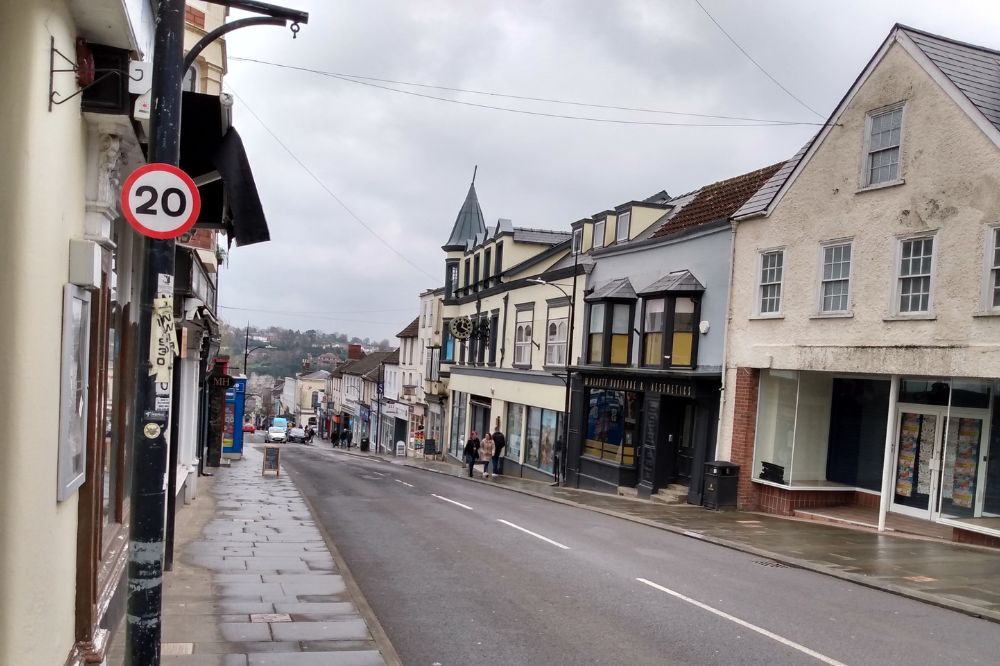
Interesting that you’ve used Chepstow as an example pic. Most of those buildings seen in the picture are owned by a property company that refuse to do basic maintenance and repairs, but also charge full wack, basically only the large chains can afford the rent.
Suggestions and ideas are constantly put forward by business experienced members of the community, but thrown back. Basically unless it’s a craft fair, you’ve got zero chance in Chepstow.