

TV airtime will favour Reform UK in Senedd election, but Plaid has other routes to voters
Martin Shipton
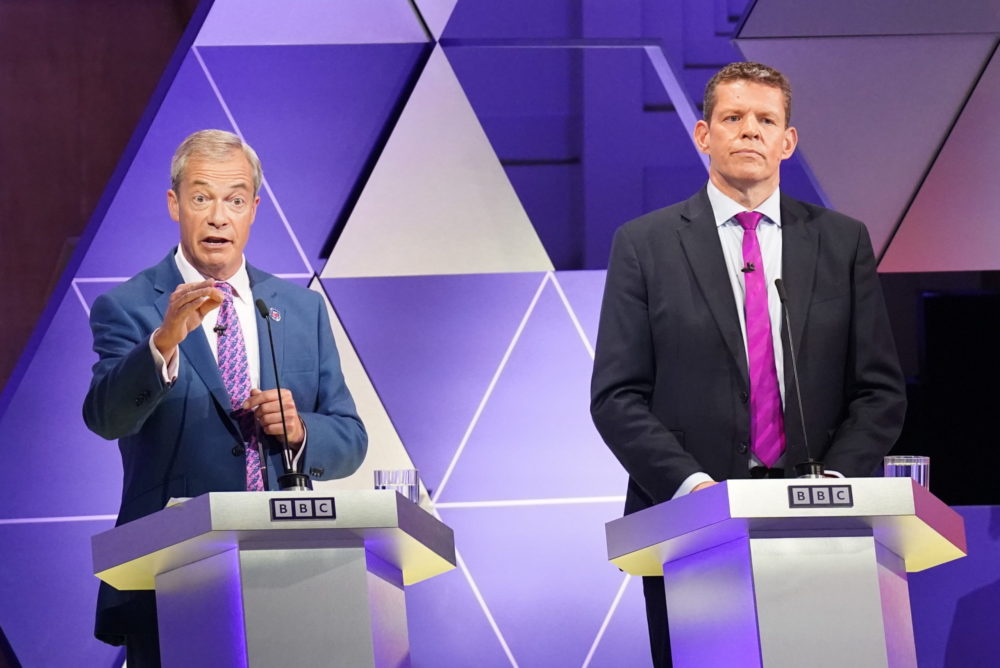
The amount of time devoted to covering Reform UK by TV broadcasters would appear to give the party led by Nigel Farage a significant advantage over Plaid Cymru in terms of exposure in the run-up to next May’s Senedd election.
But research undertaken by academics at Cardiff University shows that Plaid voters are less likely to get their news from TV than from less traditional media like news apps and websites without a linked newspaper like Nation.Cymru.
Recent polls suggest that the battle to win the highest number of seats in the Senedd will be between Plaid Cymru and Reform UK.
The research, led by Professor Stephen Cushion at Cardiff University’s School of Journalism Media and Culture, shows that Reform UK overtook the Conservative Party as the most referenced opposition party (37) on both the BBC news at Ten and ITV News at Ten in September 2025.
The Conservative Party (25) had previously received more attention as the official opposition throughout 2025, but coverage of Reform UK in September increased with a focus on stories about immigration and asylum along with the party’s conference.
Reform UK’s Nigel Farage was the most referenced party leader on ITV News at Ten (49), followed by the Conservative’s Kemi Badenoch (33), and the Liberal Democrats’ Ed Davey (10). On BBC News at Ten, Kemi Badenoch (57) was the most referenced party leader, followed by Nigel Farage (47) and Ed Davey (20).
Reform UK was the dominant party in more than twice as many stories as the Conservatives and just under four times more stories than the Liberal Democrats. On the BBC News at Ten, Reform UK was the main focus in 26 items, compared to the Conservatives’ 14 items, and the Liberal Democrats’ 8 items. On ITV, Reform UK was the dominant party in 25 items, compared to the Conservatives’ 11 items, and the Liberal Democrats’ 5 items.
Between January and September 2025, on BBC News at Ten there were 338 references to opposition parties: 157 to the Conservatives (44.4%), 83 to Reform UK (24.6%), 61 to the Liberal Democrats (18%), 24 to the SNP (7.1%), 12 to the Greens (3.6%), and just 1 to Plaid Cymru (0.3%).
Between January and September 2025, on ITV News at Ten there were 225 references to opposition parties: 101 to the Conservatives (44.9%), 74 to Reform UK (32.9%), 25 to the Liberal Democrats (11.1%), 14 to the SNP (6.2%), 10 to the Greens (4.4%) and 1 to Plaid Cymru (0.4%).
Reform UK received 3x as many references as the Liberal Democrats on ITV News at Ten, and 1.36x as many references as the Liberal Democrats on BBC News at Ten.
Immigration and asylum was the dominant context in which opposition parties were referenced, accounting for 56 (16.6%) references on BBC and 51 (22.7%) on ITV.
News at Ten
On BBC News at Ten, the Conservatives were the most referenced opposition party in relation to immigration and asylum with 26 (46.4%) references, then Reform UK with 20 (35.7%), and the Liberal Democrats with 8 (14.3%). On ITV, Reform UK was the most referenced opposition party in relation to immigration and asylum with 24 (47.1%) references, then the Conservatives 23 (45.1%), and the Liberal Democrats with 8 (15.7%).
Despite the SNP being the party in government in Scotland and having nine MPs, it received limited airtime in TV news, with a large proportion of coverage related to Operation Branchfoot and the embezzlement scandal that led Nicola Sturgeon to resign as First Minister (of which she was cleared).
There was scant coverage of the current SNP government’s policy agenda in Scotland or its members in Westminster.
The Greens received very little coverage despite polls showing they attracted 10% of voters throughout 2025 (in October 2025 this increased to 17%). When the party was covered, it was mostly in the context of the local elections and the Greens’ 2025 leadership contest. And even then, neither BBC nor ITV News at Ten covered the announcement or build-up to the Green Party leadership election in the summer. Both bulletins only covered the result on September 2.
Supporters of political parties differed in terms of their main sources of news:
Plaid Cymru
A news app on a mobile or tablet device: 15.0%
A news website not associated with a newspaper: 14.9%
A newspaper’s website: 10.1%
A printed copy of a newspaper: 2.3%
Blogs not associated with major media organisations: 3.5%
Radio: 9.4%
Social network websites: 12.6%
Television: 28.5%
Reform UK
A news app on a mobile or tablet device: 12.7%
A news website not associated with a newspaper: 8.4%
A newspaper’s website: 9.9%
A printed copy of a newspaper: 4.7%
Blogs not associated with major media organisations: 1.2%
Radio: 8.3%%
Social network websites: 12.8%
Television: 35.8%
Wales Green
A news app on a mobile or tablet device: 15.9%
A news website not associated with a newspaper: 13.1%
A newspaper’s website: 9.7%
A printed copy of a newspaper: 0.7%
Blogs not associated with major media organisations: 0.0%
Radio: 14.5%
Social network websites: 16.6%
Television: 18.6%
Welsh Conservative
A news app on a mobile or tablet device: 10.6%
A news website not associated with a newspaper: 6.4%
A newspaper’s website: 7.9%
A printed copy of a newspaper: 7.9%
Blogs not associated with major media organisations: 0.5%
Radio: 12.3%
Social network websites: 2.5%
Television: 47.8%
Welsh Labour
A news app on a mobile or tablet device: 15.1%
A news website not associated with a newspaper: 14.2%
A newspaper’s website: 6.7%
A printed copy of a newspaper: 2.9%
Blogs not associated with major media organisations: 0.4%
Radio: 10%
Social network websites: 7.5%
Television: 42.7%
Welsh Liberal Democrat
A news app on a mobile or tablet device: 15.9%
A news website not associated with a newspaper: 11.2%
A newspaper’s website: 3.7%
A printed copy of a newspaper:2.8%
Blogs not associated with major media organisations: 0.0%
Radio: 11.2%
Social network websites: 10.3%
Television: 39.3%
Professor Cushion said: “Digging deeper into this survey, we can see that TV news continues to be an important source of information for people in Wales. The survey doesn’t indicate what channels and programmes audiences are consuming, but the latest Ofcom audience data shows more people tune into UK-wide network news than national news in Wales.
“Given that UK-wide news does not regularly cover Wales or the Senedd, many people may be consuming news that does not directly inform them about political issues and policies that shape what is happening in Wales. If we combine online news, including through apps on phones and tablets, and social media, it makes up approximately 45% of people’s main sources of information. Once again, it is difficult to know what sites and posts people are accessing, but Ofcom data suggests it is more likely to be UK or internationally produced information than news produced in Wales.
“If we look at people’s main news consumption habits according to which party they’ll vote for at the Senedd election, the two traditional parties – Labour and Conservative voters – rely on TV the most while Plaid Cymru and Reform UK are more reliant on social media and other media, including ‘none of the above’ which suggests they’re going outside the mainstream media.
“This will inform how the parties pitch their policies ahead of the Senedd election next year – appealing to the traditional broadcasters and their online and social media networks, but also casting the net wider to ensure they catch all demographics and their changing news habits.
“The survey also discovered that higher social classes rely the most on online and social media for their main source of news, while many in lower social classes turn to TV or indicated they didn’t consume any media – a finding that demonstrates the information gap between different parts of Welsh society.
“While the survey provides some insight into people’s news consumption habits, it is essential we continue to learn more about what informs people in Wales about their democratic choices.”
Support our Nation today
For the price of a cup of coffee a month you can help us create an independent, not-for-profit, national news service for the people of Wales, by the people of Wales.



The amount of airtime that Reform gets is absurd.
It’s very easy to get TV news coverage, you just make vitriolic announcements of vindictive blame, faux outrage and controversial, unrealistic, simplistic, shallow solutions which you know will never come to pass but will buy you air time on the day. It’s clickbait news and TV media should be ashamed of themselves.
The clickbait is a mixed blessing for any political party. Reading some of the coverage is bound to put the reader off rather than generate support.
The Pavlovian response of ‘media’ to Farage, perhaps n.c could flesh this out. I have remarked on the coverage of the lethal ‘Poster Boy’ effect several times.
Reform are even bragging about the disproportionate coverage they get:
Reform UK is still novel and Farage is a very skilled communicator – even if most of the other Reform characters appear to be pretty dumb and dull clucks.
So the media, whose prime aim inevitably is to attract public attention and draw viewers/listeners/readers to their emanations, hang on to Nige’s every word because they reckon that he has the skills to draw in the punters.
That’s how the game operates. A pity, but there it is.
Pay attention to the US. farage has the same advisors. Trump is gutting any news org that says the truth to him. farage will do the same.
Yet our press fluff for farage. Really needed levenson II to sort out the mail, murdoch etc.
People have to remember that Farage, like trump is a very skilled actor, entertainer and salesman. They both use exactly the same psychological methods as Derren brown in one of his shows to control the crowd. The media knows exactly what they’re doing.
Anyone regularly watching the “News at Ten” on either ITV or BBC would have to have been extremely inattentive not to have noticed that Reform UK has had massive, extraordinarily favourable coverage during the last year or two. It has received way in excess of what could possibly be justified by its meagre 4 MPs. Comparison with the attention given to the Lib-Dems it is very striking. In these 2 bulletins, in September 2025, with 72 MPs the Lib-Dems got 30 mentions but with just 4 MPs Reform got 96! This blatant favouritism is an absolute disgrace.