


Two Welsh areas among UK’s toughest places for businesses to survive
Nation.Cymru staff
Two Welsh council areas are among the toughest places in the UK for businesses to survive, according to new research.
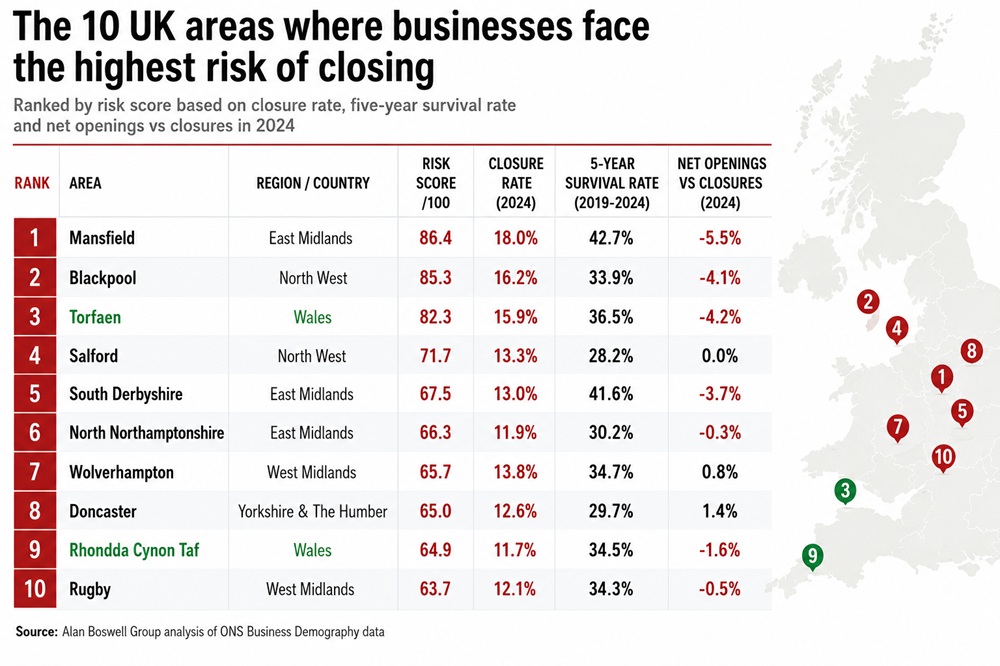
A study of business closures has ranked Torfaen and Rhondda Cynon Taf among the 10 local authority areas where firms face the greatest risk of shutting down.
The research, by insurance firm Alan Boswell Group using Office for National Statistics business demography data, assessed areas using business closure rates, five-year survival rates and whether more businesses opened than closed.
Torfaen ranked third in the UK, behind Mansfield and Blackpool. Almost one in six businesses (15.9%) closed during 2024, while the area also recorded more closures than new business openings.
Rhondda Cynon Taf was ninth in the rankings. Its business closure rate stood at 11.7%, while just 34.5% of firms established in 2019 were still trading five years later.
The picture was more positive elsewhere in Wales.
Powys was ranked the sixth least risky area in the UK, with a closure rate of 6.7%, a five-year survival rate of 50% and more businesses opening than closing during 2024. Gwynedd also featured in the 10 lowest-risk areas, placing seventh with a five-year survival rate of 55.2%.
Heath Alexander-Bew, Personal Lines Director at Alan Boswell Group, said: “When almost one in five active businesses in an area close in a single year, it shows just how much pressure some local firms are under.
“For most small business owners, shutting down is not a quick decision. It usually comes after months of dealing with higher costs, quieter trading, late payments, staffing challenges or unexpected expenses.
“What is concerning about places like Mansfield, Blackpool and Torfaen is that the pressure is showing in more than one way. These areas are not only seeing high closure rates, but in some cases more businesses are closing than opening. That can have a real knock-on effect locally, from empty units on high streets to less confidence among other business owners.”
The study excluded regional and national totals and ranked local authority areas using three measures: the proportion of businesses that closed during 2024, the percentage of firms launched in 2019 that were still trading five years later, and the balance between business openings and closures.
Closure rates accounted for 40% of the overall score, with five-year survival weighted at 35% and the balance between openings and closures making up the remaining 25%.
Support our Nation today
For the price of a cup of coffee a month you can help us create an independent, not-for-profit, national news service for the people of Wales, by the people of Wales.
Get more trusted Welsh news
Choose Nation.Cymru as a preferred source in Google News to see more of our journalism.




Need to very employers NI by postcode according to relative deprivation.
I disagree, I think you should not charge employers tax and such just to employ anyone.
While not charging businesses under 250k a year TO VAT
This would help businesses grow and employ people as their business will be in a position to need workers then
If you want to abolish employers NI you’ll need to explain how you’re going to replace the revenue. The basic idea is that employers and employees are both contributing to the social security pot. My proposal is simply to reduce the employers contribution in the areas that need the jobs the most, offset by a modest increase in the areas that can most afford it. By making poorer areas more attractive to employers more employment will follow, reducing benefits bills and contributing to UK growth. All without running up the national debt.
*vary
These are shocking figures on the face of it, but a comparison between 2014-19 and 2019-24 would have been useful to factor in Covid, and subsequent soaring post-recovery costs. Not saying this research isn’t relevant.
A lot of businesses start as sole traders working from home, and in a poorer area it may just not generate enough income to sustain that person, however good the idea or premise behind them. Cost pressures can be the cost of a point of sale terminal, which can be extortionate, or the cost of borrowing to grow the business (cash flow is a major problem) and this is before a business even thinks of taking on a business property or employing anyone. Scaling up any business is the difficult part. Can any government really provide help in scaling micro-businesses… Read more »