


Volcanologist from Welsh university joins deep-sea mission
A volcanologist from a Welsh university is set to explore one of Earth’s most mysterious underwater landscapes as part of an international expedition off the coast of Japan.
The mission will investigate “petit-spot volcanism”, a little-known phenomenon that may influence earthquake behaviour, by drilling into the Japan Trench near the epicentre of the 2011 Tohoku Earthquake.
Dr Katie Preece, Senior Lecturer in Volcanology at Swansea University, will join scientists from around the world on the International Ocean Drilling Programme (IODP3) Expedition 502.
Tectonic activity
The team will retrieve a 225-metre core of rock and sediment from close to the subduction zone to better understand how these volcanic features affect seafloor sediment and tectonic activity.
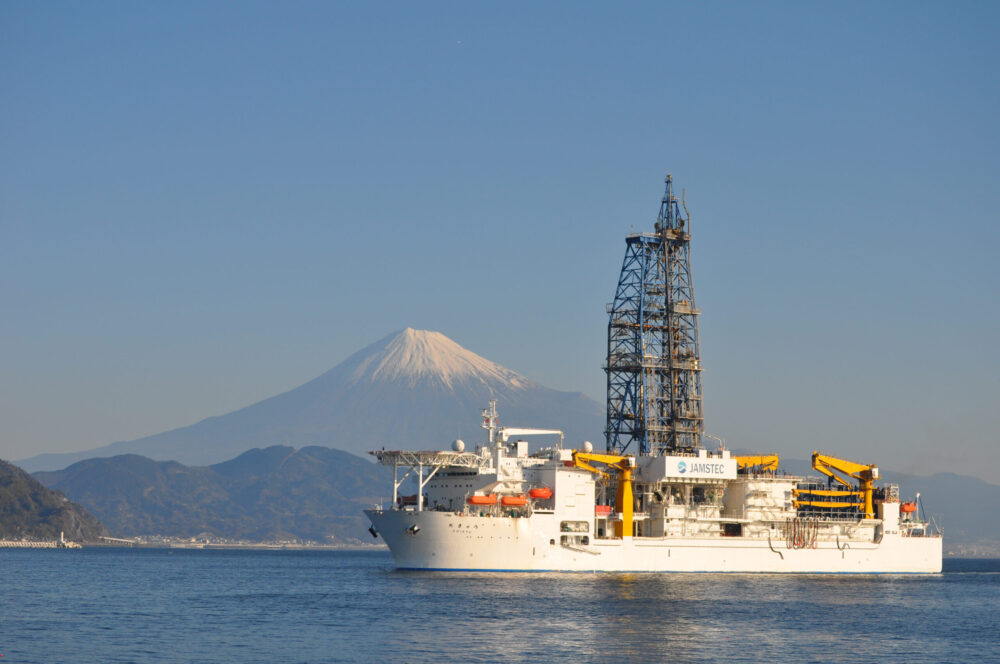
Dr Preece will serve as a sedimentologist aboard the state-of-the-art research vessel Chikyu, where she will help describe and interpret the core samples as they are retrieved.
Dr Preece said: “This is an extraordinary opportunity to contribute to cutting-edge research on a global scale. Petit-spot volcanism is still poorly understood, and this expedition will provide the first complete sequence of rock samples from these systems.”
Beyond this role, Dr Preece’s research focuses on reconstructing eruption histories and understanding how volcanic systems evolve. Combining fieldwork with laboratory techniques, including petrology, geochemistry and geochronology, she investigates how magma behaves before and during eruptions.
Her previous fieldwork has taken her to volcanoes in Indonesia, Ascension Island and Armenia, but this will be her first time participating in an IODP expedition.
Post-expedition research
Following the voyage, Dr Preece will lead post-expedition research analysing the textures and chemical composition of the recovered rocks. Her work will help scientists understand how petit-spot activity alters the subducting tectonic plate and contributes to Earth’s deep geochemical cycles.
Expedition 502 is a collaboration between 17 countries. Like many IODP missions, it presents significant technical and scientific challenges, with drilling operations taking place in some of Earth’s most extreme environments. In this case, the drill site lies beneath nearly 5.5 kilometres of water.
Dr Jude Coggon, UK IODP Programme Coordinator, said: “We are very proud to have three excellent UK scientists sailing on this expedition, as well as another participating in shore-based research.
“Over the past 50+ years, scientific ocean drilling has pioneered development of technologies for sampling the seafloor beneath the deep ocean, and explored this frontier to repeatedly transform our understanding of how our planet works. Expedition 502 is an exciting endeavour, which will help us to understand how this recently discovered style of volcanism impacts fundamental Earth processes, including megathrust earthquakes and the carbon cycle.”
Support our Nation today
For the price of a cup of coffee a month you can help us create an independent, not-for-profit, national news service for the people of Wales, by the people of Wales.


