


Wales getting ‘pat on the head’ in UK Government’s rail plans – Lib Dems
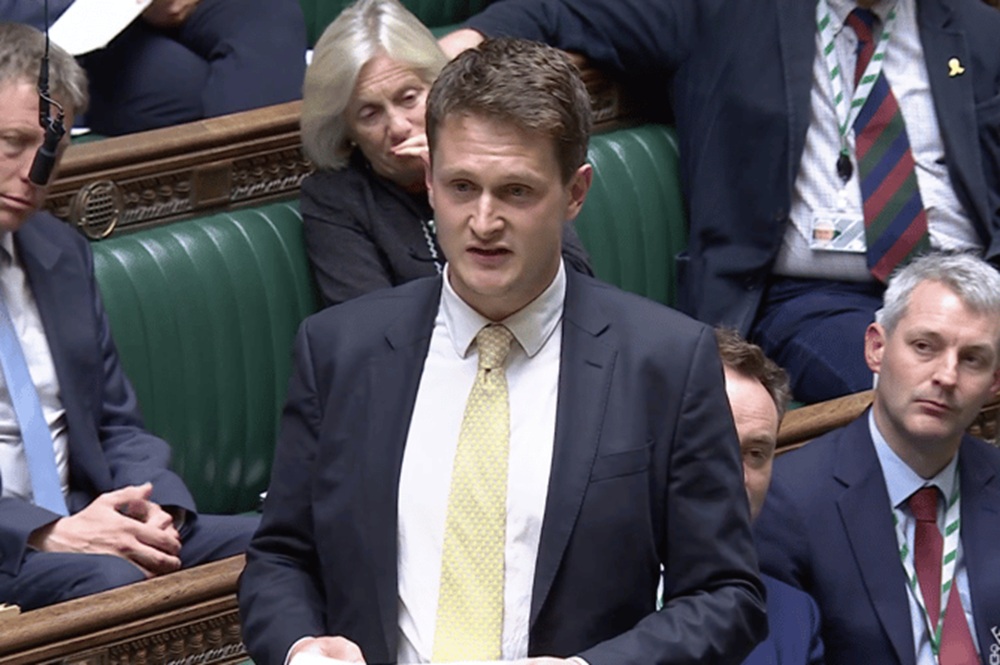
Westminster is offering Wales “nothing more than a pat on the head” in its rail plans, a Liberal Democrat MP has said.
David Chadwick criticised the UK Government’s treatment of Wales, which he said was suffering from “systemic neglect” while Scotland gets real power over its railways.
Mr Chadwick was speaking during the debate on the Government’s Railways Bill, which will bring train services under public ownership and enable the creation of the new publicly-owned body, Great British Railways.
The Brecon, Radnor and Cwm Tawe MP told the Commons on Tuesday that his constituency had some of the most neglected rail lines anywhere in the UK, forcing people to endure cancellations, slow journeys and “signalling technology that belongs in a museum”.
The Liberal Democrat Wales spokesman said: “What does this Bill do to fix any of that? Nothing.
“Instead, it centralises even more power here in Whitehall and offers Wales nothing more than a pat on the head and the promise of consultation.
“Consultation is what Wales has had plenty of for the last 30 years. And look where it’s got us.
“But the real injustice here is this: Scotland gets real power over its railways, and Wales gets nothing – no power of direction, no power over infrastructure, no power over funding, not even a guarantee that Welsh needs will be taken seriously.”
Mr Chadwick claimed the UK Government had “gone out of its way” to give Scotland meaningful authority, while Wales has “no plan of action”.
Billions of pounds
He added that England was set to receive tens of billions of pounds in rail investment over the next decade, while “Wales will receive only a few £100 million”.
“A gap so vast it can only be described as systemic neglect,” he said.
Plaid Cymru’s Ann Davies said the Bill “does not work for Wales” and it will continue to be overlooked as a result.
The MP for Caerfyrddin said: “Currently, two governments on either side of the M4 control different parts of what should be a single, unified train and rail network in Wales.
“This bizarre split makes for designing railways in the best interests of the people of Wales almost impossible.”
She continued: “It saddens me to say that this Government has decided to follow an age-old adage, ‘for Wales, just see England,’ and we are the only nation in Great Britain who does not have full control over our own rail network.”
Shrewsbury
Labour’s Julia Buckley, whose Shrewsbury constituency sits near the Welsh border, said the Bill will “deliver benefits for Wales”.
She said: “The cross-border gateway and the freight connections between our two nations, and growth in this area, aligns with the priorities over the border.
“We saw in the Budget, the Chancellor commit to £445 million investment over the next 10 years specifically to support transport infrastructure in Wales, highlighting the importance of that major investment of cross-border rail activity.”
Support our Nation today
For the price of a cup of coffee a month you can help us create an independent, not-for-profit, national news service for the people of Wales, by the people of Wales.



So, according to the Hon Memb for Shrewsbury, the Bill will benefit English trade with Cymru,, ignoring the scandalous lack of rail investment inside Cymru.
Independence is never given; it is only ever taken. Teach it to your children.
This debate exposes, yet again, the constitutional absurdity at the heart of UK governance. If Westminster were serious about fixing Welsh rail, it would devolve 100% of rail powers to the Senedd, along with the infrastructure, funding levers and strategic authority that every other nation takes for granted. But the deeper problem sits beneath it all: the Barnett Formula. It structurally underfunds Wales, bakes inequality into the system, and ensures that Wales is left holding the crumbs. Until Barnett is scrapped and replaced with a needs-based settlement, this systemic neglect will continue. Wales doesn’t need another consultation. It needs control.… Read more »
Which version of a needs based replacement for Barnett do you advocate?
Scrapping it is probably unwise as its replacement could be worse.
Better to keep it as a “catch all” with needs-based rules for specific funding streams as and when flaws are identified.
For example, per capita health funding could have a simple x7 multiplier applied to the proportion of the population aged over 80 to account for the inflated costs of caring for older people.
The other gap to close is in reserved matters where a law is required to prevent London administrators short-changing the regions and nations in spending they are still responsible for.
The Barnett formula only determines year-on-year changes to the devolved block grant by apportioning UK spending changes on a per-capita basis and does not reflect relative needs.
Independent reviews (Holtham; Silk) long recommended moving to needs assessments because Wales has structural needs (age profile, poverty, rurality) that per-capita changes fail to capture.
Recent UK devolved tensions have reinforced that Barnett can produce outcomes that look arbitrary or unfair to devolved governments.
A modelled allocation that captures structural, long-term needs: i) Indicators: population (age bands), child poverty rates, deprivation indices, disability prevalence, rural sparsity, health morbidity, school pupil needs (e.g. SEND), and relative input cost multipliers (wage and supplier cost differentials). ii) For changes in UK departmental programmes that affect devolved functions, use the per-capita adjustment but weighted by a needs factor (i.e. per-capita × (1 + α × relative needs score)), where α is a tunable parameter (e.g. 0.3–0.5) to blend equal per-person growth with needs sensitivity. iii) Barnett floor guarantee that any transition will not immediately reduce Wales’s total block… Read more »
Westminster: governance, mafia style.
The signalling may be old but I bet it’s still working!
In 2024 the rail regulator called out Network Rail’s performance in Wales as the worst in the UK for delays caused by asset reliability (track and signalling) problems.
Being part of the UK is destroying Wales.
£445 million over the next 10 years.
Or, to put it another way, an average of £44.5 million per year.
Or, to put it another way, bugger all.
Or to put it another way, £90m before RefCons get in and the rest is cancelled.