
Wales has lowest share of electric vehicles in Britain
Nation.Cymru staff
Just 2.6% of vehicles in Wales are electric, the lowest share in Great Britain, according to new analysis that highlights gaps in access to charging.
The Open Road Partnership, a coalition of automotive and vehicle rental businesses, found that electric vehicles accounted for 4.1% of vehicles in Scotland and 6.8% in London.
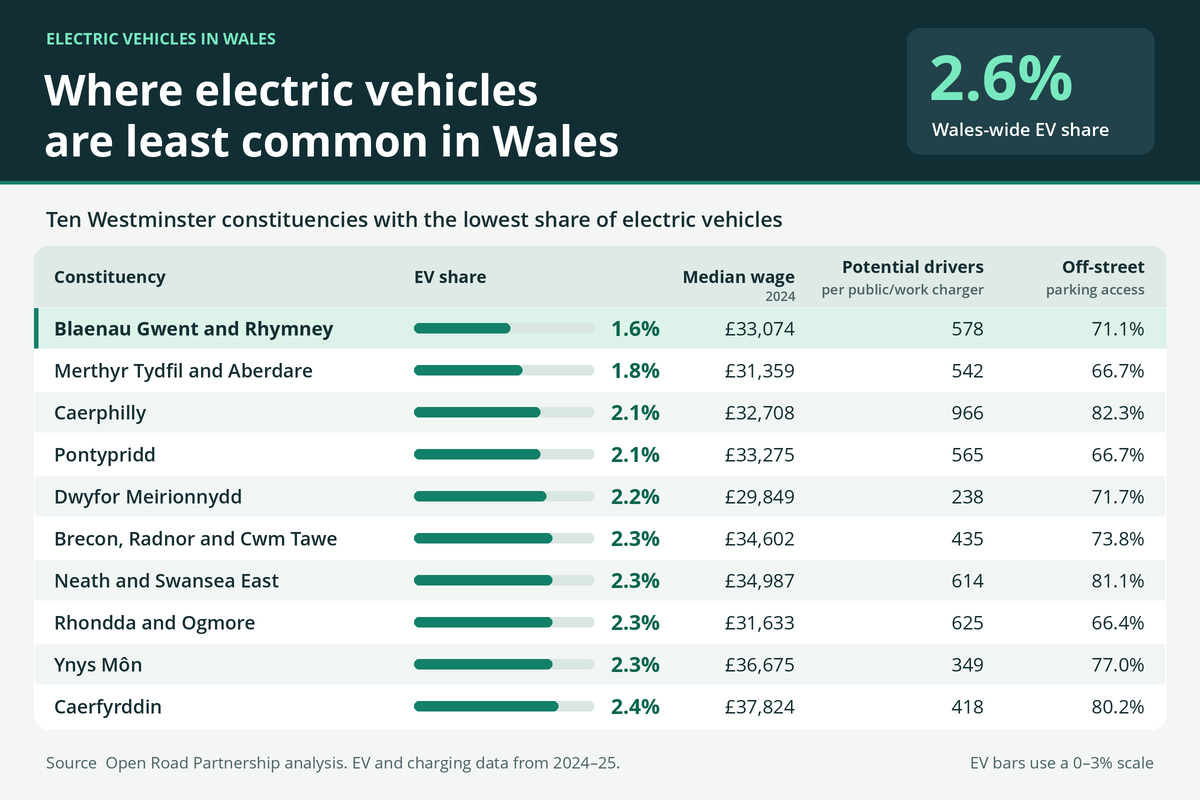
The share was below 3% in three-quarters of Wales’s 32 Westminster constituencies. Blaenau Gwent and Rhymney had the lowest figure at 1.6%, followed by Merthyr Tydfil and Aberdare at 1.8%. Caerphilly and Pontypridd both stood at 2.1%, while the figure in Ynys Môn was 2.3%.
Access to charging varied widely. Swansea West had an estimated 1,308 potential drivers for every public or workplace charger, more than twice the Welsh average of 583. Clwyd North had 959 potential drivers per charger, about 64% above the Welsh average.
In Dwyfor Meirionnydd, there were an estimated 238 potential drivers per charger, but just 2.2% of vehicles were electric.
The findings come as the UK and Welsh governments consider responses to a joint consultation on the Zero Emission Vehicle Mandate, which sets sales targets for manufacturers. The consultation closed on 23 October.
The partnership, whose members include Enterprise Mobility, United Rental Group, Vertu Motors and Zenith, argues that the timetable for meeting the targets is unrealistic given the cost of switching and uneven access to charging. It is calling for more affordable public charging, particularly for people who cannot charge at home, and for sales targets to reflect consumer demand.
Brian Swallow, Wales general manager at Enterprise Mobility, said: “Every day, we work with motorists and businesses across Wales who are considering the switch to electric vehicles. We know that affordability and access to reliable charging remain significant barriers for many.
“These findings underline the scale of the challenge in Wales, where lower EV uptake and significant gaps in charging provision risk putting the transition further out of reach for some communities. For drivers without access to charging at home, the practical and financial barriers can be particularly difficult to overcome.”
Richard Jones, chief executive of Zenith, said drivers who could charge at home could make substantial savings, while those relying on public chargers could in some cases pay more to run an electric vehicle than a petrol or diesel one.
The analysis covered all 632 Westminster constituencies in England, Scotland and Wales. It used electric vehicle and charging data from 2024–25, alongside figures on wages, transport density and access to off-street parking.
Support our Nation today
For the price of a cup of coffee a month you can help us create an independent, not-for-profit, national news service for the people of Wales, by the people of Wales.
Get more trusted Welsh news
Choose Nation.Cymru as a preferred source in Google News to see more of our journalism.