


Wales’ new minister for culture and sport sets out priorities for the next Senedd term
Ella Groves, ICNN Senedd Reporter
Culture and sport “are not a nice to have – they are part of the solution to creating a healthier, more prosperous society”, according to Wales’ new culture and sport minister.
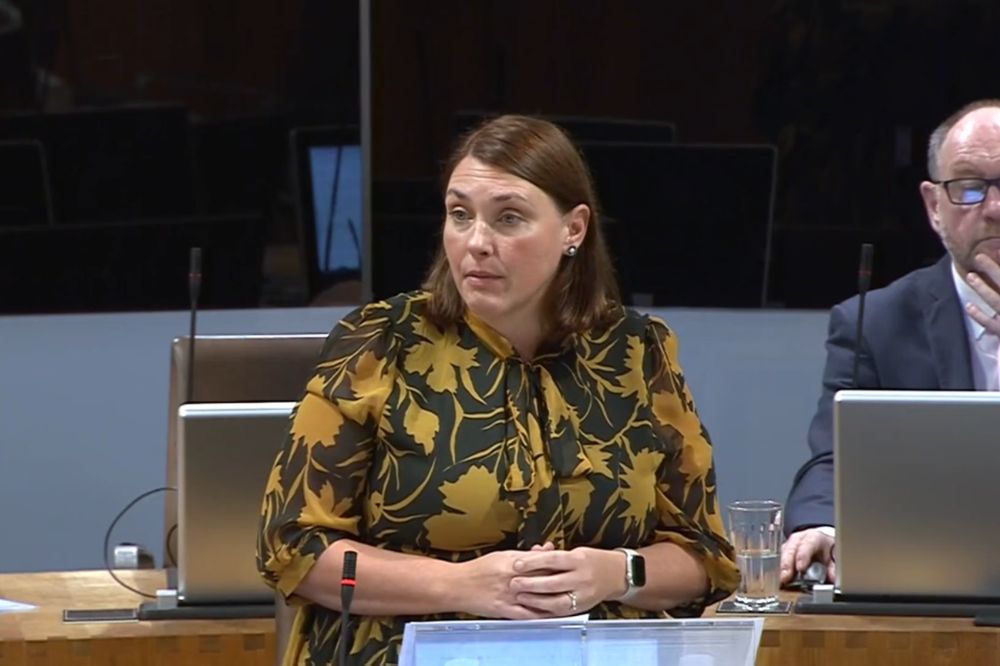
Outlining her priorities in the Senedd on Tuesday June 16, Heledd Fychan highlighted the importance of the arts and sport in preventative health.
She also spoke of the importance of the Welsh language and Wales’ music industry, and called for the devolution of broadcasting,
“These priorities mark the beginning of a journey and the beginning of a new chapter for culture and sport here in Wales,” Ms Fychan told the Siambr.
She continued: “This government believes in the power of culture and sport to transform lives, to contribute to the vision of moving towards a preventative health agenda to put our health service on a more sustainable footing, and because we are determined to build a Wales where creativity thrives.”
“Completely unnecessary”
Ms Fychan, of Pontypridd Cynon Merthyr, was quizzed on her government’s calls for the devolution of broadcasting.
In her statement, the minister pledged to create a “stronger media environment” which reflects a “confident and prosperous Wales”.
Laying out her priorities for broadcasting, she said: “Wales deserves a confident, diverse and sustainable media landscape rooted in public value and national ambition.
“To achieve this, Wales must have a voice in the decisions that affect us. That is why we are determined to continue to make the case for the devolution of powers over broadcasting.”
She revealed work is underway to set up a shadow broadcasting and communications authority – designed to build a “stronger and more accountable” media landscape in Wales.
She also highlighted her plans to support public-interest journalism and “safeguard the provision of high-quality news”.
Describing the development of a shadow broadcasting authority as “completely unnecessary”, Reform’s Louise Emery – who is shadow minister for culture – said: “This is more constitutional navel-gazing, more quangos, more slow state-building towards independence, and more cost.”
Ms Emery went on to criticise the government’s plans to support public-interest journalism and said: “On this side of the chamber, we feel we already have a state-funded news outlet with blatant political bias, and we don’t need any more.
“I would suggest that state-funded journalism in Wales will mean state-funded interference, and I would also suggest that ‘high-quality news’ is a highly subjective phrase. Who is going to decide what is high-quality journalism and therefore needs state help?”
She added: “How can we ensure there is no foreign interference when allocating Books Council of Wales funding to news outlets?”
Ms Emery’s comments were met with laughter in the Siambr from opposing politicians.
However, Ms Fychan made no reference to Ms Emery’s comments in her response.
Paul Davies, Welsh Conservative spokesperson for the Welsh language, culture and sport, echoed Ms Emery’s criticisms of the devolution of broadcasting powers.
Outlining his party’s opposition to broadcasting devolution, Mr Davies said: “Given the challenges that the cabinet minister has already highlighted in her statement today, surely this is not the best possible use of resources, especially given that these powers are not devolved.”
Mr Davies called for Ms Fychan to reveal how much was spent on the new authority, how it will be funded, and how it will operate.
Similarly as with Ms Emery, Ms Fychan did not reference Mr Davies’ broadcasting comments in her response.
“Integral”
Ms Fychan described use of the Welsh language, particularly social use, as an “integral” part of her priorities.
Discussing the upcoming Eisteddfod – which is celebrating it’s 850th anniversary – she said: “A contribution of £0.25 million from the government will support a programme of activities to inspire people to use the language and raise the international profile of the National Eisteddfod.
“Our financial support will also ensure that local low-income families have free access to the festival.
“It is vital that everybody has an opportunity to enjoy our culture, language and National Eisteddfod.”
Reform’s shadow minister noted that she was “really glad” to hear the Welsh language was being prioritised.
Responding briefly to the cabinet minister in Welsh, Ms Emery shared that she has been learning Welsh for two years and is hoping to practice her skills at the Eisteddfod this summer.
However, she questioned Plaid’s plans to get people speaking the language, adding that “coercion drives resentment, not fluency”.
She said: “If the Welsh Government is serious about one million Welsh speakers, it needs to invest in the conditions that make people choose the language, not mandate it on those who don’t speak it.
“Welsh culture, the arts and sport should lift people up and bring communities together – that we agree on. But they can do that in whatever language they choose.”
“Part of the solution”
In her statement, Ms Fychan said: “For too long, culture, the arts and sport have been pitted against the NHS rather than being recognised as completely connected to it.
“These sectors are not a ‘nice to have’; they are part of the solution to creating a healthier society. Our manifesto commits to making culture and sport accessible to all.
“That includes addressing inequalities in access, whether due to cost, geography, disability or other barriers.”
Reform’s shadow minister for health, prevention and sport, James Evans, noted that he “never thought [he’d] find the day” he would agree with the minister on so much.
Mr Evans described sport as a “key part” of the prevention agenda, before questioning the minister on how much of the NHS budget will be reallocated to sports.
He said: “We’ve heard a lot today about money being moved, but I think a lot of the sports organisations listening to today’s proceedings would like to know exactly what proportion that’s going to be.”
In response Ms Fychan said: “In terms of the exact figures and how we will do this, this is a completely new way of working for government, and what I can give you the assurance of is that there is an acknowledgement across government of the importance of this, that we are ensuring that those discussions are now taking place within those first 100 days and we will update the Senedd as we can.”
“Home-grown creativity”
Labour’s Mike Hedges questioned the minister on music tourism and it’s importance to both Welsh culture and the economy.
Stating that music touring in Wales, “attracted 834,000 visitors, supported 3,650 jobs, and generated £384 million for the economy” in 2024, Mr Hedges pressed the minister to commit to supporting Welsh music.
He said the Welsh Government must “grow Welsh music through smart public investment, bring down barriers to exporting Welsh music, ensure music education is accessible to all, and support home-grown creativity and new music that drives Welsh tourism”.
In response, Ms Fychan referenced a report released last year which showed that traditional music in Wales was in danger of “disappearing entirely”.
Noting that fewer children are taking GCSEs in music, drama, and art and that universities are cutting courses in creative areas, Ms Fychan said often these areas are seen as “not worth investing in” – adding that, “of course”, they are.
Closing her response to the member she said: “Hopefully we will then see, […], that there will be a future for creative people here in Wales, and a future for these sectors that are seen as economically beneficial.”
Support our Nation today
For the price of a cup of coffee a month you can help us create an independent, not-for-profit, national news service for the people of Wales, by the people of Wales.
Get more trusted Welsh news
Choose Nation.Cymru as a preferred source in Google News to see more of our journalism.



Would someone like to point out that Right wing outlet GB ‘News’ (?) has cost £121 Million to date & continues to spend £22Million each year on fabricating racist hate & division?? That reform members think that’s OK tells you all you need to know? After all their leader has taken £22 Million from a Foreign investor to date & thinks that’s fine?