


Warmest August bank holiday Monday ever for Wales
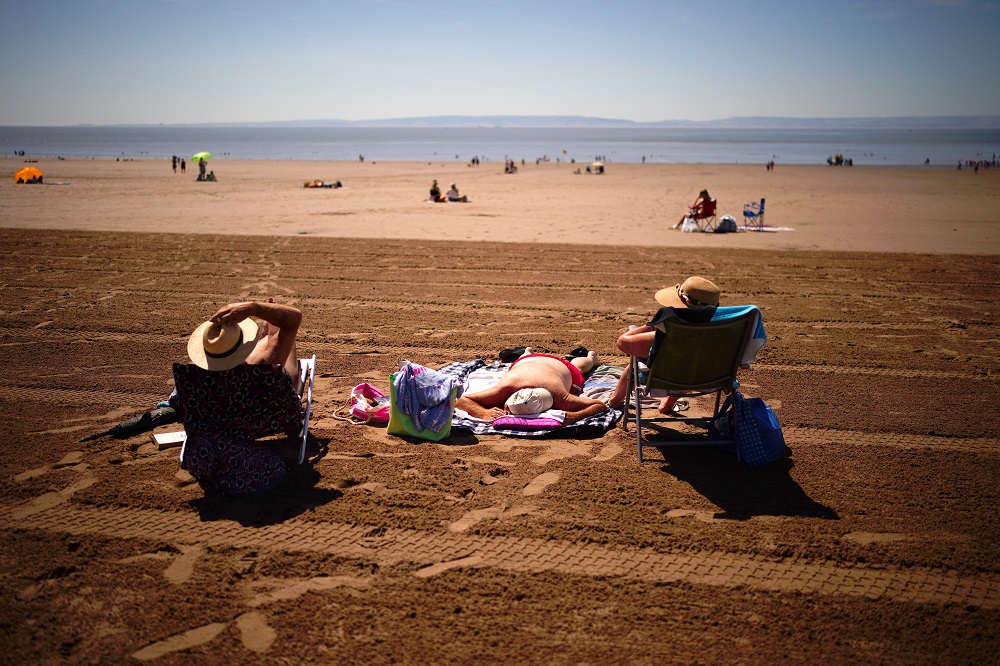
Wales has recorded it’s warmest August bank holiday Monday on record – but wet weather is on the way.
Temperatures reached 29.1C in the village of Hawarden in Flintshire, beating the previous record for Wales of 26.5C dating back to 1991.
Northern Ireland also set a new record of 24.5C in Magilligan, Londonderry. Although it hasn’t been a bank holiday in Scotland, it also saw a record for the equivalent day with 27.1C recorded at Charterhall.
But by late Monday, the remnants of Hurricane Erin will bring rain and wind to Wales continuing throughout the week.
Breezy
Met Office meteorologist Marco Petagna said: “It’s going to become breezy, and we’ll see a band of rain pushing eastwards across the UK tonight, clearing east and south-east England tomorrow morning.
“So the first significant rain for many areas for some time.
“Thereafter, it stays more unsettled for the rest of the coming week, with showers, or longer spells of rain, temperatures returning to average and breezy at times as well.”
Mr Petagna said he did not expect any weather warnings to be issued during the coming week.
For the rest of the week temperatures will be nearer average, low 20s in the south and high teens across the north.
Drought
Earlier this month a drought was declared in south-east Wales following driest six-month period for nearly 50 years.
The rest of Wales remains in prolonged dry weather status, but teams from NRW continue to monitor river flows, groundwater levels and impacts on the environment, land, agriculture and other sectors closely.
Other impacts of the drought include the drying of private water supplies in some areas, impacts on land management, tree planting, navigation and recreation and farmers needing to seek alternative livestock watering supplies and supplementary feeding due to reduced grass growth and the loss of recently planted trees.
The areas affected by the move to drought status include:
Wye (Wales)
Usk
Valleys (Taff, Ebbw, Rhymney, Ely, Llwyd & Rhondda)
Vale of Glamorgan (Thaw & Cadoxton)
Respite
While some parts of Wales saw some respite from the dry weather in June, July saw the return of the hot, dry weather with south east Wales only receiving 53% of the monthly average rainfall.
As a whole for Wales, the period between February-July has been the 16th driest in 190 years (February-July) – and the driest since 1976.
Wales so far this year has received 555mm rainfall (Jan to July 2025), which is almost as dry as conditions in 2022, where the whole of Wales was placed into drought status by September.
The majority of river flows across Wales are therefore low or exceptionally low, as are groundwater levels.
Support our Nation today
For the price of a cup of coffee a month you can help us create an independent, not-for-profit, national news service for the people of Wales, by the people of Wales.



Hawarden is not an accurate measure of ‘extreme temperature’ as it is subject to an urban ‘heat island’ effect. More a measure of the prolification of new housing estates and an airbus factory next door which didn’t previously exist. To make an accurate assessment of climate records in Wales we need to look at a dataset where the local environment has remained constant in the historical context. Better to look at weather stations like Trawscoed in Ceredigion. Also the volume of flow in the Usk and Wye is managed by reserviors upsteam, the water management is determined by abstraction needs… Read more »
Trees are shedding leaves like no tomorrow because drought. This is not normal.
It depends on the species of tree and it’s immediate location. Notice that ‘specimen trees’ planted on new housing estates have lost their leaves and do suffer but native trees in rural areas have weathered the drought with no ill effects. I do remember the same happening in the summer of 76, a much more severe drought. It’s normal for this to happen during the lifespan of trees. It can be seen in the rings. Dendrochronology. We see this in the period 1651 to 1654, the ‘great drought’ and this correlates with agricultural records of the time.