


Welsh astronomers to help build $1.2bn NASA space telescope
Nation.Cymru staff
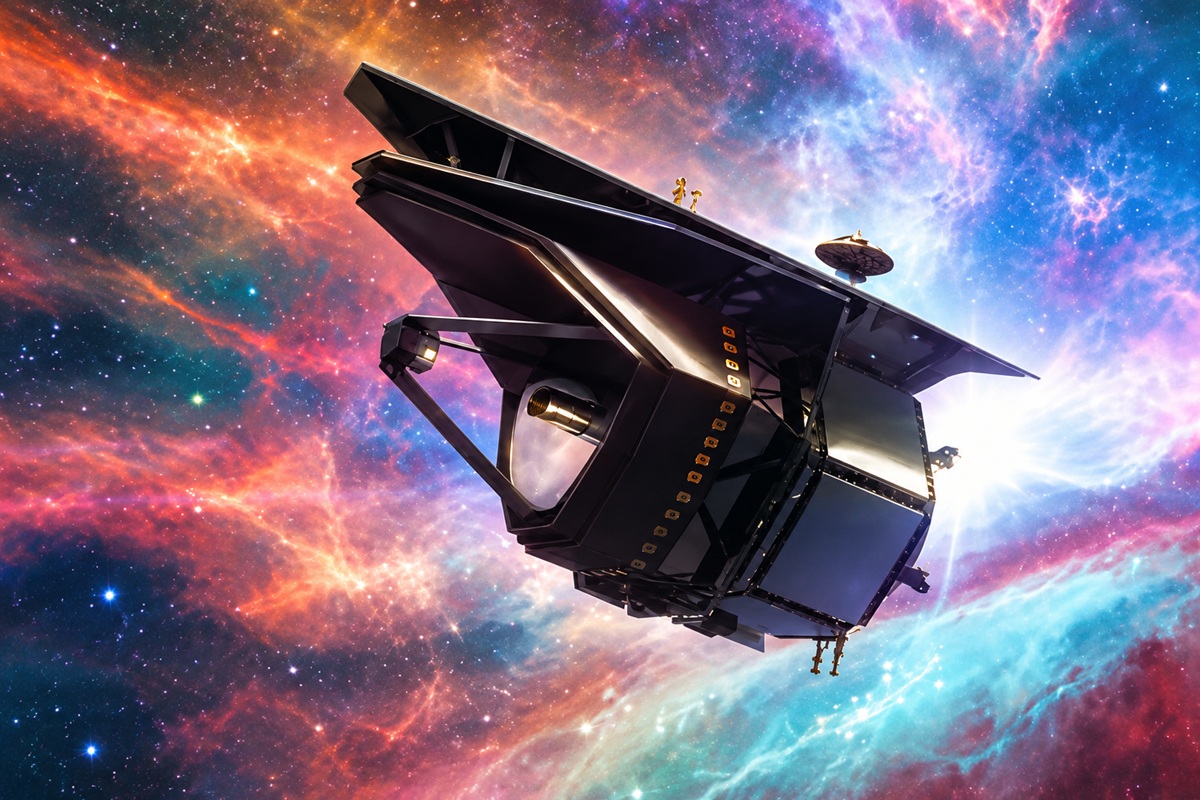
Welsh astronomers are to provide key technology for a $1.2bn NASA space telescope designed to shed new light on the origins of planets and the evolution of galaxies.
Researchers at Cardiff University are part of the UK team working on PRIMA – the PRobe far-Infrared Mission for Astrophysics – which has been selected by NASA to move to its next stage of development.
The observatory is scheduled for launch in 2033 and is expected to operate for five years.
PRIMA will use a 1.8-metre telescope to observe the universe in far-infrared light, detecting forms of radiation that cannot be studied by telescopes operating at other wavelengths.
Scientists hope it will help answer questions including how planets outside our solar system form, how galaxies and their black holes have evolved and how dust and heavy elements accumulated during the history of the universe.
It is the first of a new class of NASA missions known as Probe Explorers and is intended to fill a gap between infrared observatories such as the James Webb Space Telescope and radio telescopes.
Researchers from Cardiff University’s Astronomy Instrumentation Group will provide specialist filters needed to observe far-infrared light, as well as equipment used to calibrate the telescope’s instruments while it is in space.
The university is working alongside the University of Sussex, Imperial College London, RAL Space and Celtic Terahertz Technology Ltd, with the UK contribution supported by the UK Space Agency.
Cardiff and Celtic Terahertz Technology have developed specialist expertise in producing far-infrared filters, with components previously supplied for major observatories and space missions.
The Cardiff team will also provide internal calibration sources, building on technology used for the SPIRE instrument aboard the Herschel Space Observatory, as well as contributing to systems on the ground supporting the mission.
Professor Matt Griffin, an emeritus professor at Cardiff University and a member of the UK PRIMA team, said: “PRIMA’s selection is fantastic news for astronomers worldwide and for Cardiff University.
“The observatory will study the Universe at far infrared wavelengths with a spectacular leap in sensitivity compared to previous space satellites.
“It will allow us to see how galaxies evolved over cosmic time, to probe the magnetic fields in our Galaxy and find out how they influence star formation, and to examine the dust, gas, and ice around young stars, the material from which planets form.”
Experience
The UK team’s involvement builds on work on infrared space missions dating back to the 1980s, including the Infrared Astronomy Satellite, Infrared Space Observatory, Spitzer and Herschel Space Observatory.
Professor Pete Hargrave, head of Cardiff University’s Astronomy Instrumentation Group, said: “We are really excited to be working with a fantastic international team to collectively provide a new space observatory that will push the boundaries of our understanding of the Universe.
“The unique technologies, skills and expertise developed over many years by the Cardiff AIG and its industry partner, CTT Ltd, are key to the successful implementation of PRIMA.”
If development proceeds as planned, PRIMA is targeted for launch in 2033.
Support our Nation today
For the price of a cup of coffee a month you can help us create an independent, not-for-profit, national news service for the people of Wales, by the people of Wales.
Get more trusted Welsh news
Choose Nation.Cymru as a preferred source in Google News to see more of our journalism.


