


Welsh castle could get face lift
Richard Youle – Local democracy reporter
A Welsh castle’s profile may get a lift now that work to improve the adjacent square and former cinema building is set in stone, a senior councillor has said.
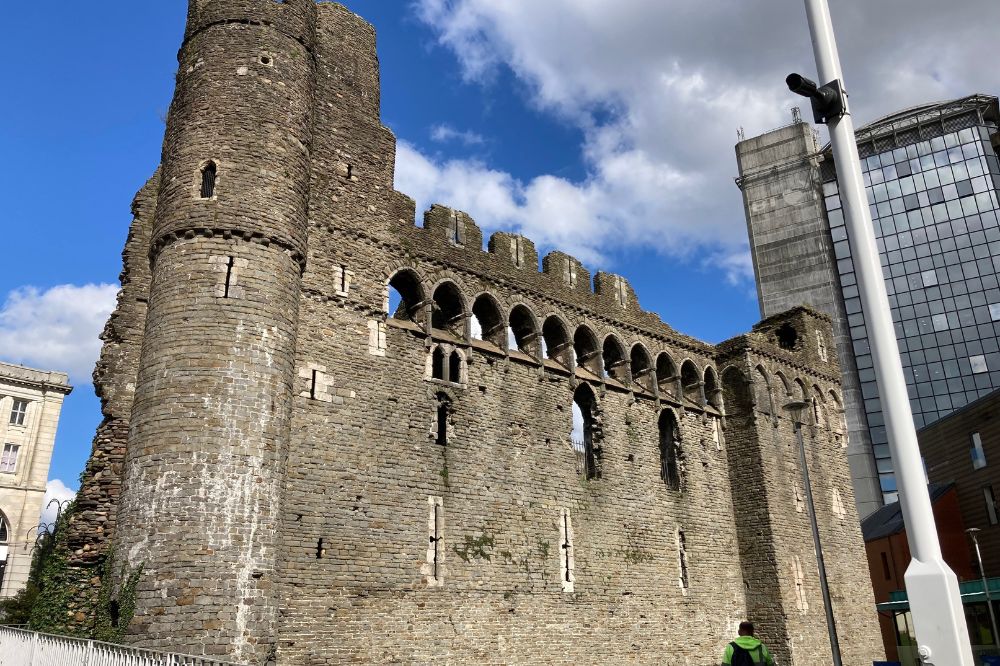
Swansea’s grade one-listed castle is easy to pass by among a mishmash of city centre buildings and is a far cry from the strategic cliff-top fortress overlooking a river that it once was.
But multi-million pound redevelopments of Castle Square and Castle Cinema could have a spin-off benefit for their enduring neighbour, which dates from the late 13th and early 14th centuries and used to have a much larger footprint than currently.
Funding
Cllr David Hopkins, cabinet member for corporate services and performance, said council officers would be talking to Welsh Government heritage body Cadw, which owns the castle, to explore the potential for developing it as a key heritage destination.
Possible funding options would be considered as part of this, he said, and set out in a report.
Cllr Hopkins was responding in writing to a question by two councillors, Stuart Rice and Peter May, who felt the castle was missing from the square redevelopment project and that it ought to be a key visitor attraction. “It deserves recognition alongside the important and fascinating medieval story Swansea has to tell,” the two councillors said.
The council is funding a transformation of Castle Square into a greener and more welcoming area. Work could be completed at end of next year.
Meanwhile a developer called EasyLiving Ltd and its partner, housing association Beacon Cymru, are turning grade two-listed Castle Cinema into flats and commercial space.
Attack
An earth and timber forerunner of Swansea Castle was built by Norman lord Henry de Beaumont in the early 12th Century. Its outer defences were destroyed in an attack in 1116.
Work began in the 1280s on a new castle, the walls of which are in place today, under the direction of William de Breos II.
A few hundred years on and the square castle tower was used as a glass works producing wine bottles, and in 1700 a town hall was built in the courtyard.
Later the River Tawe, which used to flow behind the castle, was diverted to its current position a few hundred metres away, and a post office replaced the town hall.
The square tower later became a debtor’s prison with inmates allowed to bring the tools of their trade so they could work to repay their debts.
Industrial buildings then went on to fill the ditch between the old and new castle.
Newspaper offices and printing presses occupied the courtyard and, having suffered war-time bomb damage, were finally removed around 50 years ago.
What’s left of the castle – a scheduled ancient monument – stands today. An information panel and new courtyard paving were added around 15 years ago.
One passerby in Swansea said he believed something should be done to tidy up the castle and showcase it better. “There’s history to this place, she’s been through a world war, and hopefully she’ll be around for another couple hundred of years,” he said.
Support our Nation today
For the price of a cup of coffee a month you can help us create an independent, not-for-profit, national news service for the people of Wales, by the people of Wales.



Perhaps there’s an opportunity to link the castle with the cinema and have a 4DX style movie exhibition telling grim and macabre stories about the castle.