


Welsh firefighter warns of ‘dangerous’ wildfire reporting that ignores climate change link
Abby Neve
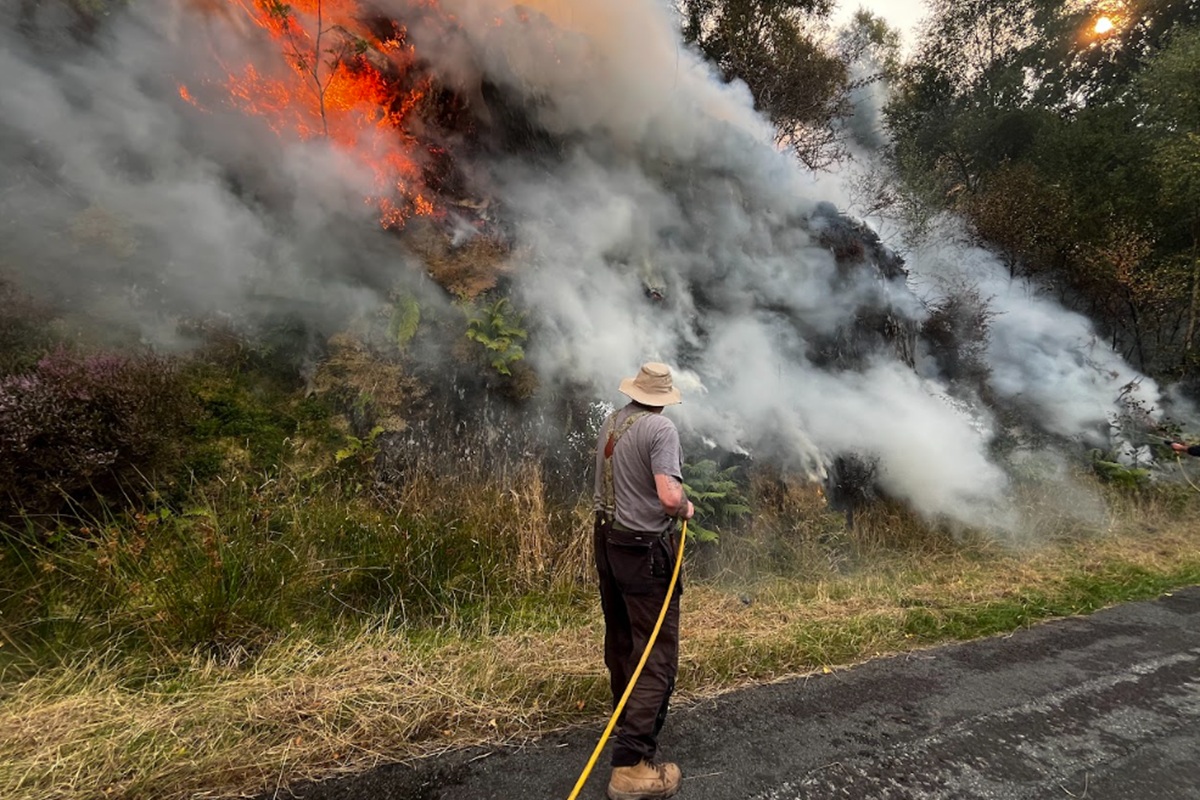
A Welsh firefighter has warned that media coverage risks normalising the growing threat of wildfires after an analysis found almost two-thirds of articles about this summer’s fires failed to mention climate change.
The analysis, by the Fire Brigade Union, examined top UK national newspapers from the first heat health alert on Friday 22 May to Friday 31 July, tracking how many articles including the phrase “wildfire(s)” also referred to “climate change” or a similar term such as “climate” or “global warming”. It found that 65.4%, almost two thirds, did not.
Gareth Tovey, Executive Council Member for Wales at the Fire Brigades Union (FBU) said: “when coverage treats wildfires as isolated events rather than part of a worsening climate crisis, it risks making an increasingly dangerous situation look normal.”
The analysis, by the Fire Brigade Union, comes after a study by World Weather Attribution of the entire wildfire season across several European regions stated in late July: “Human-caused climate change was a key driver of the fire weather conditions, primarily through its influence on exceptionally high temperatures.”
The analysis looked at articles by the Daily Telegraph, the Times, the Financial Times, the Independent, the Guardian, the Daily Mail, the Daily Express, the Sun, and the Daily Mirror. Nation Cymru was not included in the analysis.
The Sun had the lowest percentage of articles about wildfires referring to climate change, at 5.8%. The Financial Times (64.4%) had the highest percentage, followed by the Guardian (63.7%). Nation Cymru was not included in the analysis.
‘It leaves out a crucial part of the story’
The analysis follows research by ECIU last month which found that nearly three quarters of national newspaper articles mentioning the heatwave during June’s record temperatures didn’t mention climate change.
Gareth Tovey, Executive Council Member for Wales, Fire Brigades Union, said: “As firefighters, we see first-hand how dangerous and unpredictable wildfires are becoming. When the media reports on these fires without explaining the role climate change is playing in making conditions hotter, drier and more conducive to extreme fires, it leaves out a crucial part of the story.
“This isn’t just about getting the facts right. Climate change is changing the conditions we have to fight fires in, putting communities, homes and firefighters’ lives at greater risk. People need to understand why these fires are becoming more dangerous, and what is driving that change.
“When coverage treats wildfires as isolated events rather than part of a worsening climate crisis, it risks making an increasingly dangerous situation look normal. We need reporting that connects the flames we are fighting today with the climate conditions making them more likely and more severe.
“And if this is the new reality we’re facing, we need properly funded public services, including the fire service, with the resources, people and resilience to keep communities safe. We cannot expect firefighters to meet the growing risks of a changing climate without giving them the support and resources they need.”
Senedd Cabinet Minister Dafydd Trystan Davies stated yesterday that a fire summit would be held later this year to “learn the lessons we can from this summer”, adding: “in an era of climate change, we’re going to be facing hotter summers, we’re likely to see more wildfires.”
Net zero confusion
Recent polling suggests high levels of public confusion around net zero. A YouGov survey from Climate Barometer in April 2025 found 22% of those surveyed wrongly thought net zero meant ‘producing no carbon emissions at all’, rising to 41% amongst supporters of Reform UK.
Further Climate Barometer polling from April 2025 found that 38% of people think it is not essential to reach net zero in order to stop climate change, rising to 68% of Reform UK supporters.
In fact, ‘net zero’ refers to a state in which the greenhouse gases going into the atmosphere are balanced by removal out of the atmosphere, according to Net Zero Climate.
British scientist Professor Sir Jim Skea, Chair of the Intergovernmental Panel on Climate Change (IPCC) stated earlier this year in an interview with the Financial Times: “It’s chemistry and physics that if you want to stop global warming, you have to achieve net zero emissions.”
In June, a letter by leading UK climate scientists expressed “concern” about recent media coverage of extreme weather, climate change and net zero.
The letter, which first appeared in Press Gazette, stated: “While it is right to debate policy and implementation, coverage increasingly overlooks the fundamental “why”. Net zero is not an arbitrary slogan, but a boundary dictated by the laws of physics.”
The snap analysis also found that under 1 in 30 (2.9%) articles referring to wildfires and climate change additionally mentioned “net zero”.
A report published last year by Dr James Painter from the Reuters Institute for the Study of Journalism (RISJ) found that a growing proportion of media articles focussed on net zero were failing to mention climate change.
Analysis published in March by Climate News Tracker also found that net zero is also rarely explained on TV news, with 95% of morning and 76% of 10pm bulletins on BBC, ITV and Sky offering no definition.
Support our Nation today
For the price of a cup of coffee a month you can help us create an independent, not-for-profit, national news service for the people of Wales, by the people of Wales.
Get more trusted Welsh news
Choose Nation.Cymru as a preferred source in Google News to see more of our journalism.


