


Welsh fisherman designs innovative new shellfish pot

A local fisherman has designed an innovative new shellfish pot that is helping to protect fragile seagrass meadows while supporting sustainable fishing in one of Wales’s most important coastal habitats.
The design has emerged from a close collaboration in Dale Bay, Pembrokeshire, between local fishers and marine conservation charity Project Seagrass, which has been leading a seagrass restoration programme in the area.
The project is overseen by the Dale Seagrass Stakeholder Group, bringing together people from across the local community and marine sector.
Seagrass meadows are vital for coastal ecosystems, providing nursery grounds for fish and shellfish, improving water quality and storing carbon.
In Dale Bay, the restoration work began as a way to strengthen a naturally occurring meadow, trialling new techniques and raising awareness of the importance of seagrass for biodiversity and local fisheries.
From the outset, local fisherman Mark Gainfort, from Lilly May Fishing, has been closely involved in the project, helping with site selection and deploying monitoring equipment.
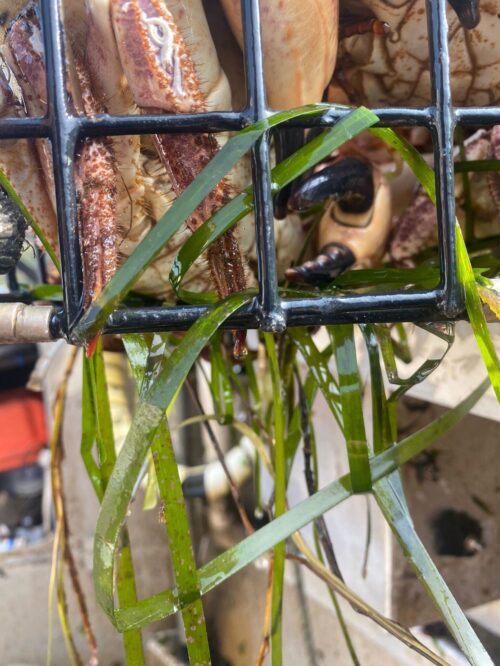
As the work progressed, he noticed a recurring problem: when hauling traditional crab and lobster pots, the metal frames could tear up sections of seagrass on the seabed.
Determined to find a solution, Mark designed a raised shellfish pot fitted with short mesh legs that lift the gear slightly off the seabed. The design reduces direct contact with the seagrass while still allowing the pots to function effectively.
The new pots were built by local boat builders Robust Boats and deployed in Dale Bay over the past two fishing seasons, with catches carefully monitored.
Early results have been encouraging. Monitoring shows the raised pots are effective for storing crab catches, with some adjustments still needed to optimise them for lobster.
Crucially, the design reduces mud build-up and significantly lessens disturbance to the seagrass meadow.
Mark said that overall the design worked very well in seagrass. He added: “I would recommend using them as storage pots in shallow water where seagrass is as it’s very low impact on the grass with the mesh legs compared to steel bar bottoms”
Project Seagrass continues to plant seagrass in Dale Bay and carries out regular monitoring to assess recovery and long-term resilience.
Reduced pressure
Researchers are keen to understand how the meadow responds over time to reduced pressure from fishing gear and whether innovations like the raised pot can play a wider role in conservation-friendly fisheries.
The work in Dale Bay is part of a broader effort across south and west Wales to combine local knowledge with scientific research.
Fishers, anglers, spearfishers, aquaculture workers and seafood gatherers have been taking part in a survey to map seagrass and fishing areas, helping to identify future restoration sites. Early findings underline the value of local experience in shaping effective conservation, with full results due to be published later this year.
Looking ahead, Project Seagrass plans to host a series of events celebrating sustainable local seafood and the role seagrass plays in healthy seas. The initiative is supported by funding from the Nature Networks Programme, delivered by the National Lottery Heritage Fund on behalf of the Welsh Government, alongside Rebel Restoration.
Support our Nation today
For the price of a cup of coffee a month you can help us create an independent, not-for-profit, national news service for the people of Wales, by the people of Wales.


