


Welsh Government ‘can legally impose sanctions on firms that assist in the illegal occupation of Palestinian land’
Martin Shipton
A speech delivered by Foreign Secretary Ed Miliband this month has made it easier for the Welsh Government to take action against companies that have assisted in the illegal occupation of Palestinian territory, according to a leading human rights lawyer.
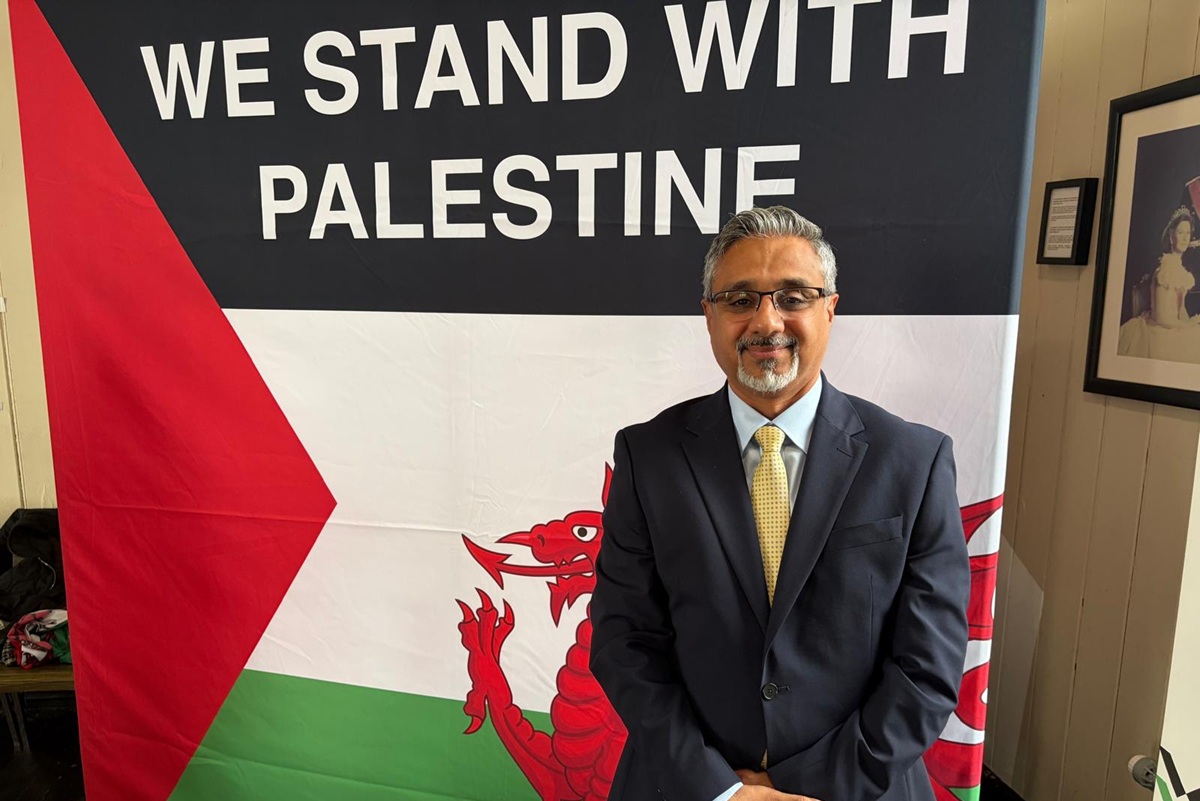
Tayab Ali, who heads the international law team at Bindmans and advises the International Centre of Justice for Palestinians (ICJP), was in Cardiff to brief Members of the Senedd on the steps the Welsh Government can lawfully take.
He said: “The question for Wales is not whether Wales should have its own foreign policy. It doesn’t have one and it doesn’t need one. The question is whether Welsh public money, meaning Welsh grants, Welsh contracts, Welsh pensions and pension savings, is being used in ways that help sustain conduct which the highest court in the world [the International Court of Justice] has found to be unlawful.”
Mr Ali said the Foreign Secretary’s statement to the House of Commons on 8 September had removed a potential objection to action by Welsh public bodies.
“Until very recently, you might have been told that acting on any of this would put Wales at odds with UK foreign policy. Well, that’s not true any more,” he said.
“On September 8 the Foreign Secretary, Ed Miliband, told the House of Commons that the official view of the British government is now that occupation is unlawful. That’s in line with the central finding of the ICJ. He said that the government agrees that there is ethnic cleansing of Palestinians in areas of the West Bank perpetrated by settler terrorists – a very important use of words.”
Mr Ali said the UK Government had also announced plans to ban imports from settlements and advertising for settlement property, as well as measures targeting exports and companies involved in settlement expansion.
He said the government had not concluded that genocide was taking place in Gaza, but accepted that a serious risk of genocide would trigger a duty to prevent it.
“We have the duty and businesses now have the duty to establish whether there’s a serious risk of genocide, and that brings obligations on us,” he said.
He argued that Welsh public bodies could now examine their grants, contracts and investments in light of the UK Government’s stated position on the occupation. Mr Ali said the Foreign Secretary had made clear that the unlawfulness of the occupation should be reflected in the UK’s economic relationships.
“When Welsh public bodies decline to fund contracts with or invest in companies that help sustain the occupation, they are not freelancing on foreign policy anymore,” he said. “On the occupation, they are applying the UK Government’s own stated legal position.”
Obligation
Mr Ali said that while foreign policy was the preserve of the UK Government, the Welsh Government had an obligation to ensure its business dealings complied with international law.
“International law does not distinguish between Cardiff and Whitehall,” he said. “The conduct of any organ of the state, central or devolved, is the conduct of the state. A decision does not fall outside international scrutiny because it was taken in Cardiff rather than in Whitehall.”
He said whether a particular grant breached an international obligation would depend on the duty involved, the evidence and what the support contributed to. “That is exactly why the checks matter: Wales cannot be the weak link in that chain.”
Mr Ali pointed to the Well-being of Future Generations (Wales) Act 2015, which includes a goal of a globally responsible Wales.
“The act is not a foreign policy power, and it does not by itself create an obligation to adopt any particular position on Palestine,” he said. “But it’s a statutory lens that every public body in Wales must apply. How can a public body say it is contributing to a globally responsible Wales, while funding companies that supply forces credibly accused of grave violations, without even asking the question?”
Procurement duty
The Social Partnership and Public Procurement (Wales) Act 2023 also places a socially responsible procurement duty on Welsh contracting authorities. First Minister Rhun ap Iorwerth has described what is happening in Gaza as genocide.
Mr Ali welcomed an ethical framework for Welsh Government engagement with the defence sector announced by enterprise minister Adam Price on 3 September. A consultation is due in the autumn.
“Of course the defence industry is an important industry. We just want it to act ethically, responsibly and within the law,” he said. “The Welsh Government can make the defence ethical framework the gold standard. It can lead the way. The consultation is due in autumn, and this is the single biggest opportunity in front of you.”
He urged ministers to set conditions on public support through the framework.
“Set clear red lines. No support for companies supplying weapons, components or services where there is a clear risk [they] will be used in serious violations or that help maintain the unlawful occupation, or that are subject to UK sanctions. This should be written into grant agreements with conditions and clawback.”
Due diligence
Mr Ali also called for due diligence to extend beyond defence.
“The same question should be asked of business grants, inward investment and procurement across government and its sponsored bodies,” he said. “Welsh Ministers can set that expectation through procurement, policy and statutory guidance under the 2023 act, with model contract clauses and supply declarations, and new human rights legislation is the natural home for a clear, permanent duty.”
Responding to a question from Nation.Cymru, Mr Ali said the Welsh Government could face a judicial review if it failed to act in accordance with the UK Government’s newly stated position.
Support our Nation today
For the price of a cup of coffee a month you can help us create an independent, not-for-profit, national news service for the people of Wales, by the people of Wales.
Get more trusted Welsh news
Choose Nation.Cymru as a preferred source in Google News to see more of our journalism.



“The question for Wales is not whether Wales should have its own foreign policy. It doesn’t have one and it doesn’t need one”….sorry but on that Mr Ali couldnt be more wrong. If Wales were an independent nation, with our own foreign policy, we could ensure there were no british MOD contractors – or private manufacturers – producing components in Wales being used to slaughter innocent palestinian civilians in gaza (or slaughter innocent civilians anywhere else for that matter). Measures which are sadly beyond the remit of the Welsh govt under the current devolution settlement. While his apparent warning regarding… Read more »
Inshaallah, the Welsh government will act decisively in take action against these evil companies that support this illegal occupation of semitic Palestinian land.