


Welsh Government releases report on rediscovering Castell Coch’s true red
Amelia Jones
The Welsh Government has released further details on the historic paint research that reveals the true colour of Wales’ famous ‘red’ castle.
Conservation experts have uncovered the original red paint colour for Castell Coch, the iconic fairy-tale castle, following detailed scientific analysis of paint samples dating back to the 1880s.
Cared for by Cadw, Castell Coch is one of Wales’s most popular castles, beloved for its magical “fairytale” appearance. Although it has origins as a medieval hunting lodge, the beautiful castle we see today is the vision of the well-known designer William Burges. Burges worked for the 3rd Marquess of Bute between 1875 – 1881 to create a masterpiece of Victorian fancy.
The distinctive red paintwork on the castle’s external timberwork – including windows, doors, shutters, fascias and gutters – has been central to Castell Coch’s identity. However, years of repainting had gradually transformed the colour into something quite different from the Victorian architect William Burges’s original vision.
Architectural paint researcher Lisa Oestreicher examined multiple samples from locations across the castle, identifying up to sixteen different phases of redecoration since the castle’s completion in 1881.
This research revealed the original paint finish was an orange shade of red – markedly different from the darker red that had evolved over subsequent decades of repainting.
A key reference sample was discovered under the handrail on the balcony adjacent to Lady Margaret’s Bedroom in the Kitchen Tower – a shaded location that helped preserve traces of the original scheme.
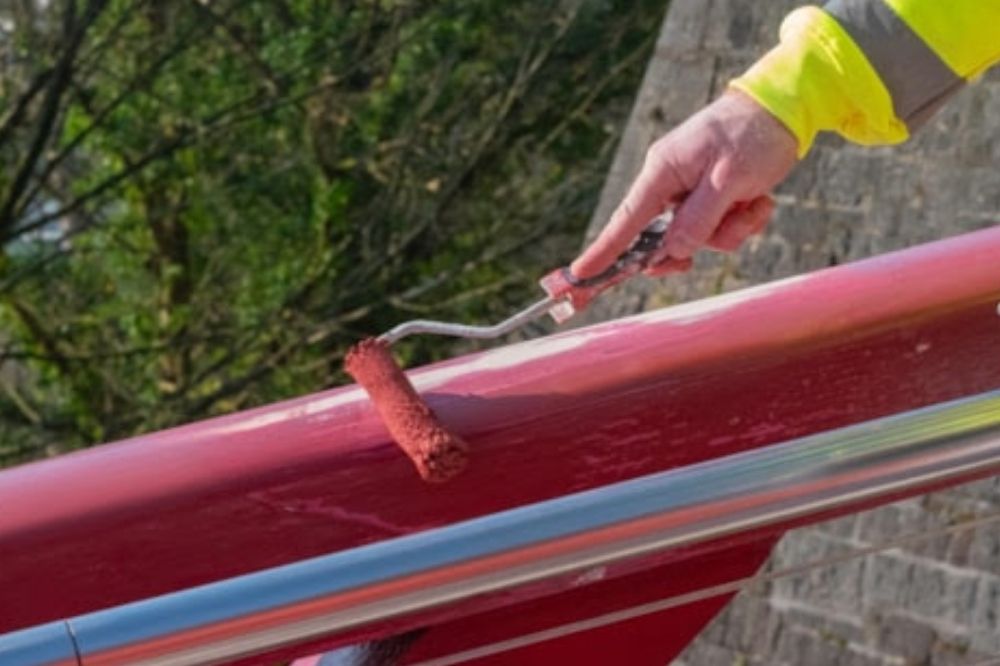
The new paint, named ‘Castell Coch Red 2025’, will be produced and used for all future external redecoration.
History
The original castle on the site of Castell Coch, which is located on a wooded hillside above the village of Tongwynlais, Cardiff, is thought to have been constructed in the late 11th century. It was built to defend Cardiff and control the land around the river Taff.
English nobleman Gilbert de Clare constructed a new castle between 1267 and 1277 to defend his lands. On Gilbert’s death, the castle passed to his widow Joan and around this time it was referred to as Castrum Rubeum, Latin for “the red castle”, probably after the colour of the red sandstone defences.
The fortress was likely destroyed during the Welsh rebellion of 1314, it was not rebuilt and the site was abandoned.
In the 1760s, the site passed to John Stuart, the 4th Earl of Bute (later the 1st Marquess of Bute), following his marriage to Lady Charlotte Windsor.
John Crichton-Stuart, 3rd Marquess of Bute, inherited the castle in 1848. One of Britain’s wealthiest men, with interests in architecture and antiquarian studies, he employed the architect William Burges to rebuild the castle.
Burges died in 1881 after catching a severe chill during a site visit to the castle. His brother-in-law, the architect Richard Pullan, took over the commission and delegated most of the work to fellow architect William Frame, who directed the work on the interior until its completion in 1891
However, he made little use of his new retreat, and in 1950 his grandson, the 5th Marquess of Bute, placed it into the care of the state.
Since 1984, the property has been administered by Cadw, an agency of the Welsh Government.
Dr Kate Roberts, Chief Executive of Cadw, said: “Castell Coch has captivated visitors for generations with its iconic towers and romantic setting, but the distinctive red paintwork that gives the castle its very name had gradually drifted from William Burges’s original vision over 135 years of repainting.
“This painstaking research has allowed us to uncover what this red truly looked like when the castle was first completed. It’s incredibly satisfying to know that when visitors see Castell Coch in the future, they will be experiencing something much closer to what Burges intended.
“This work is part of our wider commitment to preserving and presenting Wales’s historic places as authentically as possible, ensuring these treasures can be enjoyed and understood by generations to come.”
Original colour
Matching a 135-year-old exterior paint presented significant challenges. Red pigments are notoriously unstable, fading when exposed to light yet darkening when covered by later paint layers. Despite these complexities, experts have successfully formulated a new colour that closely represents Burges’s original specification.
Michael Davies, Conservation Architect who worked on the project, said: “Although detailed paint research was undertaken, there was still much to do before we could choose the most appropriate red.
“Many paint samples have been produced and there has been a great deal of discussion, but we are now so pleased to finally be returning to the red that William Burges had used 135 years ago.
“Whilst repointing the walls of the Well Tower, we have also uncovered the pink/orange medieval mortars in the lower parts of the stone walls, which had been covered up previously, making it easier to see the difference between the medieval and Victorian phases of building.”
This research forms part of Cadw’s ongoing programme of conservation work at Castell Coch, which has included repairs to the exterior walls and chimneys since 2018 to protect the castle’s internationally significant interior decorations.
You can view the announcement here.
Support our Nation today
For the price of a cup of coffee a month you can help us create an independent, not-for-profit, national news service for the people of Wales, by the people of Wales.


