


Welsh invention prevents indoor pollution from wood burning stoves
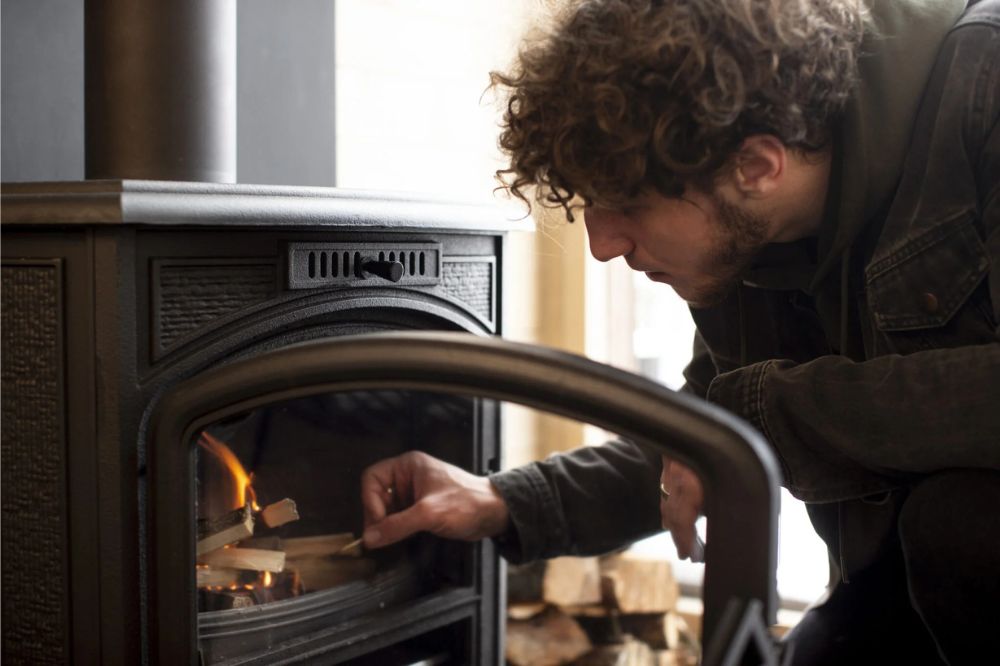
A Welsh engineer from Cardiff has invented a new type of domestic woodburning stove to eliminate indoor pollution from wood burning stoves.
Marc Howell, who studied engineering at Cardiff University followed by years working as an engineer in the automotive and semiconductor industries, spent seven years working in his garage near Cowbridge, Vale of Glamorgan to perfect new patented technology that provides a real wood burning stove experience but without the risk of indoor air pollution.
This was the driving force for Marc, the founder of Island Pellet Stoves, who could not only see the benefits of sustainably heating a home with wood, but he could also see the potential conflict of its air quality impact on health.
“Burning wood just had to be made more efficient and less polluting” said Marc “through our experiences of reducing emissions from larger scale wood pellet systems we knew there was a way to create the real wood fire experience that is so desirable in the UK but yet do it cleanly and not at the cost of harming health’.”
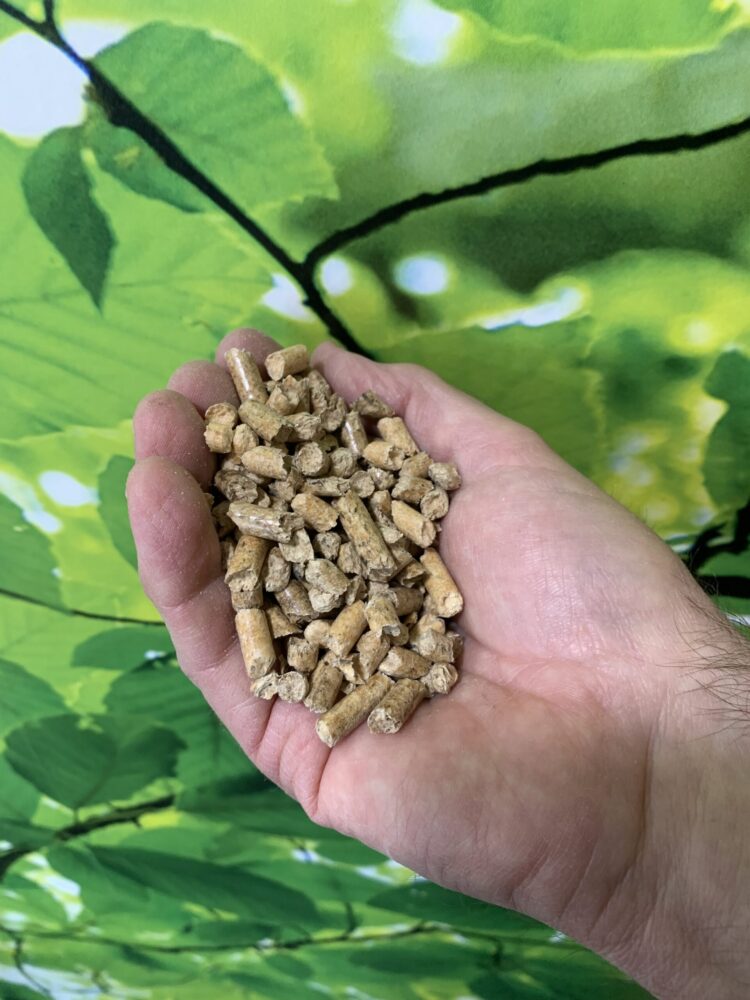
It was wood pellets that are manufactured from timber industry sawdust and are produced into dry, regular-shaped pellets containing less than 1% ash and less than 10% water that were the key to the challenge.
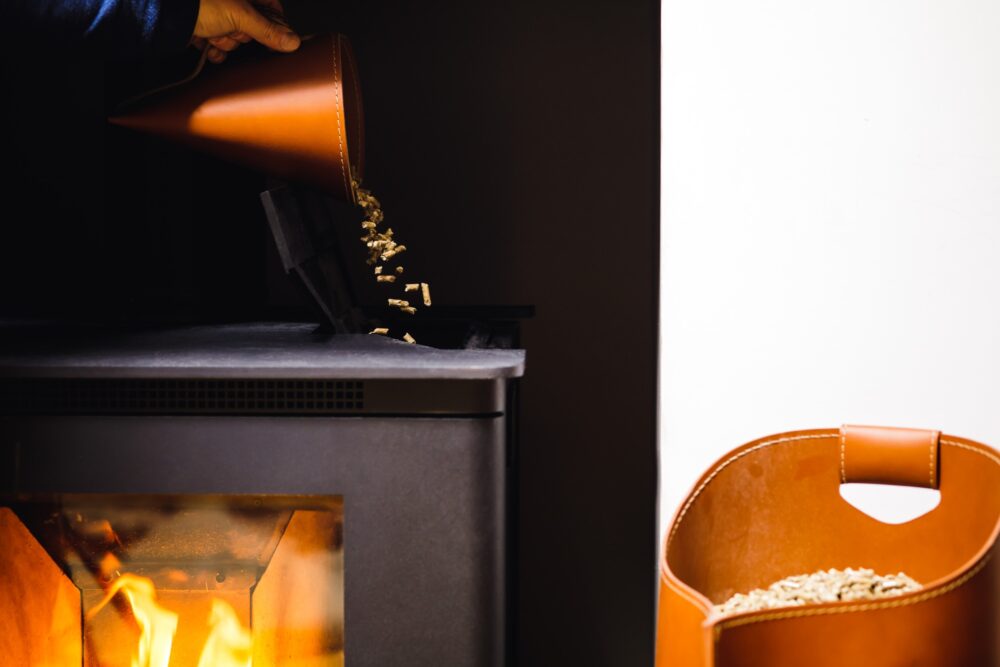
A computer-controlled stove, that automatically lights the wood pellets and controls the feeding of the pellets with precise levels of pre-heated air, allows greater control of the combustion process and was found to be the way to significantly reduce the emissions and increase the overall efficiency of using the energy from the wood pellet fuel.
The air used for burning the wood pellets is pre-heated to a high temperature by the exhaust gases using a “balanced flue” as is commonplace with domestic gas boilers.
The stoking or feeding of the pellets from the on-board storage hopper to the “burn-pot” is done automatically with a computer-controlled “Archimedes screw” and so there is no need to open the stove door during operation (as there would be with a log-burning stove) and so the risk of harmful pollutants entering the home is eliminated.
Welsh manufacturer
A recent report commissioned by DEFRA (The UK Government’s Department for Food and Rural Affairs) and published in Feb 2025 called “Emission Factors for Domestic Solid Fuels” has confirmed through their testing that the pellet stoves made by Island Pellet Stoves Ltd are around 20 times cleaner than a modern log-burner for emissions of particulates.
Marc, who considers himself simply a “man in the shed” inventor might just have cracked the problem so we can continue to enjoy wood-burning but without the harmful side-effects.
Island Pellet Stoves Ltd is the UK’s market leader in pellet stoves and proudly designs and manufactures its stoves in Wales.
Support our Nation today
For the price of a cup of coffee a month you can help us create an independent, not-for-profit, national news service for the people of Wales, by the people of Wales.



If wood burners were a working class affectation rather than a middle class one, they’d be banned by. now
Look at all the old chimneys they ripped out of council house at massive expense to the tax player
Fact: There is more pollution from cooking a Sunday roast! What about all the pm2.5 from EV car tyres? Burning wood is untaxed hence it is firmly in the governments sights! We can’t have people keeping warm and not being taxed for the privilege! Next they’ll be a tax on firewood and wooburning stoves. Your stove will need a registration certificate, plus annual checks. Should do that anyway of course, but we can’t have you doing it yourself, unless you are a registered stove inspector! All chimney sweeps will need to join a registration scheme of course, at cost, with… Read more »
Your fact isn’t true. Definitely more pollution from a wood burning stove. Myth 1: Frying eggs or grilling produces more PM₂.₅ than a stove, so stoves are harmless. Fact: Cooking does cause short indoor PM₂.₅ spikes, sometimes higher than roadside levels. But stoves emit continuously, add to outdoor air, and drive neighbourhood PM₂.₅. Comparing a kitchen spike with city-wide emissions is misleading. Wood smoke contains high levels of organic carbon, black/brown carbon, and trace metals. Studies in UK homes showed Ecodesign stoves reduce PM₂.₅ vs open fireplaces, but still produce sustained exposures (≈ 14-40 µg/m³) indoors. Myth 2: The toxicity… Read more »
Your claims are false DSI. If it were true you’d have linked to the scientific studies, absent from your comments.
These ones?
DEFRA/Ricardo (2025) Emission Factors for Domestic Solid Fuel: uk-air.defra.gov.uk/assets/documents/reports/cat07/2502130943_Ricardo_EFDSF_Report_WP3_Issue4_FINAL_v2.pdf
Island Pellet Stoves: “Occasional dust/ash can escape during de-ashing and re-fuelling”: http://www.islandpelletstoves.co.uk/wp-content/uploads/2024/05/Lundy-5-Operation-Manual.pdf
DEFRA/Ricardo (2025) Emission Factors for Domestic Solid Fuels: uk-air.defra.gov.uk/assets/documents/reports/cat07/2401030934_Ricardo_EFDSF_WP1_Report_v1.4.pdf
PubMed (2020):pubmed.ncbi.nlm.nih.gov/31253828
University of Sheffield: sheffield.ac.uk/news/indoor-wood-stoves-release-harmful-emissions-our-homes-study-finds
woodburning.london/wp-content/uploads/2023/11/London-Wood-Burning-Health-Impact-Evaluation-Technical-Report.pdf
Looking forward to seeing the scientific studies to back up your claim. It must be false as they are absent from your comment.
You deliberately conflate regular wood burning stoves (out of date 2020) to attack this Welsh innovation which is different. Also the report from the London Borough of Camden and the London Borough of Islington has not considered it. Makes me wonder what your beef is with this technology and who pays you to dish the dirt. You are also wrong about the dust when manually emptying the ash. There’s a mechanism to do this.
At DSI we have “beef” with wood burning, because it reduces air quality, which contributes to health issues. There is no safe level of PM25. It’s also not carbon-neutral. We quite like to be able to breathe properly. This stove does not prevent indoor pollution. It only reduces it. The problems with outdoor pollution still remain. And that’s the part we have issues with. Everybody is free to poison themselves if they want, but you shouldn’t force others to breathe the pollution you create. Also you must have missed the part where I quoted a line from the manufacturer of… Read more »
I think you’re wrong here DSI. I have no option but to use wood burning stoves – I live off grid in the Highlands. I have four particulate monitors and only on a couple of days per year does any of them register PM2.5s outside of good range, and even then it’s marginal. The only time we have a particulate problem is when my wife is making a fry up because she likes her tattie scones burnt. Properly operated and maintained stoves are not a problem. This man’s invention may make them even more efficient.
As we said in the Fact-Check:
Composition matters — organic compounds vs inorganic ions, black carbon vs metals all differ in toxicity. Studies show wood smoke has higher load of long-term harmful components.
Do humans eat wood? No.
So why would the emissions from cooking be the same as wood smoke pollution?
DEFRA/Ricardo (2025) Emission Factors for Domestic Solid Fuel: uk-air.defra.gov.uk/assets/documents/reports/cat07/2502130943_Ricardo_EFDSF_Report_WP3_Issue4_FINAL_v2.pdf
Island Pellet Stoves: “Occasional dust/ash can escape during de-ashing and re-fuelling”: http://www.islandpelletstoves.co.uk/wp-content/uploads/2024/05/Lundy-5-Operation-Manual.pdf
DEFRA/Ricardo (2025) Emission Factors for Domestic Solid Fuels: uk-air.defra.gov.uk/assets/documents/reports/cat07/2401030934_Ricardo_EFDSF_WP1_Report_v1.4.pdf
PubMed (2020):pubmed.ncbi.nlm.nih.gov/31253828
University of Sheffield: sheffield.ac.uk/news/indoor-wood-stoves-release-harmful-emissions-our-homes-study-finds
woodburning.london/wp-content/uploads/2023/11/London-Wood-Burning-Health-Impact-Evaluation-Technical-Report.pdf
Why do you quote studies that pre-date this Welsh invention? Issues cured by innovation.
The first fact-check I posted covered exactly these stoves. (It seems to have been deleted) Myth 1: This invention eliminates indoor pollution from wood burning stoves. Fact: No wood-burning or pellet stove can fully eliminate emissions. Even sealed systems still produce bursts of pollutants during ignition, refuelling, ash removal, or via small leaks. The DEFRA / Ricardo Emission Factors for Domestic Solid Fuels report confirms pellet stoves have much lower particulate emissions than log stoves, but do not claim zero emissions. Myth 2: Pellet stoves are ~20× cleaner than modern log burners in particulate emissions, so they’re effectively “clean.” Fact: That ~20× figure is based on certain lab… Read more »
Hi DSI I looked at your links, the Sheffield study states that stoves (and a fire) when in use had particulates between 27.34 ug/m3 and 195.83 ug/m3 – a big range there – at one end marginally over the WHO ‘safe level’ of “25 ug/m3 over a 24 hour period”. And no offense, but one of the experts is described as a criminologist. The New England Pregnant women study states in it’s conclusion: “Homes with wood stoves, particularly those that were older and non-EPA-certified or burning wet wood had higher concentrations of indoor air combustion-related pollutants.” It’s hardly unexpected is… Read more »
Thanks for taking the time to look at the sources. There are a few technical points in your reply that need correcting. First, the WHO PM2.5 figure you quote (25 µg/m³ over 24 hours) is outdated. The WHO updated its Air Quality Guidelines in 2021. The current guideline is 15 µg/m³ as a 24-hour mean and 5 µg/m³ as an annual mean. Using the older 25 µg/m³ value materially understates exceedance. On the current guidance, 27.34 µg/m³ is almost double the WHO limit, and 195.83 µg/m³ is more than thirteen times higher, so these are not marginal exceedances. It’s also… Read more »
Is my wood burner doing me more harm than my lack of Radon protection in my floor?
Yes
That’s ok then as my wood burner is my only form of heating at the moment and I have been a bit concerned about radon gas but I don’t need to worry about that now
I am fed of this country always bashing the public over something. In comparison to when I was a child the number of wood burning stoves is minimal. When I was young virtually every house was heated by open coal fires. Two or three per household. It’s nothing like that now. I read a report approx 12 months ago that stated half of all pm pollution in the UK is blown in from Europe. Add to that our home grown pollution from cars, industry etc what percentage of pm in this country is actually from wood burning stoves. And don’t… Read more »
I’m not sure where you got the idea half of PM pollution is blown in from the EU? The prevailing wind in the UK is Southwest, which would mean it comes in from the Atlantic. You would need half a year of East/Southeast wind to accomplish your opinion. In addition the EU develops more clean energy than we do in terms on Nuclear Power. Which equals zero emissions. I suggest your report is flawed.
France is the only country with huge amounts of nuclear energy. Germany went through a program a good few years ago to reduce its nuclear base. So Europe isn’t as clean as you state. You dodged the question on what percentage of pm in the air in the UK is attributable to just UK wood burning stoves.
Additionally you may have notice that the mild weather we are experiencing now is because the wind direction is coming up from the south, from Europe.
Having a computer operated wood burning stove defeats the point of having one for many people. When there are power outages wood burning stoves are the only means of providing warmth and in some cases hot water to a household, as gas boilers require electricity to operate. Sounds more like a biomass power plant. Jog on.
I agree with you wholeheartedly but you’ve got to admit it’s a good advert for Island Pellet Stoves.
My wood burner operates under a slight vacuum and if I open the door slowly, no smoke or fumes enter the house. These pellet stoves are two or three times the cost of a normal wood burner including installation. I can’t see any facts on their website. I would like to know the efficiency and emmissions. The pellets are bound to be expensive. I was buying a builder’s sack (one cubic meter) of dried logs for £40.
But the computer control would be nice. I see it has a fan, so that will add to the running costs.
Strange nobody mentions the smokeless zones initiative (1956) that has been upgraded several times since.
If the authorities are to ban sealed wood burning stoves shouldn’t they first ban all open fires and burning garden an household rubbish outdoors?
One contributor often mentions his ‘facts’ the relate to city use of wood burners but most are probably used in rural areas.
Balcas has been making these pellets for years, it’s nothing new.
I wonder if Marc applied for international patent coverage – the USA is a huge market and is comparatively cheaper to file in and maintain patents than in Europe. I hope so.
Electric powered Pellet stoves no good during a power cut. No Energy no heat.