


Welsh inventor to unveil ‘world’s first’ commercial self-cooling drinks can
Nation.Cymru Staff
A Welsh inventor is preparing to unveil what he says is the world’s first commercialised self-cooling drinks can, which can chill its contents at the push of a button.
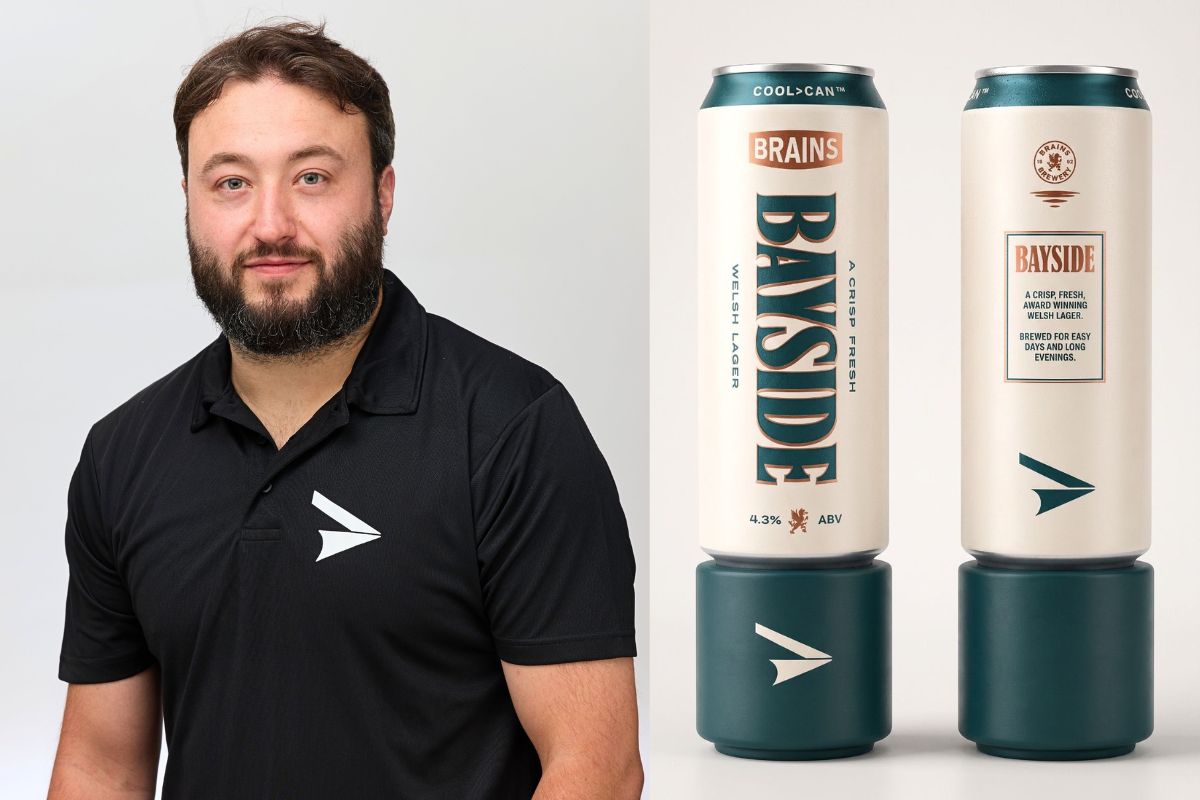
The Cool>Can, developed by deltaH Innovation, will be unveiled at London Packaging Week later this month, with a version containing Brains’ Bayside Welsh Lager becoming the first finished commercial product to use the technology.
Founder and CEO of deltaH Innovation, James Vyse, created the fully recyclable, commercialised, and branded can to ensure beer stays cool after it’s removed from the fridge without the need for bulky cool bags and ice packs.
James’ career took him from behind a cocktail bar to starting his own successful cocktail kit business. He said: “I’ve already had success in the beverage industry, but one of the pain points for me was drinks going warm on the go with no clear way to cool them down, because the cooling infrastructure is static.
“You can’t move fridges and freezers around. You can move cool boxes, but you don’t really want to put them on trains, take them to festivals, and lug them around. That’s where the idea of self-cooling came from.
“My beverage background highlighted the importance of the pain point. Having the experience of a previous successful business meant I could put the commercial side together with the creative side and deliver a proposition that’s commercially viable. That’s what we have now.”
Demand
During the early stages of development, James and the deltaH team quickly saw how valuable the idea could be.
“We did a PR campaign last spring and summer to announce that we’d achieved something and to gauge what the market was saying and, more importantly, what the brands were saying,” he explained.
“The feedback was overwhelming for a start-up. It resulted in us speaking to the biggest brands in the world, the most famous brands you can think of.
“We totally underestimated how much self-cooling in a can is wanted. It actually made us take a step back and make sure that, foundationally, we were ready for this.”
The company also had to ensure the design could work within the existing technical and logistical requirements of the drinks can supply chain.
“There are certain requirements around beverage filling and so many things we’ve had to overcome, such as filling lines and the sheer scale of the can industry,” James continued.
“You can’t just come in and disrupt that with a new can. The industry is older than any of us, and changing a can end takes two or three years. For us to be viable as a start-up, we had to find ways of doing this more quickly and efficiently within the structure that’s already there.
“That has been the biggest friction for us, making sure the process of adoption is seamless. That’s exactly what we’ve done. We’ve built it in a way that allows brands to adopt it very easily.”
Chemistry
The company said recyclability was another key consideration in developing the can, particularly as it looks to take the product into international markets.
“There were attempts at self-cooling a long time ago, with companies using refrigerants and gas,” James explained. “But you can’t put something in a can that’s going to make it unrecyclable, especially in a margin-sensitive industry. So we had to make the can recyclable, and make sure it was cost-efficient and scalable.
“It was obvious that we definitely could not use gas. So we’re using chemistry.”
The chemical reaction takes places as certain salts dissolve, creating an endothermic reaction and absorbing heat from its surroundings.
The trick, adding table salt to an ice bucket to keep beverages cool for longer, is often used by bartenders. It provided the foundation for the Cool>Can’s self-chilling technology, as the team at deltaH created their own, now-patented salt-based cooling agent called DC15.
James says the restrictions around sustainability and chemicals in products actually helped focus minds while developing the cooling solution.
He added: “We realised the chemistry we had was the only way you could do it from a commercial perspective because the regulations are so sensitive when you’re working with chemistry.
“We’ve protected that chemistry through a strong international patent portfolio, but we’ve also optimised it to be more efficient in cooling beverages, because the chemistry wasn’t originally invented to cool a beverage down.
“With the chemistry, you have to go through the relevant bodies and requirements, including UK and EU REACH and the FDA. We did all of this beforehand.
“The boxes we’ve had to tick to get to this point are crazy, but so are the twists and turns we’ve had to make with the product.
“My team has been through it all with me, with things moving and changing faster than you can blink. But it gets you to a point where you end up with something that can be taken to market.”
Design
As for the activation mechanism, deltaH knew the can had to be simple to use, keeping the DC15 salt and water separate from each other until the consumer starts the cooling reaction.
“What we’ve ended up with is effectively a can-within-a-can format. We’ve built around slimline cans because they have the perfect geometry to fit inside a standard can,” James said.
“DC15 is one part of the coolant, and water is the other. Once the water is pushed into the can walls where the DC15 is sitting, it rapidly reduces the temperature of the inner can, which is undisturbed.
“The brand’s liquid can be produced and sealed by its preferred partner in a normal slimline can. We then make a slight modification to the outer can shell, attach the cooling mechanism, and slide the beverage can inside.
“The slimline can is mechanically sealed to the external can before we attach the chemistry and water module to the bottom. We have a pilot line in Wales for that process.”
Each can features a simple button mechanism on its base that, when pressed, starts the chemical reaction inside the can walls and chills the drink by around 10–15°C depending on the starting temperature.
Cymru Connection
James, a proud Welshman who has never forgotten his roots, partnered with Brains Brewery to bring its Bayside Welsh Lager to market in a Cool>Can.
It promises to be a watershed moment for the beverage industry, but as James explains, it is not the first to come from Wales.
“Brains is based in Cardiff and has a lot of heritage in Wales. That’s a big factor for me because I’m Welsh. We had many conversations with brands, but this one felt right because the history of cans in Wales is genuinely groundbreaking.”
That history began when Felinfoel Brewery in Llanelli became the first outside the US to produce canned beer.
American brewers had managed to create a new pasteurised drink that did not absorb the metallic taste of their tin containers.
British ales required a novel solution, which arrived when Felinfoel began coating the inside of their cans with an inert wax.
This story is one James is keenly aware of. He added: “It means Wales brought the first beer can to this side of the world, and now we’ve brought the first self-cooling beer to the world.
“Brains have been a great brand to work with, but I’m definitely a proud Welshman teaming up with a Welsh brand and doing it with them first, giving Wales a piece of the history of what I believe is going to create something special in this business.”
From Wales to the world
For James, a commercial launch is not the end of the story, but rather a first step in the journey towards larger international customers.
“We can’t go from zero to 100 million overnight,” adds James. “It has to be a staged approach. If I could produce a billion cans today, we could sell a billion cans.”
“I don’t think demand is the issue. The issue is making sure we grow this business in a way that doesn’t implode and that the quality and delivery of what we’re doing is sustainable. That’s where Brains fits in well, because it’s an established brand that will get us through the first gate.”
At the upcoming London Packaging Week event, James will provide exclusive insights into the development of the Cool>Can.
“This is the first stage of taking Cool>Can to international markets. You’ve got to start somewhere. We’re excited by the start we’re making, but it is very much just the start of the process,” he concluded.
“My dream is to get on a plane, land anywhere, and see a Cool>Can. Then the team and I can ‘cheers’ to it.”
James Vyse will share the engineering, regulatory, and commercial story behind the Cool>Can in his presentation, The self-cooling can: turning packaging innovation into reality, at 12:00 on Thursday 17 September in the Discovery Theatre.
To register for a free ticket, visit the London Packaging Week site here.
Support our Nation today
For the price of a cup of coffee a month you can help us create an independent, not-for-profit, national news service for the people of Wales, by the people of Wales.
Get more trusted Welsh news
Choose Nation.Cymru as a preferred source in Google News to see more of our journalism.



Why launch with Brains? Why not Felinfoel, the pioneers of canned beer? It should have been a no brainer, if you’ll pardon the pun.