


Welsh MP pushes for plan to end animal testing
Stephen Price
A Welsh MP has joined politicians and leading scientists to support the UK Government’s plans to phase out the use of animals in experiments, calling for ‘meaningful steps’ to be made to consign the cruel practice to the history books.
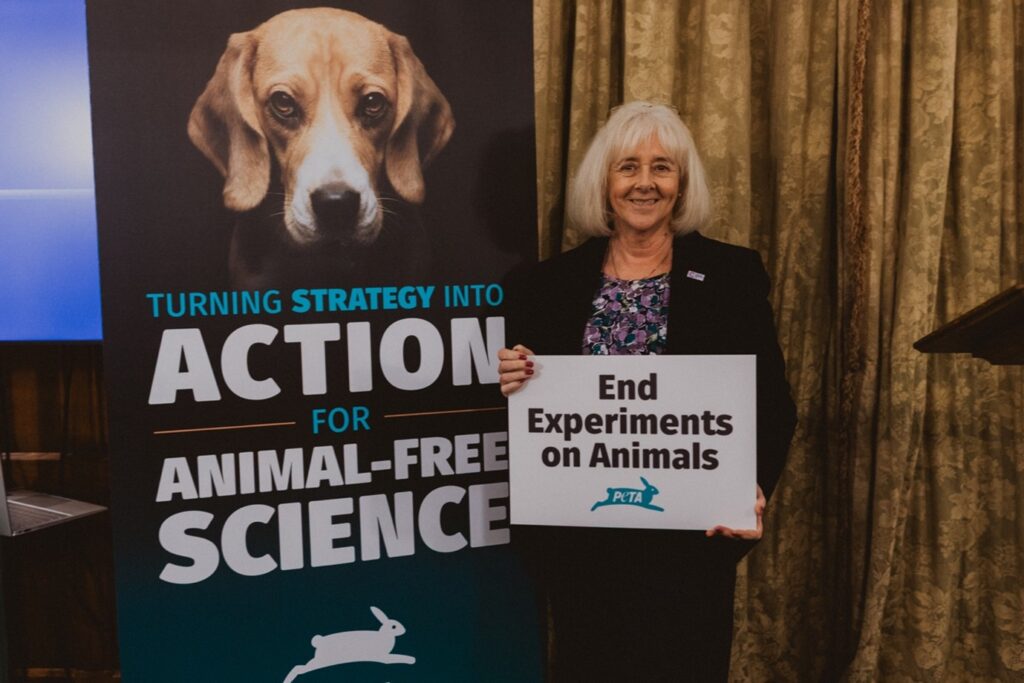
Yesterday, Ruth Jones, Labour MP for Newport and West Islwyn, joined more than 50 MPs, scientists, and policymakers at a special reception hosted by People for the Ethical Treatment of Animals (PETA) at the Palace of Westminster to show support for animal-free science.
The reception follows the government’s announcement that the use of animals in experiments will be phased out, following decades of campaigning by charities including PETA, Animal Free Research UK and other charities along with their supporters.
The event was sponsored by Irene Campbell MP and attended by other MPs and Lords, including Sir Roger Gale MP and Kerry McCarthy MP, as well as TV personality, animal advocate and septicemia survivor Gail Porter, who spoke to attendees about the importance of transitioning to human-relevant, animal-free research methods, and encouraged support for PETA’s campaign to end sepsis experiments on animals.
“The UK’s roadmap is a welcome milestone, proof that science can evolve beyond cruelty and outdated methods,” says PETA Head of Science Policy Dr Julia Baines.
“But it’s only the starting line. The government must now take meaningful steps to end all animal experiments, not just because superior technologies exist, but because better, human-relevant science is both possible and urgently needed.”
In 2024, more than 2.5 million animals were bled, poisoned, deprived of food, isolated, mutilated, or otherwise subjected to psychological suffering and physical pain in British laboratories.
Millions more were bred and discarded as “surplus” because, for example, they were not of the desired sex or lacked certain disease characteristics.

Animal rights charities cautiously welcomed the UK Government’s first-ever strategy for replacing the use of animals in research and testing as a “significant step forward” for science and for animal welfare.
The new plan – ‘Replacing animals in science: a strategy to support the development, validation and uptake of alternative methods’ – includes many initiatives that PETA, the RSPCA and others have long called for, including increasing investment in people and infrastructure to support the development and uptake of non-animal methods.
It also proposes steps to prioritise human-relevant approaches, and to build awareness and confidence amongst scientists, funding bodies and regulators in these new technologies.
Actions will be complemented by moves to help promote the wider cultural shift required so there is greater challenge of a perceived ‘need’ to use animals; including an immediate emphasis on not using animals where alternatives already exist.
Instead of using animals, there are increasing opportunities for UK scientists to embrace new technologies and tools – such as organs-on-chips – that have the potential to enable high quality science, and more efficient development of new safe and effective medicines, without causing animals harm in the process.
Barney Reed, Senior Science and Policy Manager for the RSPCA’s Animals in Science Department, said: “This strategy marks a significant step forward in ending the use of animals in science. We know the UK public wants to see action and supports this; with 77% of UK adults agreeing that the UK Government should commit to phasing out the use of animals in scientific research and testing.
“Huge momentum has been building in recent years, driven by the emergence and pace of development of exciting new non-animal technologies. These have allowed everyone involved to raise their ambitions for how it might be possible to do the science of tomorrow better – and without animals suffering.
“These are exciting times for innovation in the life sciences, with opportunities for UK scientists to exploit new approaches that don’t cause harm to animals. Every day, we are seeing more breakthroughs with technologies like organs-on-chips, organoids, and computer modelling. These can enable better science to be done, without using and harming animals.
“While the UK Government itself describes the strategy as ‘a start’, and exact details for how some of the proposed actions will be enacted still need to be set out, the direction of travel is clear. We particularly welcome the recognition from the UK Government that “we are now at a tipping point in the transition to alternative methods”, and that they “will not accept a slow pace of change when scientific and technical advances mean that a faster transition away from animal use is possible”.
Dr Julia Baines, head of science policy, PETA UK welcomed the plan, sharing: “We welcome the clear, actionable and timely steps to replace animal use in toxicity and safety testing. However, the roadmap must also initiate meaningful change that goes beyond ending tests for which non-animal methods are already widely available.
“Nearly 90% of all experiments on animals in the UK are not required by law but rooted in curiosity-driven research in which animals are routinely cut open, drilled into, drugged, starved, electrocuted or mutilated before ultimately being killed. Animal experimentation has delivered far too much pain and far too little progress.
“This roadmap must not be a public relations exercise that defends past mistakes, but rather a bold first step toward ethical, humane, and scientifically superior research.
“Our scientists, with international expertise in non-animal methods, look forward to engaging with the government to deliver a detailed, cross-sector strategy that accelerates the development of effective disease therapies and establishes the UK as a global leader in life sciences, healthcare, and animal protection.”
PETA, whose motto reads, in part, that “animals are not ours to experiment on or abuse in any other way”, notes that its Research Modernisation Deal – which provides a clear, actionable framework for ending the use of animals in research, testing and education – played an important role in shaping the roadmap when Dr Baines attended the Government’s stakeholder roundtable last May.
For more information, visit PETA.org.uk or follow PETA on X, Facebook, or Instagram.
Support our Nation today
For the price of a cup of coffee a month you can help us create an independent, not-for-profit, national news service for the people of Wales, by the people of Wales.



Wales Against Animal Experiments has serious reservations about the Government’s strategy on replacing animals in science. Although the transition to human-relevant technologies is inevitable, the strategy, led by Lord Patrick Vallance (a proponent of animal research), argues that such a transition is a long-term goal. It does not promise the elimination of animal use but the replacement of animals ‘wherever possible’. Our reading concurs with that of Dr Andre Menache (leading scientific expert on medical research) that the Government’s plan is a ‘smokescreen to buy time for the pharmaceutical and chemical industries’. For a deeper dive into this topic or… Read more »