


Welsh researchers welcome renewed UK support for landmark Mars mission
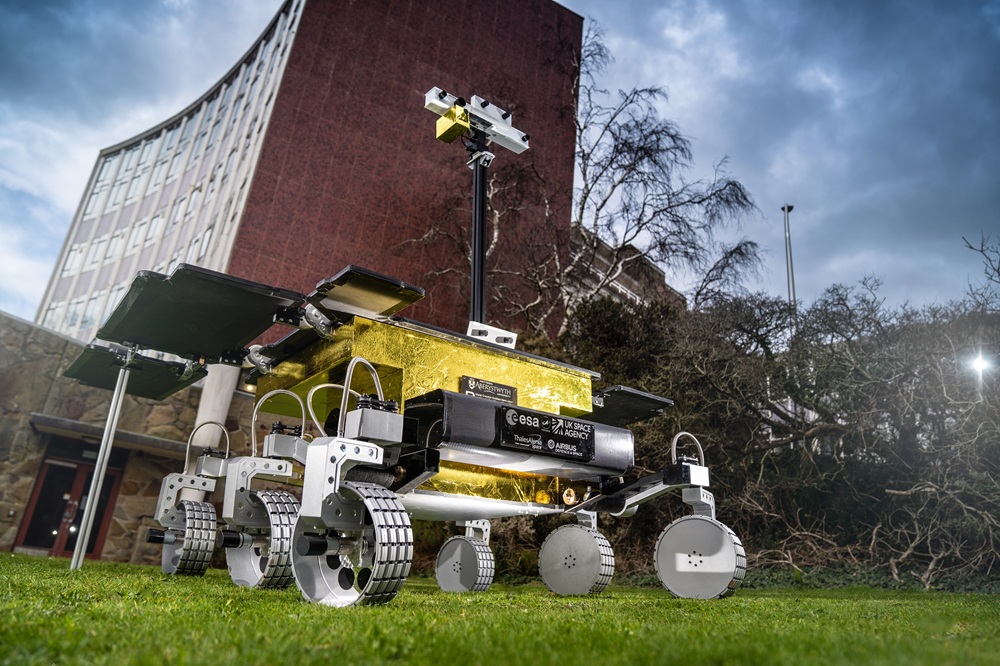
Aberystwyth University scientists have welcomed a major UK Space Agency funding commitment that will keep Europe’s first Mars rover mission on track for launch in 2028.
The Rosalind Franklin rover – the centrepiece of the European Space Agency’s ExoMars programme – is scheduled to land on the Red Planet in 2030.
It will carry out the most advanced search for life ever undertaken on Mars, drilling up to two metres beneath the surface to analyse soils shielded from harsh radiation.
No previous rover has been capable of reaching such depths, making the mission one of the most ambitious in planetary exploration.
At last week’s ESA Ministerial Council in Bremen, the UK confirmed a £1.7 billion investment in European space programmes. The package secures British involvement in a range of flagship missions, including the ExoMars project, and guarantees continued funding for instruments designed by UK researchers.
The Rosalind Franklin rover is being assembled by Airbus in Stevenage and will carry a suite of UK-built scientific instruments. Among them is Enfys, an infrared spectrometer designed and developed at Aberystwyth University.
Working in tandem with the rover’s PanCam imaging system, Enfys will identify minerals on the Martian surface and help pinpoint the most promising drilling locations. Samples collected from deep underground will then be analysed by an onboard laboratory equipped to detect organic molecules and potential biomarkers of life.
Dr Helen Miles, Operations Software Lead for Enfys at Aberystwyth University, said the renewed funding was a significant boost for UK and Welsh space science: “Aberystwyth University’s role in the Rosalind Franklin mission builds on decades of pioneering research in space science and robotics. The UK Space Agency’s renewed commitment is fantastic news – not just for this mission, but for the future of planetary exploration.
“For the first time, we will be able to drill deep beneath the Martian surface to search for signs of life. The clues we uncover could radically change our understanding of Mars’ history and its potential to sustain life. Being part of the team developing these vital instruments is a privilege, and we’re excited to see Welsh science contributing to one of the most ambitious space missions of our time.”
Testing
Development and testing of the Enfys instrument is led by Aberystwyth University in collaboration with the Mullard Space Science Laboratory at UCL, STFC Rutherford Appleton Laboratory and optics specialist Qioptiq Ltd.
Aberystwyth’s role in the programme expanded after European cooperation with Russia’s Roscosmos collapsed in 2022 following the invasion of Ukraine.
The breakdown of the partnership required ESA to reconfigure elements of the mission, with UK teams – including Aberystwyth – stepping in to take on additional responsibilities.
The Rosalind Franklin rover marks a major milestone for European planetary science. If successful, it will not only deepen humanity’s understanding of Mars but also reinforce the UK’s long-term ambitions in space research, engineering and exploration.
Support our Nation today
For the price of a cup of coffee a month you can help us create an independent, not-for-profit, national news service for the people of Wales, by the people of Wales.


