


Welsh seabird colony may not recover from bird flu until 2041
Emily Price
One of Wales’ most important seabird colonies could take nearly two decades to recover from bird flu, according to a new study.
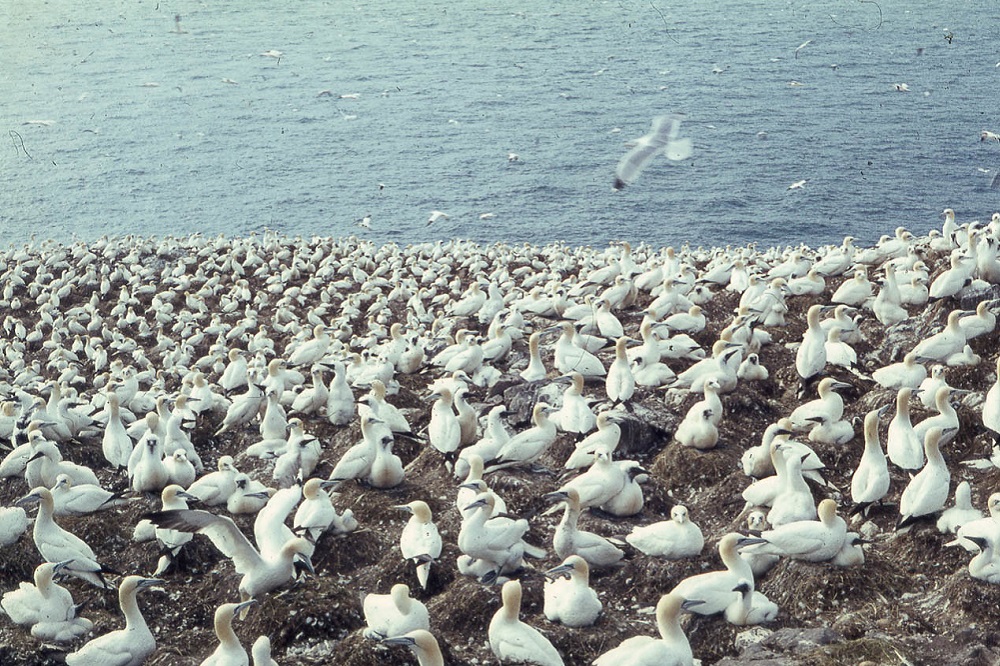
Researchers found that two of the world’s largest northern gannet colonies on Grassholm in Wales and Bass Rock in Scotland may not return to pre-outbreak numbers until 2041 following the spread of highly pathogenic avian influenza (HPAI).
The findings, published in the July issue of Biological Conservation [1], show bird flu was responsible for a fourfold increase in deaths of adult gannets, for which the UK is responsible for a high proportion of the global population.
Mortality rates were found to have jumped from an annual average of 6% at Bass Rock and 11% at Grassholm in the 11 years prior to 2022, to 33% and 47% respectively during the outbreak.
This led to a 26% decrease in the size of the gannet colony at Bass Rock and a 38% decline at Grassholm in 2023, the year after the outbreak.
The RSPB warned that as it is adult breeding birds that drive the population growth in colonies, the spike in deaths will have a “profound negative impact” on overall population size and future sustainability.
Population modelling forecasts that the colonies are unlikely to recover to the size they would have had until 2041, 19 years after the outbreak.
However, the authors caution that these predictions are a likely best-case scenario and recovery could take even longer.
In light of this unprecedented mortality and subsequent population recovery time linked to a single disease outbreak, the study’s authors have recommended revising the species’ global conservation status which is currently ranked as “Least Concern” on the IUCN Red List.
The H5N1 bird flu virus was first identified in poultry in Asia in 1996 before spreading to wild bird populations.
The disease was first confirmed in gannets at Bass Rock on June 4, 2022, and at Grassholm the following month.
Impact
While the outbreak was already known to have killed tens of thousands of gannets, this latest study is the first to provide robust estimates of adult survival in a seabird species, and, using these estimates, the first to predict the long-term impact and population recovery times for these two globally important seabird colonies.
Jude Lane, lead author of the study and marine conservation scientist at the RSPB, said: “The bird flu outbreak in 2022 dealt an unprecedented deadly blow to UK seabirds and these findings show that key Gannet colonies on Bass Rock and Grassholm will be impacted for decades to come.
“While we can’t prevent diseases like bird flu, with long-term monitoring at key colonies and across wider populations we can better understand the impacts.
“With that knowledge we are in a far better position to address the many other pressures facing seabirds and halt the devastating declines of recent years.”
Jana Jeglinski, senior author of the study and Associate Professor at the Department of EcoScience at Aarhus University in Denmark, said: “The scale of mortality we observed during the 2022 outbreak was unprecedented.
“Our study shows that gannet populations will not simply bounce back from the blow of a single disease outbreak but instead will take decades to recover.
“We must not forget that gannets, and seabirds in general, are also under increasing pressure due to bycatch, plastic pollution and climate change to name but a few.
“It is now, more than ever, paramount to scrutinise, quantify and mitigate against any additional impact on the much-depleted metapopulation.”
Support our Nation today
For the price of a cup of coffee a month you can help us create an independent, not-for-profit, national news service for the people of Wales, by the people of Wales.
Get more trusted Welsh news
Choose Nation.Cymru as a preferred source in Google News to see more of our journalism.


