


Yes Breizh: Breton devolution group contacts Welsh FM to ‘open dialogue’
Stephen Price
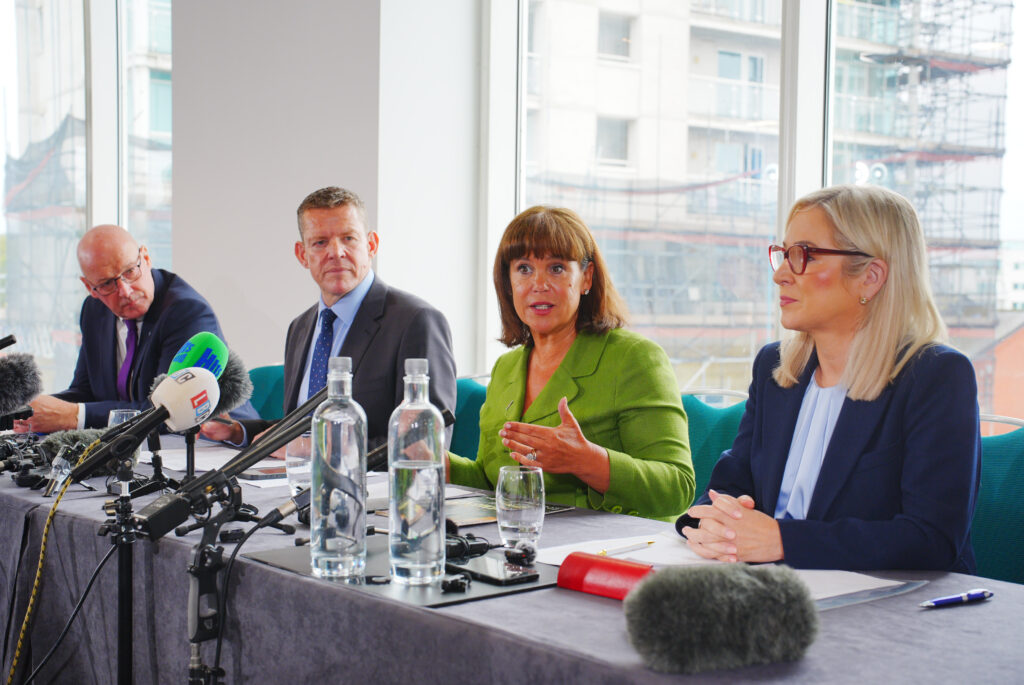
The President of a campaign group calling for devolution of powers and responsibilities to Brittany has written to the Welsh First Minister alongside the heads of The SNP and Sinn Féin to propose opening a direct dialogue to help further the Celtic nation’s shared mission for autonomy.
The letter follows this month’s meeting between Plaid Cymru, the SNP and Sinn Féin where they signed a new agreement pledging to work together on independence and calling on the UK Government to prepare for constitutional change.
The memorandum of understanding was unveiled as the parties’ leaders met in Cardiff on Monday 14 September, with cooperation promised on areas including renewable energy, the economy and relations with Europe.
The agreement says Wales, Scotland and Ireland each have the right to determine their own future through democratic means and argues that the political landscape across the UK and Ireland is changing.
It states: “Momentum is behind our movements; we believe that constitutional change is coming.”
The parties have committed to sharing ideas on building what they describe as stronger and fairer economies, expanding renewable energy and rebuilding relationships with Europe.
They also state that they believe the future of their nations lies in the European Union and insist that Westminster should not be able to block votes on their constitutional futures.
The agreement acknowledges that the three parties have different constitutional positions and that each nation would determine its future “in its own way and in its own time”.
It calls on the UK Government to “prepare for, plan and facilitate constitutional change in each jurisdiction”.
Mr ap Iorwerth was joined in Cardiff by Scottish First Minister and SNP leader John Swinney, Northern Ireland First Minister and Sinn Féin vice-president Michelle O’Neill and Sinn Féin president Mary Lou McDonald. They were meeting in their capacities as party leaders rather than representatives of their respective governments.
Philippe Corréa, President of Yes Breizh, has now written to Rhun ap Iorwerth, First Minister of Wales, to set out their movement’s position on democratic devolution in Brittany and to propose opening a direct dialogue between Yes Breizh and Plaid Cymru.
Beyond this initiative, they also wanted to place Brittany within the wider discussions currently taking place among several Celtic and European nations about their institutional future and their ability to make more decisions for themselves.
President of Yes Breizh, Philippe Corréa, wrote: “I write as President of Yes Breizh, a Breton civic movement working for the democratic devolution of powers and responsibilities to Brittany. I followed your meeting in Cardiff on 14 September with great
interest. Its emphasis on democratic choice resonates with our own work.
“Brittany has its own constitutional circumstances and must chart its own course, guided by the expressed will of its people. We seek a devolution shaped in Brittany and agreed with the French Republic. I enclose our statement following the Cardiff meeting, which sets out this position.
“I would welcome a direct exchange between Yes Breizh and Plaid Cymru on democratic self-government and practical cooperation between Brittany and Wales. I am also sending the joint letter to you and, separately, to John Swinney, Michelle O’Neill and Mary Lou McDonald.”
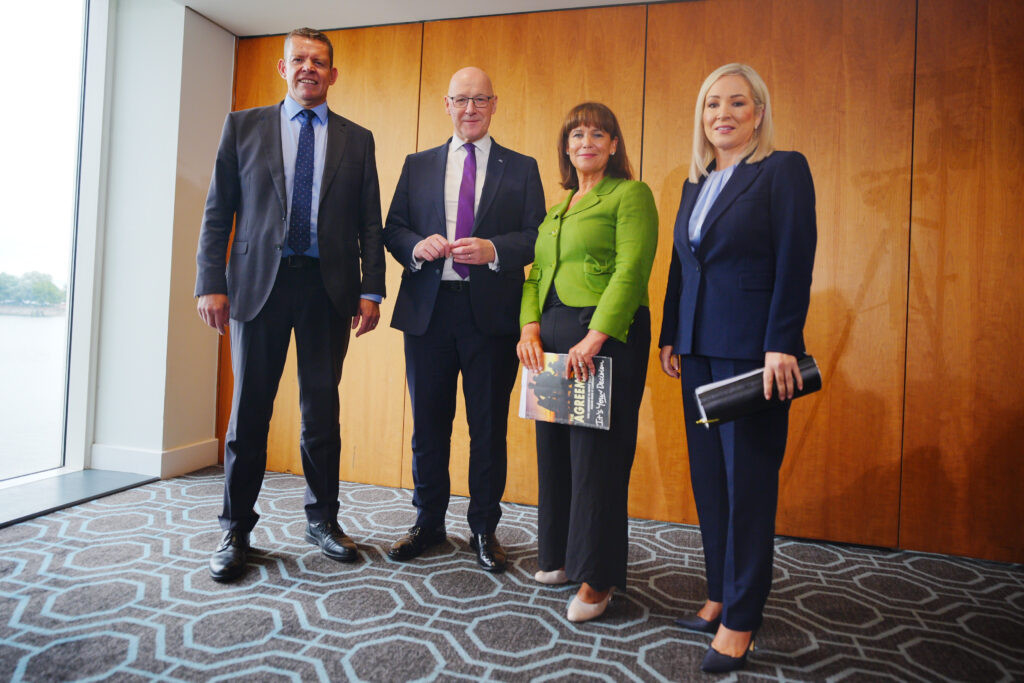
Sinn Fein leader Mary Lou McDonald and First Minister of Northern Ireland Michelle O’Neill. Photo Credit: Ben Birchall/PA Wire
A representative from Yes Breizh told Nation Cymru: “Brittany stands. Proud of its identity, confident in its strengths and determined to shape its own future. The last continental Celtic nation with its five million people, Brittany has the history, the talent and the ambition to make its voice heard in Europe and beyond.
“But our future is not one we wish to build alone.
“Across all our Celtic nations, we share history, values and a belief that our peoples can achieve more by working together. From Brittany to Scotland, Wales, Ireland, Cornwall and the Isle of Man, let us turn our common heritage into a common ambition. Let us go forward together.”
Statement
The Statement by Yes Breizh reads: In Cardiff, political leaders from Scotland, Wales, and Ireland jointly affirmed a principle that ultimately transcends their individual nations: a people must be able to democratically decide its own future, and no central authority can indefinitely stand in the way of the expression of that will.
This declaration primarily concerns Scotland, Wales, and Ireland. Yet, it cannot leave Brittany indifferent.
It is, in fact, surprising that Brittany was not present—even as an observer—at a meeting of such significance, dedicated to the future of nations with which we share so many historical, cultural, and human ties; neither the so called ‘Région Bretagne’ nor any of its parliamentary representatives took part.
However, let us avoid making overly simplistic comparisons.
Brittany is neither Scotland, nor Wales, nor Ireland.
It is Brittany.
It has its own history, character, interests, strengths, and weaknesses. Above all, it has its own path to chart a way that belongs to the people of Brittany.
Yes Breizh is not proposing that Bretons adopt a model imported from elsewhere. Nor are we asking them to choose between loyalty to Brittany and belonging to the French Republic.
We propose that they regain control over matters that can and must be decided within Brittany, in order to take action on the issues that directly shape its future: the economy, housing, healthcare, languages, education, energy, the environment, agriculture, maritime affairs, the digital sector, security, and regional planning.
This is what we call devolution.
It is neither a privilege demanded of the State nor a favour to be awaited from it.
It is a modern conception of public responsibility.
For a nation named today a region, that decides almost nothing eventually ceases to be accountable for much of anything.
And a State that claims to decide everything from the centre too often ends up making decisions far removed from reality.
Yet, nothing lasting can be built without the consent of the Breton people themselves.
Devolution cannot simply be decreed. It will not be the work of a single party, organisation, or group of elected officials. It will only possess legitimacy if it stems from the clearly expressed will of the Breton people.
That is why our primary task is to persuade—not through slogans, but through facts; not through mere assertion, but through demonstration.
To explain. To compare. To provide figures. To propose.
To show that a Brittany endowed with new responsibilities is not only possible but can be more efficient, more democratic, and more in control of its own destiny.
It will then be up to Brittany and the French Republic to find, together, the legal and constitutional paths to translate this will into institutional reality.
For a long time, France was built through the concentration of power. That was its history.
But history does not dictate that the solutions of the past must be repeated indefinitely.
No institutional arrangement is eternal.
No Constitution is intended to freeze history in place.
The 21st century can be an era for a Republic confident enough to trust its constituent parts, strong enough to share responsibilities, and modern enough to recognise that unity does not require uniformity.
Our ambition is not to pit Brittany against France.
It is for Brittany—mindful of its victories and tenacity throughout history, responsible for its actions, and confident in what it can become—to finally play its full part in shaping its own destiny.
Scotland will follow its own path.
Wales will follow its own.
Ireland will follow its own path.
Brittany must now forge its own path.
The office of Rhun ap Iorwerth MS has been contacted for a response.
Support our Nation today
For the price of a cup of coffee a month you can help us create an independent, not-for-profit, national news service for the people of Wales, by the people of Wales.
Get more trusted Welsh news
Choose Nation.Cymru as a preferred source in Google News to see more of our journalism.



“Nor are we asking them to choose between loyalty to Brittany and belonging to the French Republic.”
And yet we in Wales are asked to choose. We Welsh are asked to cast away our loyalty to the United Kingdom, our British inheritance and future.
Agree entirely with what you say but they are all separate parties by definition and they got enough votes to justify talking about it
Llydaw am byth