

3FM = y?
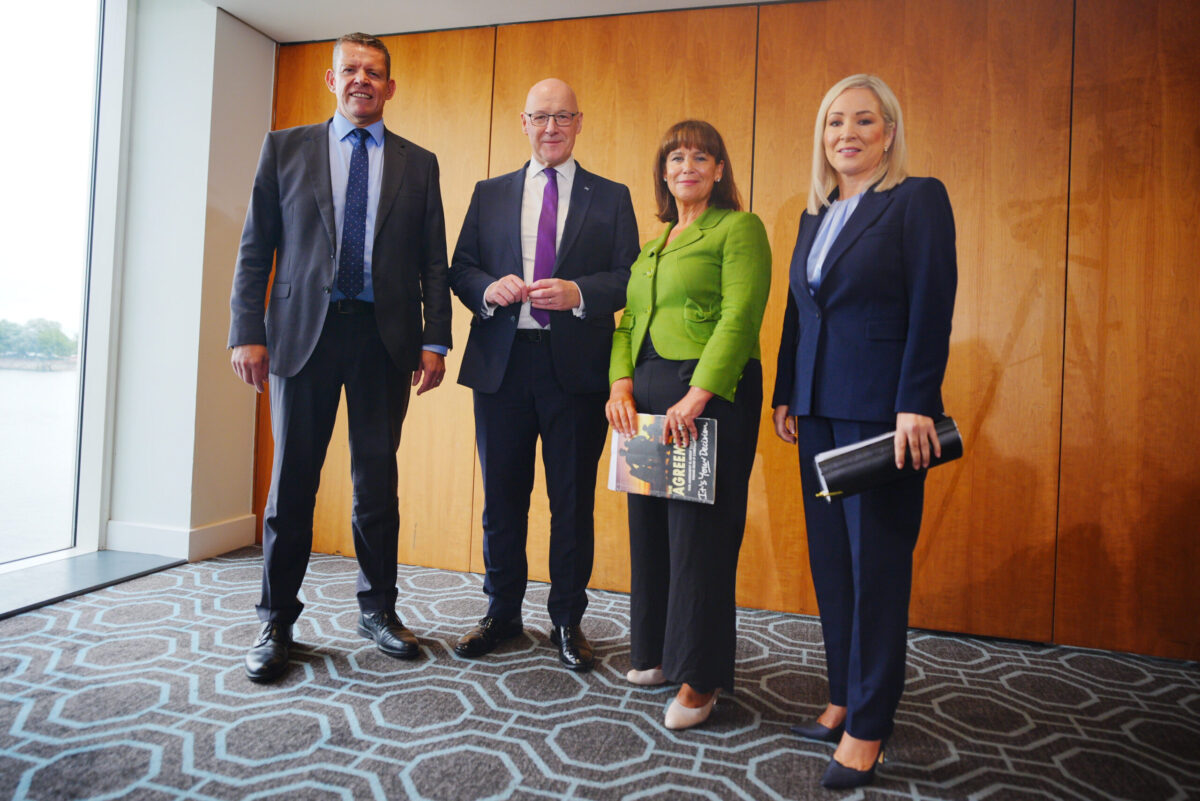
Sinn Fein leader Mary Lou McDonald and First Minister of Northern Ireland Michelle O’Neill. Photo Ben Birchall/PA Wire
Desmond Clifford
With even a little hindsight, the meeting of the three First Ministers in Cardiff a couple of weeks back echoes with symbolism.
Only a few days later the President of Ireland, Catherine Connolly, made an official visit to Scotland. A day or two after that, the Taoiseach, Micheál Martin, made an official visit to the Prime Minister – in Manchester.
Put all of that together and you realise just how much Britain has changed during thirty years of devolution.
President Trump added spice to the sauce when he said in County Clare (my mother’s birthplace, as it happens) that he’d “love” to see a united Ireland.
There are, of course, millions of Irish-identifying voters in America, and their understanding of Northern Ireland is, like Trump’s, anything but nuanced. Although it falls short of a clamour, there’s increasingly serious talk about the practicalities of re-unification in Ireland and what it might mean.
Ulster Unionism is on the back foot. The DUP lost its status as Northern Ireland’s largest party and unionism today generally lacks personality, leadership and confidence.
The Drumcree Orange Parade feels like a re-enactment of earlier times, like a Sealed Knot weekend at Marston Moor. Yet, what did Churchill say about the dreary steeples of Fermanagh and Tyrone emerging once again unaltered by World War 1, and the integrity of their quarrel?
Traditionally unionism has friends on the right of the Tory party but they’re not much evident just now. Reform UK has, surprisingly perhaps, kept a little distant, although Danny Kruger MP recently attended the DUP conference.
Andy Burnham is closely associated with English devolution. In some senses he’s become Mayor of England, keen on municipal announcements, but, so far, failing to convey a fully convincing UK agenda.
His forays beyond England have been maladroit. Irish noses were out of joint when he said a border poll was “off the table”. That’s not even British Government policy.
The terms of the Good Friday Agreement, an internationally binding treaty, stipulate precise circumstances for a border poll and they don’t include a passing Prime Minister’s personal opinions. Burnham’s spinners were deployed to say he only meant “off the table” for today.
The Prime Minister compounded his error by saying a Scottish referendum is “off limits” for the same reasons as Northern Ireland. He was wrong about Northern Ireland and he’s wrong about Scotland too.
Pro-independence governments
Scottish voters keep returning pro-independence governments and the purpose of a referendum is to ask the question, not to confirm the answer.
Wales is in a different position again. Both Michelle O’Neill in Northern Ireland and John Swinney in Scotland are pressing (though not too hard, actually) for referendums now, while for Rhun ap Iorwerth, a Welsh referendum is contingent on Plaid Cymru winning the next Welsh election in 2030.
Burnham has met Rhun ap Iorwerth and his deputy, Sioned Williams, and all emerged from those conversations with doors remaining open. Burnham’s conspicuous northern identity helps.
The Smiths-loving, guitar-playing, Everton-supporting Prime Minister represents a more sympathetic branding compared to his predecessors’ concoctions of home counties, Eton College, and lofty detachment from the world beyond London – and I include Keir Starmer in that.
Rhun ap Iorwerth, also guitar-playing but Cardiff City-supporting, is confident he can build good personal dynamics with Andy Burnham. The larger question is whether they can find something to discuss other than Fender Stratocasters. They meet again soon, so we’ll see.
For all his preoccupation with Manchester and English localism, there’s no sign of Burnham having thought seriously about devolution in the nations or the dynamics of political relationships within the UK.
The early signs are that he responds on the hoof when under pressure and trots out deadening clichés from the Downing Street briefing book. In the medium term that won’t do, and if he has nothing more to offer, the slowly freezing tundra between the nations and the union will continue to ice over.
The Downing Street response to the meeting of First Ministers was the traditional condescension of ‘we’re concentrating on the serious business of government’ rather than “engaging in constitutional debates”.
Captured
These comments could have come from anyone from Boris Johnson to Keir Starmer, and it’s beginning to look as if Burnham is captured by the same Downing Street machine. He needs to reverse from that cul-de-sac smartly if he wants to breathe life into the wheezing union.
It’s a bit rich, isn’t it, if Andy Burnham challenges the Welsh Government for a preoccupation with constitutional matters? What was he doing in Manchester these last ten years!? He was forever banging the table and cajoling Whitehall for more powers and money.
He was very good at it. Why is that OK for Burnham in Manchester but not OK for ap Iorwerth in Wales? The PM will have to do better than that.
It matters for another reason too. You can hardly expect Britain’s prime minister to enthuse about ending the union but there is a very legitimate question about the circumstances for triggering referendums in the nations if the union is to remain voluntary and democratic.
The alternative is that union is compulsory and non-negotiable: if that’s what a UK Government thinks, it should say so.
For Scotland, this debate is becoming increasingly urgent; voters have returned the SNP at every election since 2007.
Stark choices
There is another reason for Burnham to engage if he really believes in the union. At present, Welsh voters are presented with two stark choices: independence or the status quo. There is another way, if only a UK Government would embrace it: gradual and evolving devolution.
This is what most of us thought we had until Boris Johnson used Brexit to slam devolution into reverse and Keir Starmer, stupidly and ruinously, followed suit (ruinously because look where it left Labour in Wales and Scotland).
Burnham should come up with another offer. He should revive the concept of devolution-as-a-process. The zero-sum status quo created by the Johnson-Starmer Continuum does nothing except drive voters towards the spectrum’s extremities. Plaid Cymru doesn’t mind; all this works like a dream for them.
Boris Johnson and Keir Starmer have been Plaid’s best recruiting agents. Their disrespect for and dismissal of Wales are offensive and drive voters towards separatism, presumably the opposite of their intention. If people feel constantly condescended to and marginalised by UK politics, it’s small wonder that independence burns more brightly.
Separation
When three of four national leaders pose together around the common aim of independence, it’s hardly a good look for the United Kingdom. Does it mean separation all round is inevitable? Not necessarily.
There’s no reliable and clear-cut majority for independence in any of the three nations. Equally, any or all three could become independent on the back of democratic majorities within a decade or two (strictly speaking, the issue for Northern Ireland is to separate from the UK to form a new state in a united Ireland). The future is unwritten and nothing is inevitable.
What’s clear, though, is that the old order of the UK as a single monolithic block has gone for good. It’s even disappearing in England.
It was fascinating to see Ireland’s Taoiseach, Micheál Martin, visiting the Prime Minister in Manchester rather than London. It makes sense; Manchester is a substantial Irish city, as Oasis and The Smiths can testify.
It’s a Welsh city too and probably surpasses Liverpool these days as the alternative capital of North Wales.
The question is whether any of the UK political parties are willing to grasp the realities of a changing Britain, or whether the nations will continue to drift further apart.
On paper, Andy Burnham is better placed than his predecessors. If he gets it, other futures might unfold. If he doesn’t, the union continues drifting towards an end. Not today, not tomorrow, but slowly and surely.
Support our Nation today
For the price of a cup of coffee a month you can help us create an independent, not-for-profit, national news service for the people of Wales, by the people of Wales.
Get more trusted Welsh news
Choose Nation.Cymru as a preferred source in Google News to see more of our journalism.


