


A blade fell from a Brechfa wind turbine. What happened next is the real public-safety story
Sarah Eyles
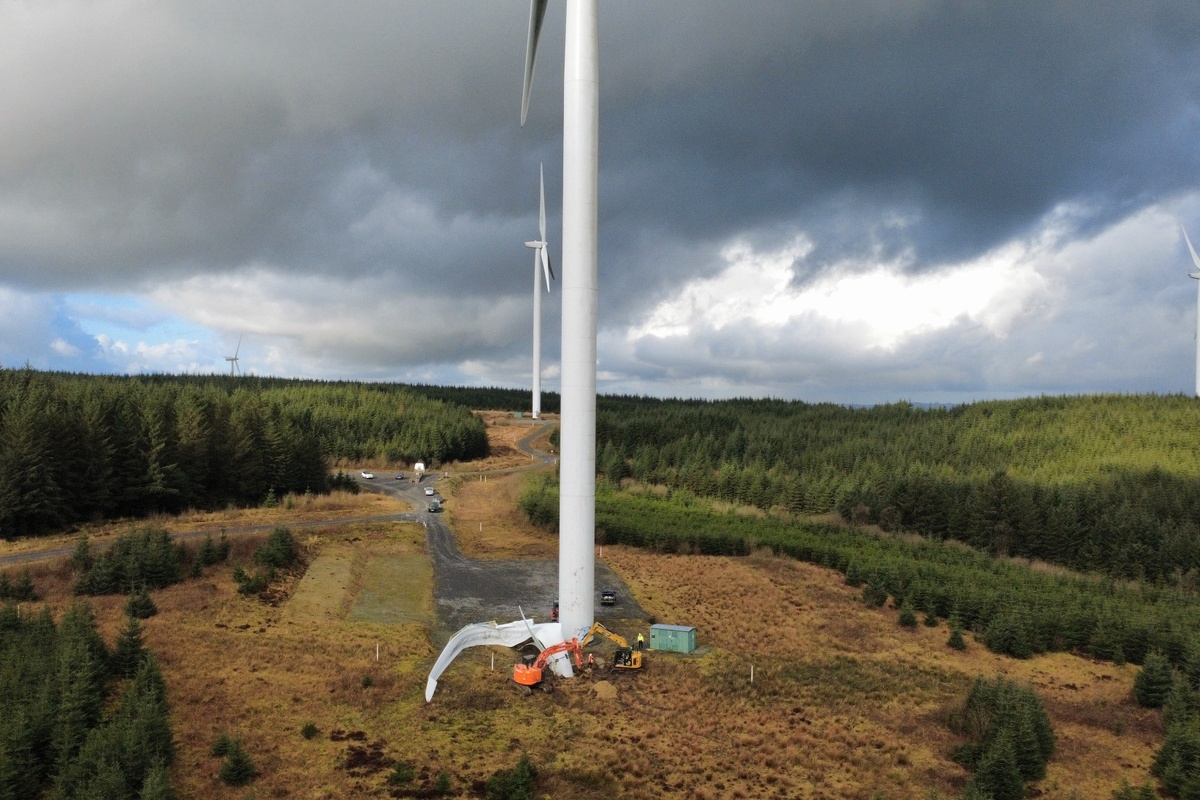
In the early hours of 26 February, a complete blade detached from turbine T303 at Brechfa West Wind Farm and fell to the ground.
The formal notification from RWE Renewables UK Ltd (RWE) to Natural Resources Wales (NRW) records that it came to rest on high-voltage cabling.
That alone is serious. But the more troubling story lies in what happened afterwards: turbines were brought back into operation before the whole wind farm had been inspected, while NRW was still seeking key safety information from the operator.
The picture emerges from internal emails, incident reports and public statements released after a Freedom of Information (FOI) request by Havard Hughes of CRAiG Sir Gâr. Some of the most relevant correspondence is substantially redacted, including technical and mitigation material.
The papers raise uncomfortable questions about public safety, access and who ultimately decides when turbines are safe to restart.
NRW’s incident report recorded concerns for the safety of the public, staff and contractors. On 27 February, it imposed a Countryside and Rights of Way (CRoW) exclusion over 962 hectares, expressly “for the purpose of avoiding danger to the public”.
Turbines restarted before the full inspection
The initial position was that all turbines would be inspected and a full risk assessment shared before repowering. Yet by 28 February, RWE reported that circuits 1, 2 and 4 were running, and on 4 March said seven turbines had returned to service. On 5 March, the position changed: all turbines would be paused and inspected, with none restarting until the Case to Operate and control measures had been discussed with NRW.
Why were turbines restarted before the site-wide inspection had been completed? This is a basic public-safety question.
Immediately after the incident, RWE also asked NRW to warn staff and contractors of the “identified risk on site” and ensure that personnel did not “remain stationary in proximity to the turbines”. In other words, staff and contractors were told not to stop near the turbines. The papers do not explain the reason for the instruction.
The blade was also resting on high-voltage cabling. HSE guidance warns that damaged underground cables can cause fatal or severe injury through electric shock, arcing, explosion and flames. RWE later reported that a third-party contractor inspected the cables and found no sign of damage.
Who independently decided it was safe to restart?
NRW repeatedly sought RWE’s Case to Operate, details of its incident-management process and the basis for the 100-metre risk zone. On 11 March, correspondence shows RWE considering whether the Case to Operate was commercially sensitive and referring to the ongoing FOI request.
On 13 March, NRW recorded that it had still not received the Case to Operate and said that the decision to resume operation rested solely with RWE as owner and operator.
Think about that. NRW managed public access and said it needed to be fully informed to protect the public, yet also said it could not advise on the operational decision.
The disclosed records do not identify a public body that independently approved the restart after this catastrophic component failure.
Section 3 of the Health and Safety at Work etc Act places a general duty on employers to conduct their undertakings so that non-employees are not exposed to health and safety risks, so far as reasonably practicable.
Public routes and the unexplained 100-metre zone
Other safeguards were unclear. NRW said it had been told on 27 February that fencing had been installed around T303 and the detached blade. After a site visit on 5 March, it wrote that this was “not the case” and urgently requested suitable fencing before the CRoW exclusion expired the following night.
The formal CRoW direction did not affect public rights of way. NRW warned RWE that rights of way crossed the wind farm and that separate action by Carmarthenshire County Council might be required. The papers do not establish whether every route was formally closed, but the 962-hectare direction did not itself close them.
Nor do the disclosed papers provide a substantive explanation for the 100-metre zone. TAN 8, which applied when Brechfa was developed, advised a planning setback from a public highway or right of way of at least the turbine’s height to the blade tip; Brechfa’s turbines were consented at up to 145 metres.
A planning setback is not the same as a post-incident exclusion zone. But the contrast raises an obvious question: what was the basis for 100 metres?
What Brechfa means for future wind farms
By 18 March, RWE said all turbines had returned to service. Later correspondence records further inspections during annual servicing, no issues on ten turbines inspected since April, and a two-phase rebuild of T303.
What remains missing from the disclosed papers is the final root-cause report explaining why a complete blade detached.
HSE guidance says work equipment exposed to conditions that could cause dangerous deterioration should be inspected at suitable intervals and after events liable to jeopardise its safety. The purpose is to identify deterioration and remedy it before it results in a health and safety risk.
Until the root cause of the T303 failure and its inspection history are disclosed, it is impossible to know whether the failure should have been detected or prevented. That makes disclosure of the inspection regime, maintenance records and root-cause investigation particularly important.
Long-distance paths, forestry trails and public rights of way pass through or close to operational wind farms across the UK. People are encouraged to use these landscapes, but who assesses and takes responsibility for the risks associated with a major turbine failure?
Future wind-farm proposals should therefore explain who will independently oversee turbine safety and restart decisions; how every public route will be controlled after a serious incident; the basis for emergency exclusion zones; and whether root-cause findings will be published.
Public safety cannot rest on blurred or divided responsibilities. It must be clear who assesses the risk, who controls public access, who has authority to approve a restart, who independently scrutinises that decision – and who is ultimately accountable when something goes wrong.
A future failure could have far more serious consequences.
Wales is embarking on a major expansion of onshore wind. If communities are expected to accept larger and more numerous turbines, “trust us” is not enough.
Support our Nation today
For the price of a cup of coffee a month you can help us create an independent, not-for-profit, national news service for the people of Wales, by the people of Wales.
Get more trusted Welsh news
Choose Nation.Cymru as a preferred source in Google News to see more of our journalism.



‘Wind Power is safe, to argue otherwise is folly..’
Okay then…
Good luck with the spent fuel rods stashed for generations.
Perhaps the damage a gas station does every time it fires up.
At this moment in time solar and wind are carrying the main load in the UK.
I appreciate the lady didn’t write this article, but there is risk with virtually everything we do in life. We do lots of things in life – we ride bikes we drive cars we use electricity. None of these things are risk free. And there is no technology in the world which can be 100% safe, all we can do is reduce the probability of failures. And we know overall the probability of failures and dangerous instances from wind farms is pretty much close to 0. It’s the safest form of electricity, and electricity generation does not cause that many… Read more »
Brechfa raises a serious question about how existing safety duties are independently scrutinised and enforced. General health and safety law applies, but the disclosed records identify no independent public body approving the restart after this blade failure. Who checks the operator’s safety case, ensures public routes are protected, and has authority to prevent an unsafe restart? Those responsibilities need to be explicit and publicly accountable.
with the greatest respect, its a single Incident, which didn’t come close to a near miss or any personal injury, and you want the wholesale changes, but you don’t know what they’ll be just a ‘public body’. If any changes happen, do you know who will pay for these changes?!
Ultimately this needs the Health and Safety Executive to report and act.
I regularly walk in Brechfa forest and right past the turbines. This incident will not stop me; I suspect I have more chance of being struck by lightning while up there, than of a turbine blade falling on my head. As for the sadly necessary 2 miles I have to walk along roads to get onto the forest paths, I am far more likely to be hit by an idiot motorist driving too fast or playing with their phone, than I am to be killed by a turbine blade.
Quite, a bit of common sense, which seems to be disappearing in our wider society.